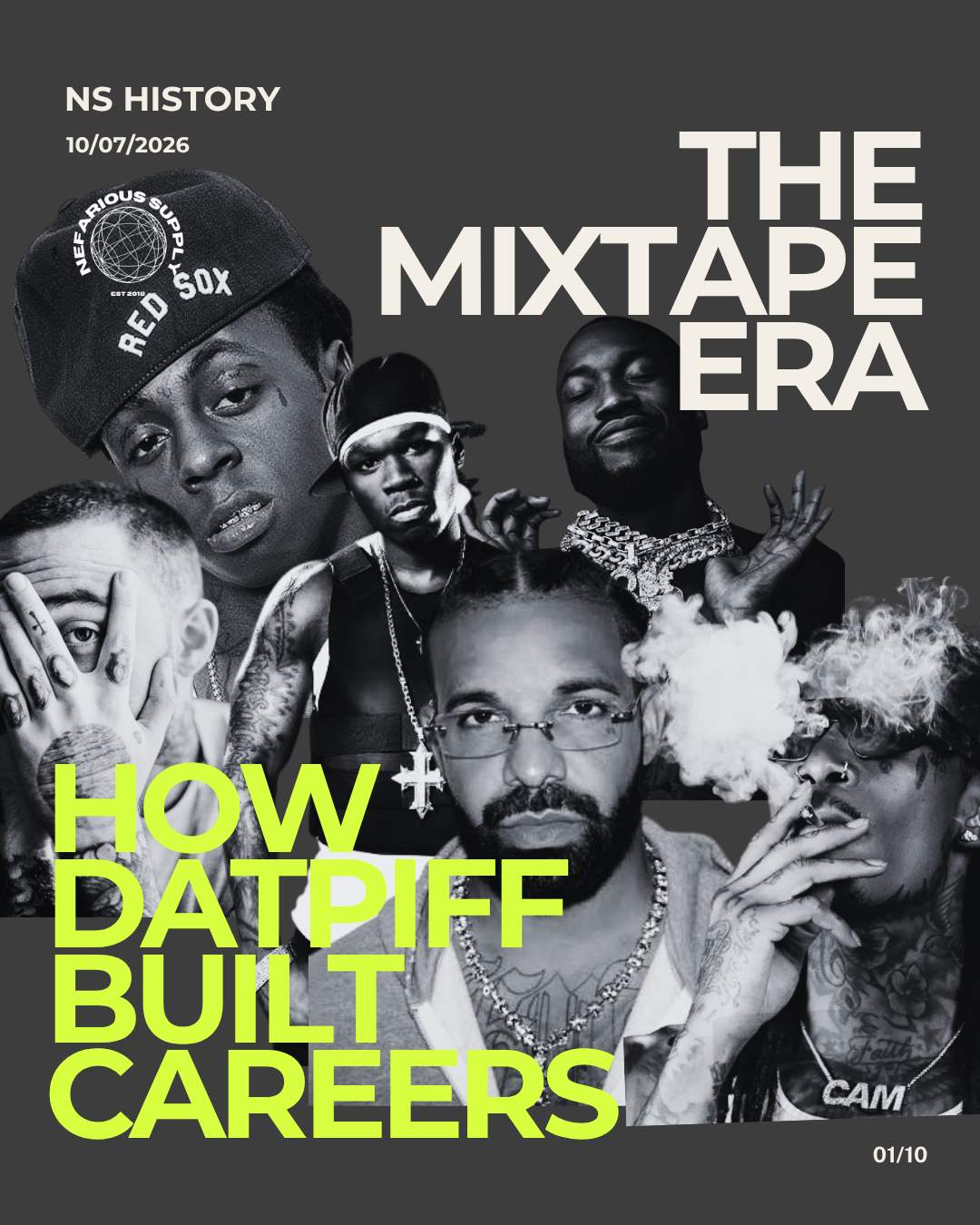
NS History: How DatPiff built careers, and what artists can learn today

Today, a new release often arrives as a link to Spotify or Apple Music. An artist announces a single, EP or album, and listeners open it in the same app they use for the rest of their listening. It is a familiar route from artist to audience, but music has not always reached people this way. Some of rap’s most consequential releases built their following outside that system.

Across the 2000s and early 2010s, mixtapes circulated through CDs, music blogs and dedicated download sites. A rapper’s debut album could arrive well after listeners had begun following their work. These earlier projects were not necessarily rough drafts for the official release. They could introduce an artist’s perspective, give established rappers room to experiment, and become bodies of work listeners valued on their own terms.

DatPiff became one of the places where that music found an audience. It helped carry mixtapes beyond the local scenes and physical copies through which they had circulated. In Jimmy Ness’s 2014 interview for Passion of the Weiss, the platform’s Kyle “KP” Reilly recalled persuading artists that giving music away online could open markets far beyond their home cities. Beside the music, a download counter made the response public. A free project could give an artist something to point to before there were album sales to discuss.

The platforms have changed, but making music available and building a lasting audience remain different tasks. Revisiting DatPiff means looking at the work around a release as well as the music itself: how artists introduced a perspective, reached listeners beyond their immediate circle and gave those listeners a reason to follow the next project. A download could signal curiosity without establishing a lasting connection. For independent artists today, the useful inheritance is not a demand to give everything away or release more often. It is a clearer understanding of what a project should communicate, where an interested listener can go next, and what an artist can do to sustain that interest after someone presses play.


Before the download
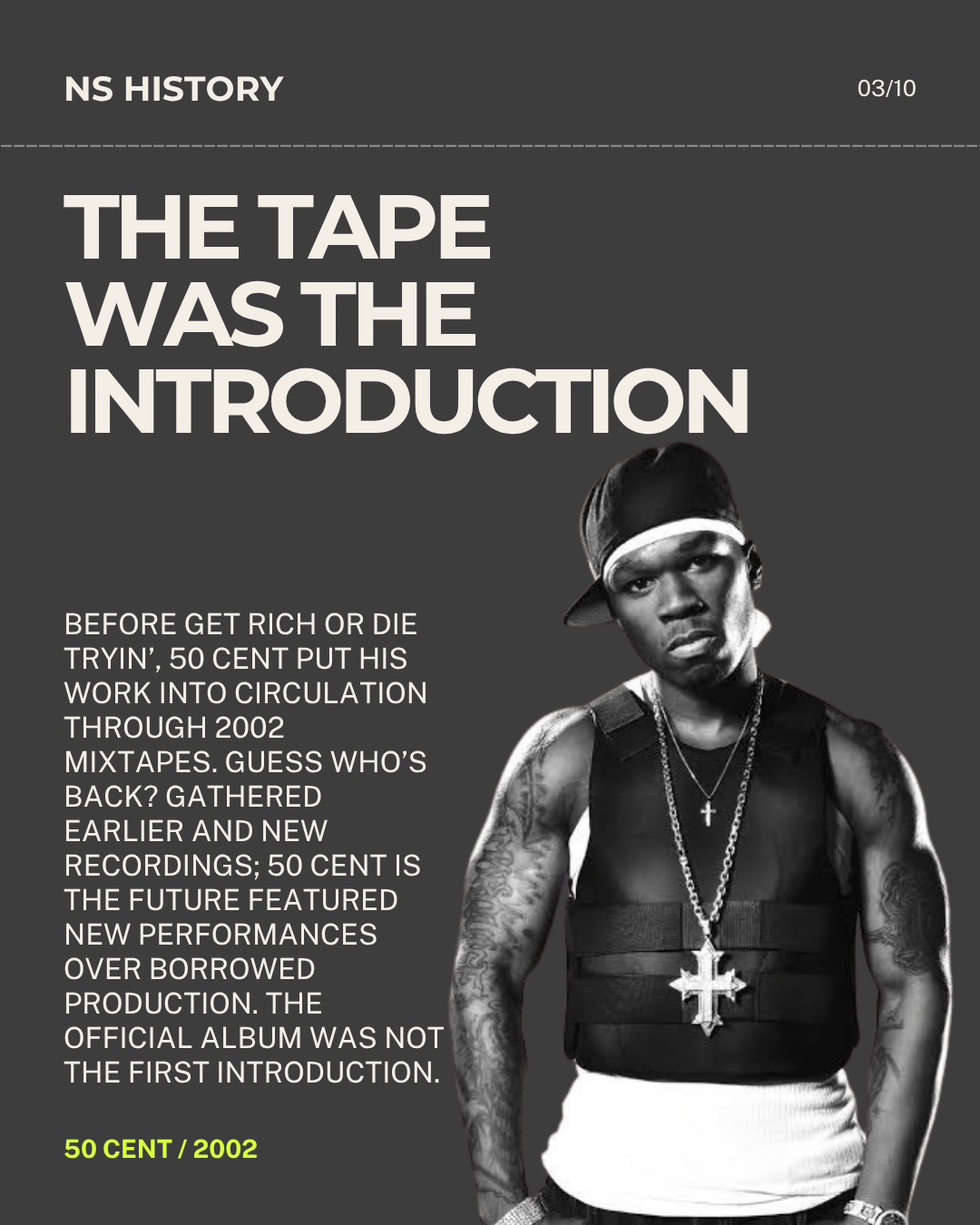
An official album was not the only way to make an artist’s case. In 2002, 50 Cent used mixtapes to put work into circulation before Get Rich or Die Tryin’ arrived the following year. In Paul Thompson’s retrospective for The FADER, Guess Who’s Back? brought together new recordings, earlier mixtape material and songs from his shelved Columbia album. 50 Cent Is the Future, released that June, took a different approach: new performances over largely borrowed production, with Lloyd Banks and Tony Yayo appearing alongside him. The tapes gave listeners more than an announcement that an album was coming. They gave them work through which to understand the artist before it arrived.

Thompson distinguishes that artist-centered format from a DJ’s compilation of material by different acts. The familiar production could provide a point of entry, while the new verses redirected attention toward the rapper performing them. Across a full project, an artist could establish more than the appeal of one song. The mixtape offered a sustained introduction on terms that did not have to match a retail album. That does not mean it alone explains 50’s rise; Thompson explicitly cautions against that reading.

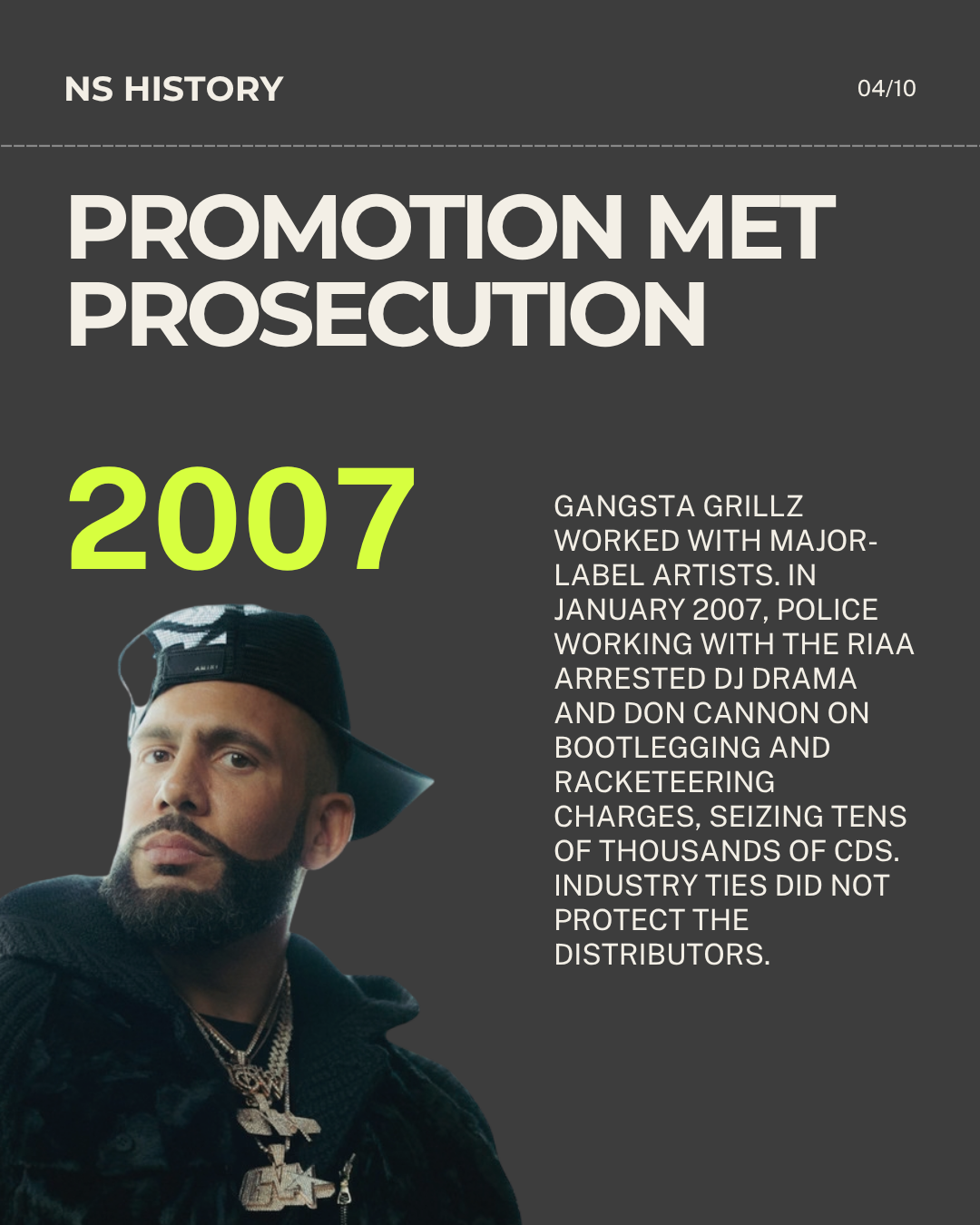
The artist becoming the focus did not remove the DJ from the process. NPR’s Louder Than a Riot account traces the role of DJ Drama’s Gangsta Grillz series in the careers of T.I., Lil Wayne and Jeezy. These were artist projects circulating under a recognizable series, and the operation worked directly with major-label artists to promote and distribute new music. Mixtapes were not simply recordings that escaped the industry. They could be part of how the industry developed attention around its own artists.

That relationship makes the January 2007 raid especially revealing. NPR reports that officers, working in collaboration with the RIAA, confiscated tens of thousands of mixtape CDs and arrested Drama and Don Cannon on bootlegging and racketeering charges. An operation participating in the promotion of major-label artists was being treated as a criminal distribution enterprise. The contradiction was not that mixtapes existed entirely outside the music business. It was that involvement in that business had not protected their distributors from enforcement.

The raid did not create online distribution, and physical mixtapes did not disappear overnight. DatPiff was already operating, having launched in 2005, as Andre Gee later documented in Rolling Stone. But the arrests exposed a vulnerability in the physical model: the CDs carrying an artist’s promotional work were also stock that could be seized. Digital distribution offered another way for that work to travel. It changed the means of circulation, not the underlying question of who had the right to distribute the music.

The Audience Became The Pitch
DatPiff’s initial problem was smaller than transforming the music industry. Marcus Frasier wanted a way to share mixtapes with friends without burning another CD. In Jimmy Ness’s 2014 interview for Passion of the Weiss, Kyle “KP” Reilly recalled joining early to handle content and marketing. Listeners found the site through searches for mixtapes, and the team promoted it on Myspace. A practical solution to copying music began to gather people already looking for it.

The significance was not simply that an artist could upload a project. DatPiff assembled a destination for that kind of music. As Andre Gee’s Rolling Stone history describes, emerging acts could appear alongside established names. That proximity offered a possibility a solitary download link could not: reaching listeners who had arrived for someone else.

But access to the site was not the same as equal access to its attention. Reilly’s 2014 account describes arrangements with DJ Drama, Don Cannon and DJ Holiday, beginning in 2011, that brought DatPiff into planning for their hosted projects. Distribution, social promotion and placement could be coordinated before a release arrived. Visibility was shaped by those working relationships as well as by the ability to upload music.

The counter made one part of that response visible. An artist’s team could point to download activity instead of asking everyone to take its claims of interest on faith. It remained an imperfect measure. Reilly said DatPiff scanned for suspicious activity and banned users who manipulated statistics; those were the platform’s assurances, not an independent audit. The important shift was that a release outside the retail album system could produce public evidence of activity. What that activity meant for a career still required interpretation.

More Than An Album’s Waiting Room
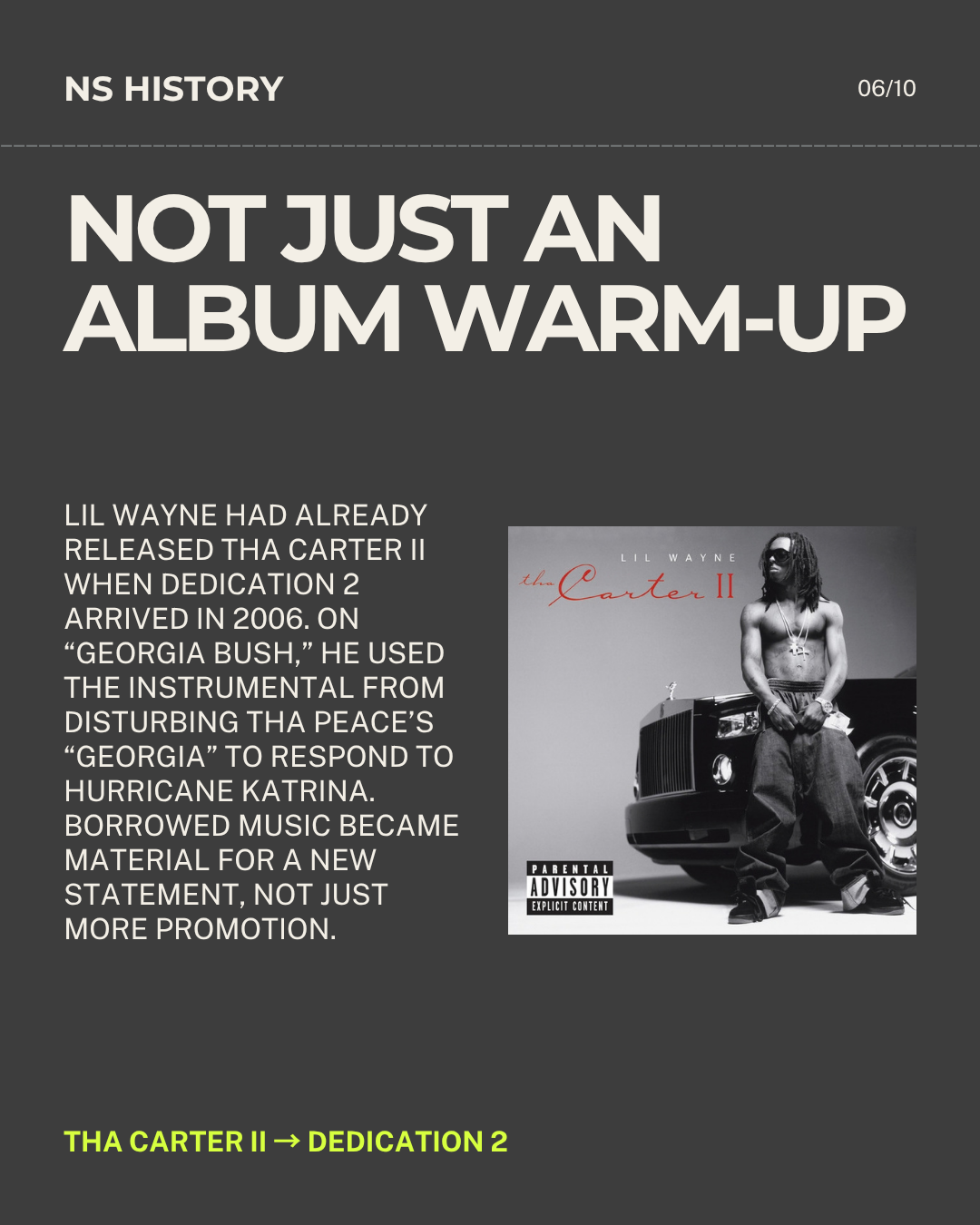
The format also changed what an artist could make. Lil Wayne’s Dedication 2, released with DJ Drama in 2006, arrived after Tha Carter II. It was not simply a demonstration that Wayne was ready to make an album. He had already done that. The mixtape offered another setting in which to extend his work.

In Peter Macia’s contemporary Pitchfork review, the material includes Wayne’s performances over production associated with “What You Know,” “Hustlin’” and “Poppin’ My Collar.” Macia also singles out “Georgia Bush,” which uses the instrumental from Disturbing Tha Peace’s “Georgia” for Wayne’s response to Hurricane Katrina and the failures surrounding it. An existing record could become the starting point for a different subject, not merely a backing track for more verses.

That example helps explain why a mixtape’s significance cannot be reduced to its price or promotional function. The borrowed material was part of the creative method. The project could place an artist in conversation with songs listeners already knew while giving that conversation a distinct purpose.

The same conditions complicated the music’s future. In Brian Josephs’s New York Times reporting, signed artists sometimes released music without label oversight, and many projects used uncleared samples. The freedom to circulate a tape did not establish the rights needed to keep every recording available indefinitely. What made the format flexible in its moment could make it difficult to transfer unchanged into another distribution system.

The Proof Class

The careers associated with the era did not all begin in the same place or follow the same route. Reducing them to a story of an unknown artist uploading a free tape and becoming a star misses the relationships and earlier work already in motion.

Drake: an audience before the major-label decision

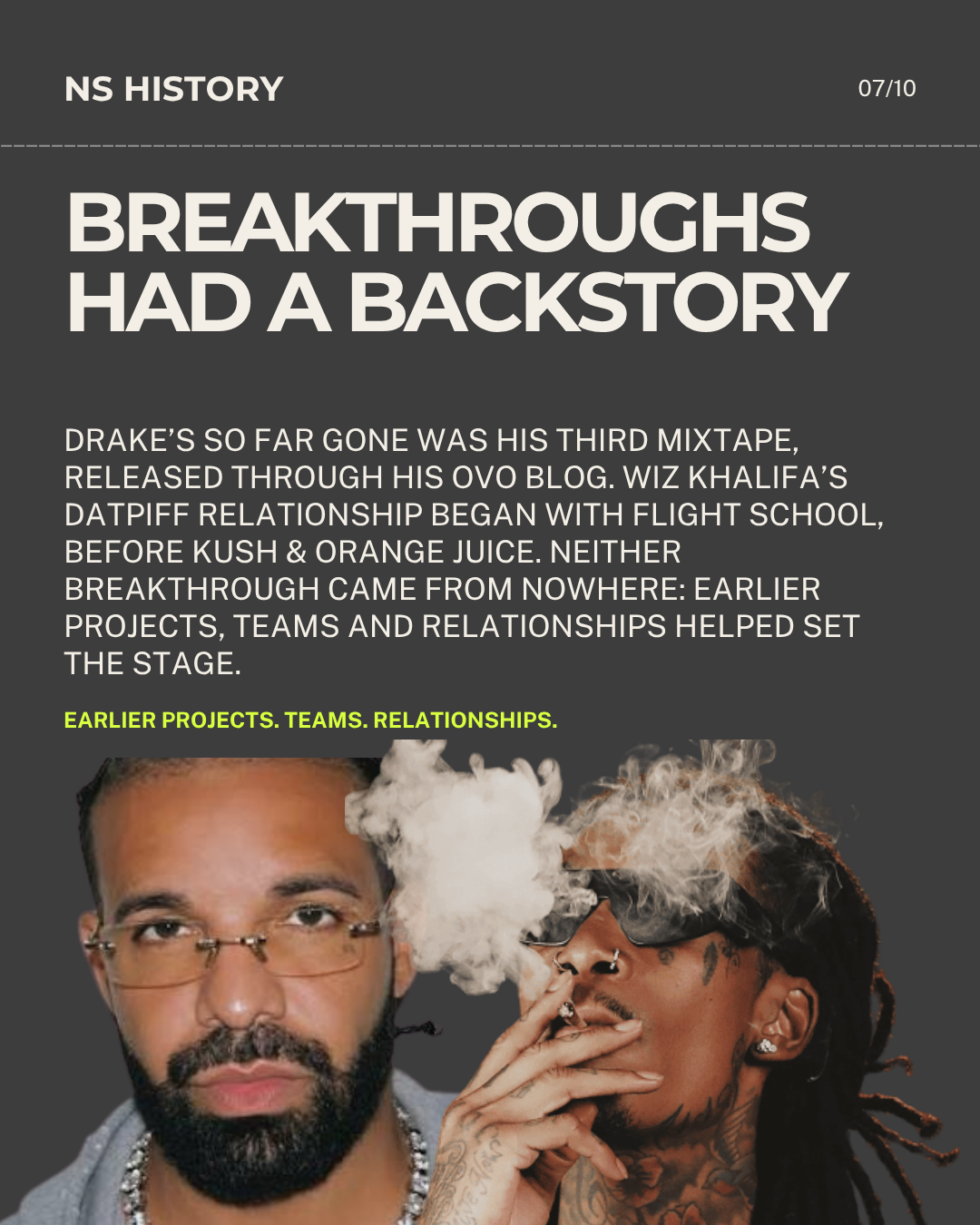
Drake’s So Far Gone was his third mixtape, not his first introduction. Paul Bowler’s uDiscover Music retrospective traces Room for Improvement in 2006, Comeback Season in 2007 and touring with Lil Wayne in 2008. So Far Gone arrived as a free download on Drake’s OVO blog on February 13, 2009.

By June, Mariel Concepcion’s Billboard report described major labels competing to sign him. It also documented his existing Young Money affiliations and management team. Drake told Billboard he wanted a label to add to what his team had already built. The audience was part of his negotiating position, but he was not approaching the industry without relationships or support.

Drake was negotiating from an existing body of work and a team around it. A major-label partnership would build on that foundation, rather than make the first introduction.
Wiz Khalifa: a breakthrough with a history behind it

For Wiz Khalifa, 2010’s Kush & Orange Juice was both a larger introduction and a more defined artistic identity. Speaking to Jordan Rose at Complex in 2025, Wiz described earlier work that had not yet given him the same sense of himself: “Kush and OJ gave me my identity.”

The platform relationship had begun earlier. In Kemet High’s 2019 Complex report, manager Will Dzombak traced the team’s first official DatPiff release to Flight School. Contact with Reilly continued online and eventually in person. The celebrated launch was therefore part of an existing sequence of projects and relationships. Its value was not simply attracting more people. In Wiz’s own account, the project made the artist they were meeting more clearly defined.

Mac Miller: free work and a commercial next step

Mac Miller’s 2010 K.I.D.S. was another introduction that remained important after the artist’s career moved forward. David Renshaw’s FADER report documents Rostrum Records marking its tenth anniversary with a deluxe edition. In his 2014 interview with Ness, Reilly counted Miller among the artists he believed DatPiff had helped propel.

A separate contemporary measure shows the scale of Miller’s next stage. In November 2011, Keith Caulfield reported for Billboard that Blue Slide Park debuted at No. 1 with 144,000 copies sold, according to Nielsen SoundScan. It was the first independently distributed debut album to top the Billboard 200 since 1995. Caulfield also specified the infrastructure: a Rostrum release distributed through INgrooves and Fontana, Universal Music Group Distribution’s independent arm.

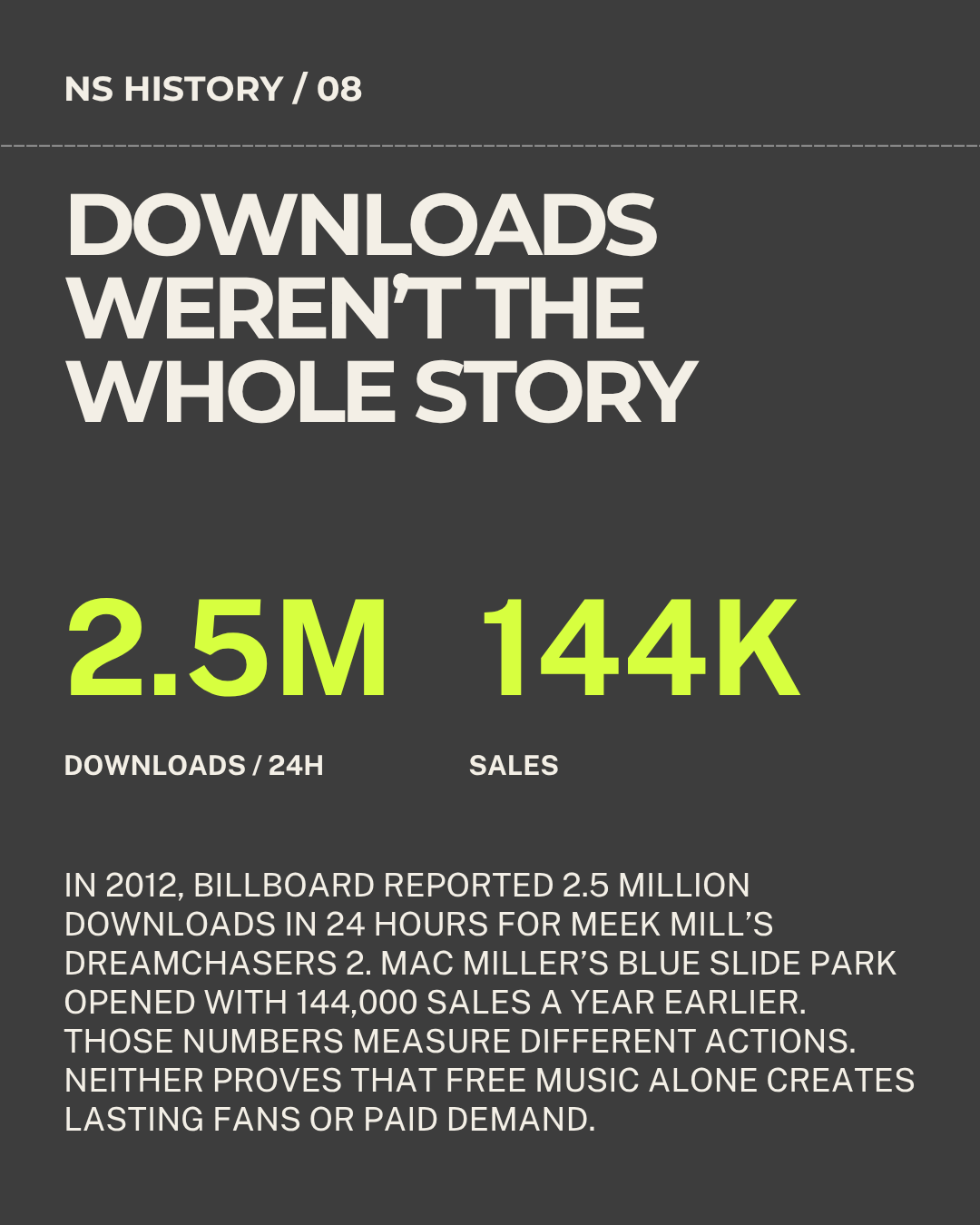
Those sales cannot be attributed to K.I.D.S. downloads alone. They do show why free music and a paid release need not be opposing strategies. The next stage involved a different product, a distribution network and listeners willing to purchase it.

Meek Mill: scale with context

Meek Mill’s Dreamchasers 2 made the scale of a free release especially visible. In her August 2012 Billboard report, Carolyn Menyes reported 2.5 million downloads in 24 hours following its May 7 release. That is a reported download total, not a count of unique listeners or independently audited fan demand.

Reilly’s 2014 explanation connected the response to DatPiff’s Philadelphia base, Meek’s standing in the area, radio records and the platform’s promotional support. The counter did not show an audience appearing from nowhere. It recorded activity around an artist whose local momentum and industry position were already developing.

Chance the Rapper: recognition through a changing system
Chance the Rapper demonstrates why the larger free-music ecosystem matters more than a single platform’s origin story. Madison Bloom’s Pitchfork report identifies SoundCloud as the free-release destination for 10 Day in 2012 and Acid Rap in 2013. His career cannot be explained as a DatPiff upload leading directly to a Grammy.

In 2017, Coloring Book, released the previous year, became the first streaming-only album to win a Grammy, taking Best Rap Album. Lyndsey Havens’s Billboard report notes that the Recording Academy disputed the idea that the project caused its eligibility revision. Jordan Darville’s contemporary FADER account also makes the boundary clear: qualifying streaming services counted toward general distribution, while mixtape-site uploads remained ineligible under the rules announced in 2016.

Institutional recognition had expanded, but it had not accepted every earlier distribution method on equal terms. Even the music’s transfer could require changes. Bloom reported that when Acid Rap reached major streaming services in 2019, the original “Juice” recording was absent because its samples had not been cleared.

Listening links lead to streaming editions, which may differ from the original mixtapes.

Free Was A Price, Not A Business Model

The listener’s price did not describe the cost of making or circulating the music. In his 2014 interview with Ness, Reilly put advertising at roughly 60–65 percent of DatPiff’s revenue. He also described DJ-hosting arrangements costing artists thousands of dollars, connected to promotional support and platform placement. The music could be free to download while the system around it remained commercial.

For an established artist such as Wiz, Reilly described free mixtapes as something fans expected alongside buying concert tickets and merchandise. An artist without a touring audience or a viable merchandise offer could not assume the same exchange would work.

The useful distinction is between the price of one release and the economics of a career. A free project could contribute to discovery, satisfy an existing audience or create material for a performance. None of those functions removed recording costs, rights questions or the need to fund the next stage. The work still needed a purpose beyond being free.

When the discovery platform became an archive

The platform’s later history puts another limit on the idea of permanence. In High’s 2019 Complex interview, Reilly described negotiations to keep older music available, including disabling downloads or redirecting listeners to streaming services. He also recalled having to remove Drake’s So Far Gone. Keeping a catalog accessible involved continuing relationships with rights holders, not merely storing files.
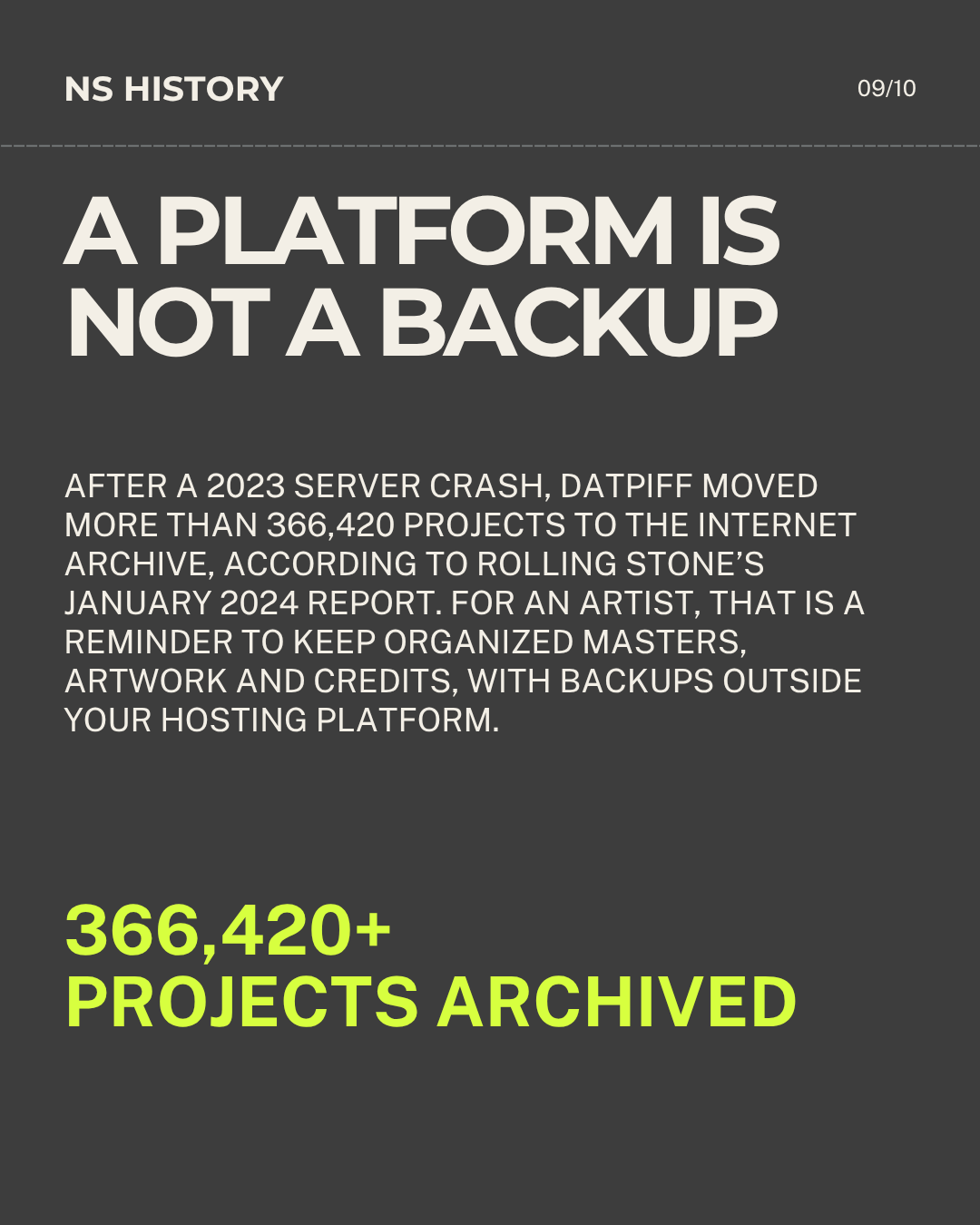
In January 2024, Andre Gee reported for Rolling Stone that DatPiff had transferred a catalog of more than 366,420 projects, approximately 50 terabytes, to the Internet Archive after a server crash in March 2023. The story was not that the entire catalog had vanished. A substantial collection had been moved into another institution’s care.

An archive, however, serves a different purpose from the community that originally surrounded the music. It can preserve the recordings without recreating the release-day attention, relationships or context through which listeners encountered them. DatPiff’s history is therefore also a reminder that an artist’s catalog and the platform carrying it are not the same thing. Availability requires maintenance, even after the moment of discovery has passed.

What to Borrow, What to Leave Behind

These are celebrated careers, not a representative sample of everyone who released a tape. The outcomes depended on different music, teams, resources and circumstances. The lessons below are our practical reading of the history, not a formula for reproducing those outcomes.

Decide what the project adds to your story

The distinction between Guess Who’s Back? and 50 Cent Is the Future shows that two releases by the same artist can do different work. One gathered material into a public introduction; the other presented new performances in an artist-centered format. Wayne’s mixtape extended a career already established through albums. Wiz described his breakthrough tape as clarifying his identity.
For your next release, identify its particular job. If it is a first single, what does it introduce about your work? If you have several projects behind you, what is different enough to justify asking listeners to return? Write an answer that the music can support. “My strongest project yet” does not tell someone what they are about to encounter.

Choose a song, performance or short account of the project’s making that gives a listener a clear way in. The aim is not to invent a story around the music. It is to communicate the one the work actually contains.

Plan for discovery and the connection afterward

DatPiff gathered listeners who were already searching for mixtapes. Its regional audience and relationships also affected which projects found support. That is a more useful lesson than simply choosing the biggest available platform.

Identify a few places where people who might connect with your work already spend time: a particular curator, publication, local event or artist community. Understand why your project belongs there before approaching anyone. A relevant, specific introduction is different from distributing the same request everywhere, and editorial interest is not a purchased entitlement.

Then decide what an interested listener should find next. It could be the rest of your catalog, a show or an optional mailing list with a clear promise about what you will send. Choose an invitation you can maintain. Do not require someone to join a community merely to hear the release, or create one you cannot look after.

The follow-up does not have to be another project. A performance or a thoughtful account of how a song was made can continue the encounter with this one. Give the release enough attention to discover what people are responding to before replacing it with another announcement.

Match the evidence to the decision

Meek’s download total made activity visible. Miller’s album sales measured purchases of a different release. Neither figure answers every question about the audience behind it. Before choosing a metric, identify what you need to decide:

  • Where should I focus outreach? Listener locations, where available, suggest places to investigate. They do not establish that a local community is waiting for you.

  • Are people returning? Repeat-listening information can help where a service provides it. An optional email sign-up gives permission for future contact, not proof of another listen.

  • Can I support a local show? Test interest with people who can attend, then distinguish their interest from actual ticket purchases. A worldwide play total cannot settle a local booking decision.

Use a response to learn what to do next, not simply to make the release look successful. If the evidence is incomplete, a small test may be more useful than a larger commitment.

Keep the freedom, account for the costs

The era’s free releases were not free of production costs, promotional arrangements or rights disputes. Nor does its history justify releasing constantly, buying a co-sign or treating attention as a guaranteed return on spending.

Decide what you can afford to make available and what it is meant to achieve. If you pay for a promotional service, specify the deliverable and its limits. An advertisement, a hosted event and independent editorial coverage are different things; none should be described as a guaranteed fanbase.

Confirm the permissions needed for material you distribute, rather than assuming a free release is exempt. Keep organized copies of masters, artwork, credits and relevant rights documentation, with backups separate from the service hosting your work. Preservation is part of caring for a catalog, not a task to begin only after a link stops working.

Put it to work on your next release

Before adding more promotional tasks, write a short brief:

  • What this project introduces: One specific sentence about what a listener should understand about your work.

  • Where to start: The song, performance, visual or story that provides an entry point.

  • Who it could reach: A few relevant communities or outlets, and why the work belongs there.

  • Where to go next: One clear destination or voluntary invitation for someone who wants more.

  • Why to return: One meaningful follow-up you can deliver with your available resources.

  • What you want to learn: One question about the response and the evidence you can realistically collect to answer it.

For a first release, this might mean a clear introduction, one performance and an invitation to hear the next piece of work. For an artist with an existing catalog, it might mean explaining what has changed, directing new listeners toward an earlier project and testing interest in a show. These are options, not a requirement to build every part of a campaign at once.

The mixtape era did not eliminate gatekeepers or the costs of a career. It showed that an artist could build a body of work and a public response before a major-label album arrived. The advantage was not free music alone. It was the room to make a sustained introduction, then give that introduction somewhere to lead. For an artist now, the release is where that work becomes visible, not where it ends.

Put these lessons to work on your next release: save the brief above, work through it with your collaborators and choose one meaningful way to keep listeners connected after release day. If you’re an independent artist with music to share, submit your music to Nefarious Supply. Send a release that represents where your work is headed, along with a little context about the story behind it. Submissions are considered independently for editorial coverage and playlist inclusion. Coverage cannot be purchased, and submitting does not guarantee coverage, placement or a response.


Editorial bibliography

Street distribution and the raid

DatPiff, economics and preservation

Lil Wayne

Drake

Wiz Khalifa

Mac Miller

Meek Mill

Chance the Rapper

Wrené Nova: Making the Unseen Audible

Wrené Nova makes electronic music for the feelings that don't have names yet. On The Intangible, an album she wrote, performed, produced, mixed, and mastered entirely herself, she sets out to do exactly what the title promises: make the unseen audible.

The record moves along the edges of trip hop, electronic art music, avant-pop, and contemporary balladry without ever settling into any of them. Wrené built it by instinct rather than blueprint. Sounds earn their place because of where they land in the body, how sharp or soft they feel, or because a moment happened once in the booth and could never happen again. The genre tags, as she tells it, only come later.

That instinct gives the album its texture. Distortion sits beside breath. Restraint gives way to release. Where a lot of electronic music gets polished until it feels far away, The Intangible keeps its rough edges on purpose, closer to a confession than a showcase. Wrené has a name for that spirit: "digital age grunge," a raw, uncategorizable refusal to shape music around what algorithms reward.
There is a quieter defiance in how the album exists, too. Tired of pouring work and soul into releases that only lived online, Wrené wanted this one to be something you could hold. It arrives as people are returning to physical media and supporting artists directly, an attempt to pull something heavenly down from the cloud and into the real world.

Underneath all of it is vulnerability: faith held against hard evidence, longing, survival, and the strange work of facing what's inside you while still trying to hit the right notes. Focus tracks "Archangel," "No Flag," "No Skin Against The Wind," and "Tomorrow will come (drip drop)" offer the clearest way into that world.

We talked to Wrené about faith, vulnerability, self-production, the artists who share her emotional imprint, and building a sanctuary out of sound.

=

You describe The Intangible as an attempt to "make the unseen audible." What was the first feeling, memory, or internal truth that made you realize this album needed to exist?

There's something really deep and human that happens, for me, when I'm able to drop into a feeling without intellectualizing it- and being able to understand everything. And at that time, what was 'unseen' for me was this feeling of profound faith in that I was going to have a beautiful life- despite all this evidence that my mind had collected, and all the things that had/hadn't happened for me, despite all the depression in and around me. I had a personal longing to bring down something heavenly into my world as something I could hold in my hands- and to show myself that if I could 'bring that down' and create that, then I could continue to do so with any other genuine desires. So now I've got a nice record, I'm still figuring out the rest. Honestly I don't always feel as high or as enlightened as I'd like but it's a good start.

And also the timing of it made sense as a small act of defiance against the feeling of pouring so much work and soul into things that ultimately only lived online- with all the streaming releases etc. It was happening during a collective shift where many people began to turn back to collecting, and rediscovering the magic of owning physical media and supporting artists directly, because we're getting tired of the corporate 'cloud' economy. So I brought 'THE INTANGIBLE' down from the cloud where there was no heaven.

The album sits between trip hop, electronic art music, avant-pop, and contemporary balladry, but it also feels like you are resisting easy genre language. When you were building the project, were you thinking in terms of genre at all, or were you chasing something more emotional and sensory?

In these times, I consider it a huge privilege to be able to carve your own space away from all the external noise that we're constantly bombarded with- and to find freedom in hearing yourself, or more simply- just asking yourself 'what do I like?' and 'what do I want to hear right now?' 'who do I want to embody right now?'- and that goes into the micro stages of producing a song too, with the sound selection it becomes- 'I want this to vibrate here', 'I want this layer to feel like a shard of glass,' or 'oh that vocal take happened by accident, and I can't replicate that moment again- put it in the comp' I think you can always interpret or identify what something might be after it's created- but the actual stages of 'building' the project are not at all calculated- I'm just adding strokes to the canvas. I'm not sure if that's more of following an emotional or sensory thread, or just removing the part of yourself that wants to control the process. And then those genres that are described are just ways to interpret the sound after hearing it- like writing down the details of a dream you had and you are trying to remember- how do I explain this experience I just had to others?

You called the spirit of the album "digital age grunge." What does that phrase mean to you, and how does it show up in the production, writing, and vocal choices across the record?

I call it digital age 'grunge' because that movement in the 90's was a raw and authentic rebellion against the status quo at that time, and this has a very similar intention. It's electronic music that dares to be a bit 'uncategorizable' in the age where conforming to and pleasing algorithms is the norm. It's also a record where it becomes very emotive in unfiltered ways- which would be recognizable to people who can empathize with it.

You performed, produced, wrote, mixed, and mastered the album yourself. How does having that much control change the emotional honesty of the work? Does self-producing make it easier to protect the original feeling, or harder because you are inside every detail?

I believe regardless of who's producing your record- a good artist who creates from emotional honesty can never have that taken from them. A good song can still be a good song- even if the production is ass- and a well produced shitty song is still well produced. I suppose meeting somewhere in the middle is the ideal haha.

I actually really enjoy the time I put into developing production skills as part of the process- and experimenting with new tools and sounds- because to me it's a lifelong evolution and a part of sustaining longevity as an artist. I'd never knock someone for outsourcing their production- and I'm always improving too. Knowing myself, I'll probably hate this record in 5 years (or tomorrow) because of the gap in my personal improvement. It's all just an extension of artistry and craft and allows you to keep a cohesive sound- it also makes you more valuable as a collaborator and sets a precedent for what you can contribute to others down the line.

A lot of electronic music can feel polished to the point of distance, but your description of this album emphasizes breath, vulnerability, distortion, restraint, and release. How did you balance precision with something more raw and human?

I think that answer lies in just having the awareness that I never stopped feeling or never shut myself off during the entire process, and that my taste naturally gravitates to those moments of 'perfect imperfection'. It's just a preference that I've been able to identify- and all my favourite music that inspires me also has these qualities. Nothing wrong with polish or refinement- it's just not as sexy to me as something with a little bit more texture, edge or vulnerable 'danger'.

The title The Intangible points toward things people feel but do not always articulate. What are some of the emotions or truths on this album that you felt were hardest to give shape to?

That's a really clever and difficult question to answer because it requires me to try to articulate what these feelings are- which I also feel I don't have the authority to. Especially for what those feelings might be to others. I'll say 'vulnerability' in my case. It's difficult to give shape to anything vulnerable because you physically seize- and that's the beautiful danger of being a human. Choosing to move through these difficult feelings- instead of maybe drugging them away, or hurting others. You booked a studio instead, and there's a flashing red light- and now you have to face that thing that's inside you AND remember to sing the right notes.

Which song on the album changed the most from its first version to the final master, and what did that transformation teach you about the project as a whole?

Actually, I was very lucky with this project that there were almost no reworks on any track. Some tracks may have taken more time than others to fully come together, but the process was pretty focused from start to finish. I would work on a track until I was happy with it, and then I would move on to the next, and then I would decide that I wanted to strip back a couple tracks to just voice and piano, and make new songs from the stems of the completed songs as the transition tracks, and that was it. I was able to make swift creative decisions from the start to finish.

Your focus tracks include "Archangel", "No Flag", "No Skin Against The Wind", and "Tomorrow will come (drip drop)". What made those songs feel like the clearest entry points into the album's world?

These songs were just the first songs that I started producing as my 'next project' before I conceptualized that the LP was going to be 'THE INTANGIBLE'. This is how I usually begin my albums. I start with a few songs just to follow and create an atmosphere that I like- and then I begin to understand what it is I'm making or what my intention is. It starts by being unconscious, and the first songs reveal what's going on and inform me on where to continue.

Let's talk about "No Skin Against The Wind." Even from the title, it suggests exposure, vulnerability, and maybe a kind of emotional weather. What was the emotional center of that song for you?

That description of what it suggests feels accurate to what it's about for me. My knee jerk answer to 'what was the emotional center of that song' is: waiting too long for something that feels necessary for your survival, and you're standing in the middle of that pain and you just have to accept that for your eternity and then the pain minimizes just enough to continue surviving.

You mention wanting music to be an immersive experience that strips away artifice. When you are making a song, how do you know when something feels too decorated or too guarded?

When you know something isn't honest- you feel like a fraud. If a performance or something I write doesn't 'go there', then it's just deeply unsatisfying. Like faking it during sex- afterwards you feel 'that was shit and now I'm empty'. I'm already fighting against a lot of numbness in daily life- it has no place in my sanctuary XD

There is a strong visual and physical quality in the way you describe the project: sonic worlds, distortion, breath, shape, release. Do you see music visually when you create, and did The Intangible have a color palette, landscape, or visual language in your head?

That's a really nice observation that I appreciate! And it did- THE INTANGIBLE is a fluid and transmutable entity of very bright white light that acts like a film or protective barrier over shadows. That's how I imagine it when I listen to it.

Your influences listed include Björk, FKA Twigs, and Massive Attack, artists who all build worlds rather than just songs. What did you learn from artists like that, and where did you feel the need to push away from those references to find your own language?

Whenever I describe artists as being influential to me, it's less about their literal sound and more of just a statement of 'these artists create music that matches my emotional imprint and personal taste' so that others that also appreciate something about these artists may gravitate to me as being likeminded in taste.

I'm never consciously thinking 'I'm going to make a Massive Attack's Mezzanine with a twist of FKA Twig's Cellophane', it's just the music I'm choosing to listen to personally when I'm having a smoke and wearing headphones.

The project credits include Sam Fortin on piano and keys, and Beryl Kessio / Kaleidokitty on additional production for "The depths of your insolence." How did collaboration enter a project that is otherwise so self-contained and self-produced?

I just felt that those particular songs worked on the album, and they happened to be born from existing collaborations. If at any point in the process, regardless if I'm the one to rework something or bring it to the finish line, if anything involves another person- they are credited. Especially on this album, for the songs they were featured on- those contributions were huge.

When someone finishes The Intangible front to back, what do you hope has shifted in them? Not just what do you want them to think of the album, but what do you want them to feel newly able to name?

My ideal hope or dream vision for this record is that it's in the hands and collection of people that recognize an emotional journey similar to their own, and when they listen to it front to back- they can process vulnerable feelings that they are working through, and give themselves permission to feel okay for 40 minutes. I hope they can discover and newly name a small sanctuary for themselves, and find something in the album's presence that speaks uniquely to them.


Spending time with The Intangible feels less like pressing play and more like being invited into someone's private world. It's a record that asks you to slow down, stay with it front to back, and let yourself feel what usually goes unsaid. We're grateful to Wrené for the honesty she brought to this conversation and for trusting us with the story behind the music. If you find a little shelter in this album too, hold onto it.

Listen: Bandcamp · YouTube

We cover what moves us. Send what moves you.

This conversation started the way so many of our favorite stories do: with an artist reaching out. Nefarious Supply has covered underground music independently since 2018, and discovering music this way never gets old. If you're making something you believe in, submit your music and tell us the story behind it. We'd love to hear it.

Selected artists may be considered for interviews, playlists, and editorial features. No fees. No pay-to-play. Ever. Submitting puts your work in front of us; it does not guarantee coverage.

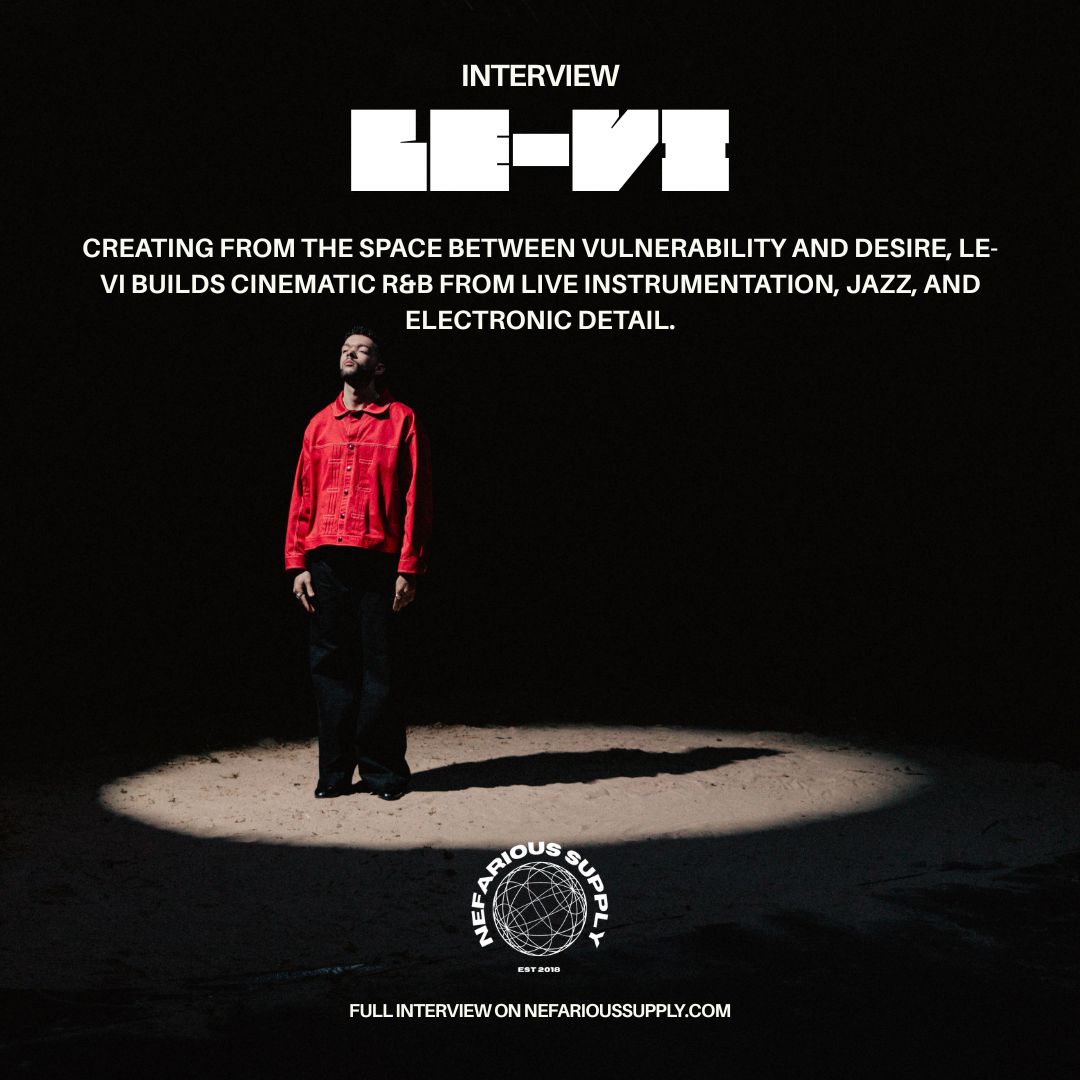
LE-VI: Building a World Between Vulnerability and Desire

Before LE-VI became the artist at the center of the record, they spent years helping other people bring their ideas into focus. Writing, producing, mixing, mastering, sound editing, and visual storytelling were all part of the work. The shift into their own spotlight did not require learning how to make music. It required becoming comfortable allowing the person behind the craft to become visible inside it.

That tension gives LE-VI’s music its emotional center. Their work moves through identity, intimacy, desire, vulnerability, and the feeling of living between categories without needing to resolve every contradiction. Toronto’s layered musical landscape is present in the atmosphere, but so are old-school R&B, alternative R&B, pop, melodic rap, jazz, hip-hop, and the immersive instincts of a producer who hears the details beneath the surface.

“Hourglass” is the first clear doorway into this chapter. Built around the feeling of wanting to hold onto a moment while knowing that time will continue moving, the record turns suspended desire into sound. Its visual world expands that idea through cycles, transformation, and the decision to step outside patterns that no longer fit.

In this conversation, LE-VI discusses the discomfort of moving from behind the scenes to the center of the frame, the creative freedom that comes with controlling every layer of a record, and the trust required to collaborate without losing the emotional core of the work. The larger project is still unfolding, but the direction is clear: an artist with the technical ability to shape an entire record is learning how to trust the vulnerability that makes the record matter.


For someone stepping into your world for the first time, who is LE-VI, and what do you want your music to reveal about you before anything else?

LE-VI is an artist creating from the space between vulnerability and desire. My music moves through emotion, identity, intimacy, and the things we often feel before we fully understand them. When the production is layered or the world around a song feels cinematic, there’s usually something very human at the center of it. I want people to feel like they can step into the music and find a piece of themselves there too.

You come from an African-Scottish Canadian background and are rooted in Toronto. How have identity, place, and culture shaped the way you hear sound and tell stories?

I think growing up between different backgrounds has made me comfortable living in the in-between. Identity has never felt like something I could reduce to one perspective or one experience, and I think that naturally shows up in the way I create. I'm drawn to contrast, sensuality and vulnerability, confidence and uncertainty, polished production and something more raw underneath. I tend to steer one way and then move somewhere unexpected, and I think that comes from a place of not belonging in one category, and not wanting to.

Toronto has also shaped me enormously. It's such a multicultural city, and you grow up surrounded by different sounds, perspectives, and ways of expressing yourself. That definitely influenced the way I hear music. I don't feel particularly interested in staying inside one genre or one emotional lane. My work is usually about blending worlds and finding the feeling that connects them.

Before people knew you as a recording artist, you spent years building through production, writing, mixing, mastering, and collaboration. What did those years teach you about the kind of artist you wanted to become?

Those years taught me how much intention lives beneath the surface of a record. When you're producing, writing, mixing, or helping shape someone else's vision, you start to understand that every decision affects how a song makes someone feel. Even the ones listeners might never consciously notice.
It always felt natural for me to hear an artist's perspective and vision for a song and then write in their voice, almost as if I knew what they had to say. That way of connecting with people and translating their perspective came naturally to me through this medium we call music. I think those years taught me that I had a real ability to understand an artist from the inside out, and ultimately helped me recognize the kind of artist I wanted to become myself.

When you moved from helping build records for other people to centering your own voice, what felt natural, and what felt uncomfortable?

The creative process itself felt natural. Writing, producing, and shaping records has been part of my life for a long time, so being involved in every layer of the music felt familiar.

What felt uncomfortable was being the person at the center of it. When you're working behind the scenes, you can hide behind the work a little bit. You're helping someone else communicate their perspective. When it's your own voice, your own face, and your own story, there's nowhere to hide. That vulnerability has probably been the biggest adjustment, but I think it's also an important part of what makes an artist feel real.

I’ve tried to crack out of my shell and become more comfortable in the spotlight by creating meaningful visual spectacles around my songs, things that connect listeners not only to me as a person, but to the world and artistry I’m trying to build.
Your background also touches sound editing, recording, media production, and visual storytelling. You have a rare level of control over your music because you can write, produce, and mix your own work. How do those disciplines and that independence shape the atmosphere and emotional honesty of the final record?
Having that level of control allows me to follow a feeling all the way through. Sometimes the smallest production decision can completely change the emotional meaning of a lyric or vocal performance. Because I'm involved from the writing stage through production and mixing, I can protect the original feeling that made me want to create the song in the first place. My sound design background also heavily influences my sound selection and the immersive details I weave between the verses and choruses, which invite the listener deeper into the emotion of the song the further they let themselves fall into it.

At the same time, independence doesn't mean I believe I have to do everything alone. Collaboration is still incredibly important to me. But having the ability to translate what I'm hearing internally without losing it through multiple layers of interpretation gives me a very direct relationship with the final record.

Toronto R&B has become known for mood, space, texture, and emotional restraint. How do you relate to that lineage, and where do you feel your own sound pushes against it?

I definitely feel connected to that lineage. Growing up in Toronto, that sense of mood, space, and atmosphere is naturally part of how I hear R&B. Looking back, the records that often played in my childhood home were also very influential to my current sound. There was smooth R&B, jazz, and boom-bap hip-hop. I've always been drawn to music that doesn't feel the need to explain everything, that leaves room for the listener to sit inside the emotion.

Where I think my own sound pushes against it is in the range of influences I bring into the music. I love traditional and old-school R&B just as much as alternative R&B, pop, melodic rap, and more unexpected production choices. I'm interested in taking familiar emotional language and placing it in different sonic environments. I don't really want to choose between nostalgia and experimentation; I want to find the space where they can exist together.

You’ve collaborated closely with artists like NUBLUU across several releases. What have those collaborations taught you about chemistry, trust, and the difference between producing a record and understanding an artist?

Working closely with another artist over time teaches you that producing a record and understanding an artist are two very different things. You can make something technically great without really understanding the person making it. But when there's trust, you start to recognize what someone is trying to say before they can fully articulate it. NUBLUU has always pushed me to put out my own music, and our friendship has grown tremendously over the years as we've grown together and continued to sharpen our craft.

My collaborations with NUBLUU have taught me how important chemistry and trust are to the creative process. Sometimes my role is to bring an idea forward, and other times it's to know when not to interfere with what already feels honest. We've definitely gone back to the drawing board a few times, but we always end up somewhere better because of it. The longer you work with someone, the more you learn their instincts, their strengths, and even the spaces where they need to be pushed. That's when collaboration becomes more than just exchanging ideas; it becomes building a shared language.

Your music moves between alternative R&B, old-school R&B, pop, and melodic rap. When a song is working, how do you know whether it is because of the genre, the feeling, or the story underneath it?

For me, it's almost always the feeling and the story underneath it. Genre is more of a language than a destination. It gives you different tools to communicate something, but it isn't the reason a song connects. Genre is an old categorical strategy to put artists in a box, but I think the music coming out right now isn’t too concerned with the term anymore and is more focused on the creative process.

A song can have influences from alternative R&B, old-school R&B, pop, or melodic rap, but if the emotional center isn't there, none of those labels really matter. Usually, when I know a song is working, it's because I can stop thinking about how it was made and just feel what it's saying. That's the point where the genre disappears a little bit, and the record exists in its own category.

“Hourglass” arrives at a moment where you’re preparing a larger project and becoming more consistent with releases. Why did this record feel like the right doorway into the next chapter?

“Hourglass” felt like the right doorway because it captures a lot of the things I'm exploring creatively right now. It's sensual, introspective, and emotionally suspended in a moment where you want time to stop, but there's also an awareness that it can't. I’m also in a moment in my life where I’m consciously thinking about work-life balance and making more time for the things I love. That was a huge influence on this record, and part of what pushed me to finally step into the spotlight and be more intentional with the time I have.

As I move toward a larger project, I want the releases to feel connected to a bigger world rather than like isolated moments. “Hourglass” introduces that intention. It represents a shift toward being more consistent, but also more committed to letting people see the full picture of who I am in a way I haven't really allowed myself to before.

The image of an hourglass carries time, pressure, patience, and inevitability. What does that symbol mean to you personally, and how does it connect to the emotional center of the song?

The hourglass represents that strange awareness of time passing while you're still inside a moment you don't want to end. There's something beautiful about wanting to hold onto an experience while knowing you can't actually stop it.

For me, the song lives in that tension. The line, “Enchanted in your hourglass, I never want time to pass lately,” is about being completely immersed in someone or something and wanting to stay there. But an hourglass is always moving. You can't pause it without changing what it is. That became a really powerful symbol for desire, time, and the things we're constantly trying to hold onto even as they move away from us.

Walk us through the making of “Hourglass.” What was the first piece that unlocked the record, and what changed the most between the first version and the final mix?

The first thing that unlocked “Hourglass” was the feeling I got after looping the record's intro, with that smooth guitar pattern and sultry vocal sample layer. Before I knew exactly what every part of the record would become, there was already this sense of being suspended in time, something intimate, hypnotic, and slightly surreal. I knew I had something here, and I just started writing to that initial loop before expanding on the compositional complexity, which formed “Hourglass”'s final form.

The biggest changes happened in the details. The core emotional idea stayed intact, but the production and mix evolved around finding the right balance between atmosphere and impact. I spent a lot of time making sure the record could feel spacious and immersive without losing its movement or energy. That's often where my background in production and mixing becomes both a strength and a challenge, I can hear every small detail, so learning when to stop is part of the process too.

You released “Hourglass” with a music video, which makes the visual language part of the experience. What did you want the video to say that the song could only suggest?

The video gave me an opportunity to make the idea of cycles and time more tangible. The song exists emotionally inside the feeling of wanting to hold onto a moment, but visually I wanted to explore what it means to be caught in patterns and eventually choose to break free from them.

The ouroboros became an important symbol for that. It's traditionally associated with cycles and infinity, and I loved the idea of connecting that imagery to the hourglass and the passage of time. The visual journey of emerging from a shed skin represents transformation, recognizing the cycles you've been living in and deciding that you don't have to remain inside them. The video expands the song's emotional world into something more symbolic and open to interpretation.

After years of developing your craft behind the scenes, what does consistency mean to you now, not just as a release strategy, but as a commitment to yourself?

Consistency means trusting myself enough to keep showing up before I have all the answers. For a long time, I spent years developing my craft, learning different disciplines, and helping bring other people's ideas to life. There can always be another skill to learn or another reason to wait until something feels perfect.

At this point, consistency is about choosing not to hide behind preparation anymore. It's a commitment to giving my own work the same time, discipline, and belief that I've given to other people's work throughout my career. Releasing consistently isn't just about staying visible, it's about continuing to build trust with myself as an artist.

When people eventually hear the larger project you’re building toward, what do you hope “Hourglass” helped them understand about the world, discipline, and emotional direction of LE-VI?

I hope “Hourglass” helps people understand that the larger project is about more than one sound or one moment. I'm building a world that moves through intimacy, identity, desire, vulnerability, and transformation.

I also hope it shows the discipline behind this chapter. After spending so much time developing my craft behind the scenes, I'm learning how to bring that same dedication forward as the artist. “Hourglass” is an invitation into that process. It's the beginning of a more consistent and intentional chapter, but it's also a reminder that I'm still growing inside the work.

Ultimately, I hope people come away feeling like they don't fully know where LE-VI is going next, and that they want to follow the journey to find out.


Thank you to LE-VI for taking the time to share the story behind the music, the craft, and the world they are building. From years spent shaping records behind the scenes to stepping into the spotlight with “Hourglass,” this conversation offers a closer look at the intention, vulnerability, and discipline behind the work.

Are you an artist with a story, a sound, or a project you want to share? Submit Your Music to Nefarious Supply for consideration. We are always listening for new voices and perspectives shaping the underground.


XTC — Underground Frequencies // Vol. 002: What Time Reveals

Editor’s Letter

This past summer, while working on the first volume of XTC, I spent time revisiting Scotty Apex’s catalog following the release of Hotel Mirage. Nefarious Supply had followed his work for years, and returning to those earlier records made the passage of time easier to recognize—in his development as an artist, in my own life, and throughout the history of the platform.

I tend to connect music to specific periods. Certain records bring back where I was, what occupied my attention, and the people and experiences surrounding that time. Revisiting Scotty’s catalog reminded me that following an artist over several years also means hearing their music alongside changes in your own life. The music becomes part of how you remember those periods.

That experience helped shape XTC. Volume I introduced the series as an experiment: a playlist treated as a finished piece of editorial, built to be heard from beginning to end. It established the rules. Start at Track 1. No shuffle. Let the transitions carry as much meaning as the individual records.

Volume I gave that philosophy its first complete form. Scotty Apex served as its center of gravity, while Burgundy, ihateyouALX, Rosabell, Mathaius Young, and SincerelyChico each shifted the energy without disrupting the listening experience. Together, the songs moved like chapters rather than isolated recommendations. The result was not simply a collection of artists I believed in, but a demonstration of what can happen when discovery, curation, and sequencing are treated as parts of the same editorial process.

Volume II moves forward with those same principles: intentional sequencing, patient listening, and the belief that underground artists deserve more than a brief moment of discovery. This volume considers what becomes visible when you continue listening—how artists develop, how catalogs accumulate meaning, and how certain records become connected to the periods in which we hear them.

THREE65 sits at the center of that idea. Like Scotty Apex in Volume I, his placement comes from years of listening rather than a single release or convenient moment. Wrené Nova, LE-VI, Chloe Tang, and Dio Valentino broaden the picture, capturing a current moment in the underground while THREE65 provides the longer view that only time can offer.

Volume II is not an attempt to recreate the first installment. It is the next entry: a new group of artists, a different listening experience, and another opportunity to make the sequence itself say something.


THREE65

Nefarious Supply first encountered the Cleveland artist under his earlier name, Heartthrobsworld. By the time he returned to the platform in 2019 with Summer’s Over, the name had changed because the direction had changed. He described leaving behind an image that no longer felt authentic and becoming more comfortable writing about his own experiences. The five-track EP drew from the relationships, thoughts, and emotions surrounding that summer, with THREE65 handling the engineering and working with close collaborators on its production and artwork.

The progression became clearer with Misery Loves Company in 2020. During the early months of the pandemic, THREE65 was making beats and writing songs every day, experimenting with his sound while becoming more confident in both his singing and his willingness to be direct. The resulting 12-track album had no guest features. He carried the project himself, contributed production to “The Way,” and mixed and mastered the entire record.

Even the sequencing reflected his growing control. “Last Call,” the final song completed for the album, became its conclusion because it resolved the story he had been building. At the time, he described music as a way to cope, with the larger goal of reaching a place of peace and helping listeners recognize that they were not alone in their own experiences.

That progression was technical as much as emotional. In 2019, THREE65 said he wanted to create something more orchestrated and become more involved in production. By 2020, that ambition was evident in the work. He contributed production, engineered the project, made deliberate sequencing decisions, and treated mixing as part of the creative process. His development could be heard both in the writing and in the control he exercised over the finished record.

More recently, I had the chance to reconnect with THREE65 and hear the body of work he is preparing to release. I was immediately struck by how complete it felt. The qualities documented in those earlier interviews remained, but the execution was sharper and the direction clearer. Hearing the project reinforced the progression already visible across his catalog and confirmed my decision to make him the headliner for Volume II.

This volume does not preview the unreleased music. Instead, it returns to the records that established his foundation. As THREE65 prepares to enter his next chapter, revisiting that catalog provides a clearer picture of what he has already demonstrated—and why the work ahead deserves attention.

That history, rather than any single release, is why THREE65 anchors Volume II. Across the name change, Summer’s Over, and Misery Loves Company, the throughline is an artist becoming more personal, more technically involved, and more certain of what he wants the work to communicate. Following that development over time is precisely what this volume is designed to document.


Wrené Nova

The Intangible begins with a difficult creative question: How do you give physical form to feelings that resist explanation? Wrené Nova answers through an electronic album built from intimate vocals, distortion, restraint, and deliberately imperfect textures. Her description of the project as “digital age grunge” is useful not as a fixed genre label, but as a statement of intent. The music resists the pressure to make every idea easily categorized or immediately understood.

That independence extends throughout the production. Wrené wrote, performed, produced, mixed, and mastered the album herself, giving her control over its emotional direction and technical details. She approaches sound design instinctively. A texture can feel like glass, an accidental vocal can become essential, and a song can reveal its meaning only after its atmosphere has taken shape.

The album developed in much the same way. Wrené began with a small group of songs that established an atmosphere before she fully understood the larger project. Those early records became guides, revealing the emotional world of The Intangible and directing what came next. “No Skin Against the Wind” offers one of the clearest entry points into that world. The song places vulnerability inside something physical, using space and texture to evoke emotional exposure without overexplaining it.

Within Volume II, Wrené changes the pressure of the sequence. Her music slows the listener down and asks them to remain inside a feeling long enough for it to become recognizable.


LE-VI

LE-VI understands a record from the inside out. Before placing himself at the center of the music, the Toronto artist spent years producing, writing, mixing, and helping other performers translate their ideas into finished songs. That experience is audible in the precision of his work. Production is not treated as decoration around the writing. Every layer contributes to how the emotion is communicated.

His music moves through alternative R&B, old-school R&B, pop, and melodic rap without settling permanently into any one category. LE-VI describes genre as a language rather than a destination. What connects those influences is his interest in contrast: intimacy and uncertainty, polish and rawness, nostalgia and experimentation. His background in sound editing also shapes the details between verses and choruses, where atmosphere becomes part of the storytelling.

“Hourglass” brings those ideas together. The record began with a smooth guitar pattern and a layered vocal sample that created the sensation of being suspended inside a moment. LE-VI expanded the arrangement around that feeling, balancing space with enough movement to prevent the song from becoming static. Its central image carries the contradiction at the heart of the record. An hourglass measures time precisely, but it cannot stop it. The song exists between the desire to preserve an experience and the awareness that it is already passing.

That tension makes “Hourglass” especially suited to Volume II. LE-VI introduces a quieter form of urgency, showing how patience, technical control, and emotional restraint can make the passage of time feel immediate.


Chloe Tang

“Photoshoot” is a polished pop and R&B record built around image, attention, and the confidence required to be seen. Chloe Tang approaches those ideas without treating them as superficial. The song represents a point in her development at which visibility is no longer something to avoid, but something she can control and enjoy.

The record began when Chloe heard a snippet posted by her friend and longtime collaborator, Tima Dee. She immediately connected with the visual quality of the writing, asked to develop the song, and completed it with Dee. The missing perspective arrived through an open-verse challenge. Las Vegas artist Yvng Jin submitted a response that transformed the record from a solo performance into a two-person exchange.

That process reflects how independent artists can now build together. Chloe and Jin connected online, but their chemistry was grounded in more than a digital opportunity. As two independent AAPI artists from the Southwest, they recognized a shared perspective while bringing distinct voices to the record. Jin’s verse does not feel added for reach. It completes the concept by answering Chloe directly and giving the song the second point of view it required.

Produced by Jesse Aicher, “Photoshoot” places a glossy, pop-facing hook over darker, drill-influenced production. Its visual language follows the same contrast: sexy and deliberately feminine, but edged with enough grit to keep the record from feeling overly polished.

For Volume II, Chloe provides release and momentum. “Photoshoot” opens the sequence outward without abandoning the larger theme of artists defining themselves on their own terms.


Dio Valentino

“STARCHILD” presents Dio Valentino at his most immediate. Its digital energy and cyberpunk framing made the song an effective point of discovery, but Dio does not treat that attention as the complete story. The record is better understood as an entrance into the larger world he has been constructing across CAN YOU HEAR? and The Noise.

The two projects function as connected sides of the same idea. CAN YOU HEAR? is driven by rap, momentum, and the confidence of an artist announcing his arrival. The Noise places greater emphasis on melody, narrative, and alternative R&B. Dio began leaning further into singing after recognizing that melody could carry parts of his story that rapping alone could not. Across both projects, processed vocals become part of the instrumentation rather than an effect placed over it.

Working closely with producer generiic, Dio combines electronic music, synthwave, hyperpop, rap, and R&B within a world designed to feel overstimulated but controlled. The production provides the scale, while his voice keeps the music connected to a human center. That balance matters because the visual language can attract attention before the substance behind it becomes visible.

“STARCHILD” captures the urgency that first draws listeners toward Dio. The surrounding catalog shows that the urgency has structure behind it. Within Volume II, the song functions as a doorway rather than a summary, accelerating the sequence while leaving enough unresolved for listeners to continue further into his work.


Taken together, the artists in Volume II do not represent a single scene or sound. What connects them is a commitment to building fully realized work without waiting for a larger institution to define its value. Wrené, LE-VI, Chloe, and Dio capture that process in the present. THREE65 provides the longer view, showing what becomes visible when an artist is given time to develop and a listener chooses to keep paying attention.

XTC is not intended to predict which artist will become “next.” It is a record of what is already happening before distance makes the patterns obvious. The songs collected here belong to this particular period, but they will not remain fixed within it. They will gather new associations as the artists evolve and as our own lives continue moving.

That is the purpose of Volume II: to document the work as it exists now, preserve the context surrounding it, and keep listening long enough to understand what comes next.

Pat Williams on Duality, Toronto, and THE KIDS WILL BE FINE

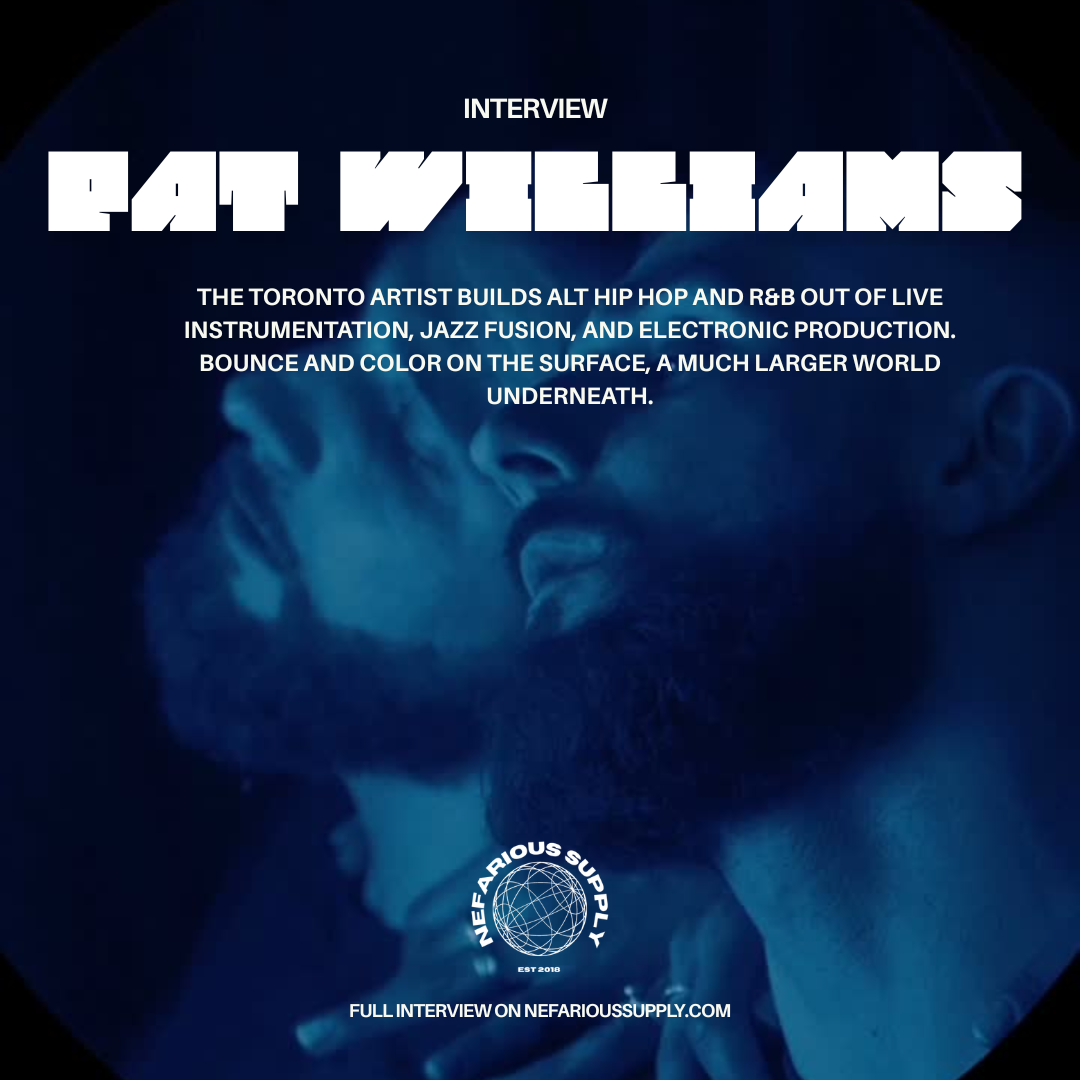
Pat Williams does not make music that sits still. The Toronto artist builds alt hip hop and R&B out of live instrumentation, jazz fusion, and electronic production, chasing what he describes as an all encompassing sonic experience unbound by classification. Since IN CASE I DON'T SEE YOU found an organic audience in 2021, he has been quietly assembling his debut album, THE KIDS WILL BE FINE, while sharpening a writing practice built on duality: ego and sensitivity, devotion and detachment, what we think versus what we actually say out loud.

He writes about love, social norms, anxieties, and the contradictions living inside all of them, usually from the position that there are more than two sides to any story. The songs reflect that. Lush arrangements sit next to chaotic environments, playful wordplay carries heavier messaging, and the production is treated less like a backdrop and more like a second voice in the room. It is a method built on tearing things down and rebuilding them until the feeling is right, which is part of why the album has taken the time it has taken.

It is also why the reach has been quietly wide. Without a traditional infrastructure behind him, he has built listener pockets in cities like Johannesburg, Lagos, Los Angeles, and London, an early sign of what happens when an artist commits to the work instead of the lane.

In this conversation, he walks through his process and how it keeps shifting session to session, the long and unexpected road behind his newest song "Tongue Tied," the perspective he wrote from that he did not fully agree with, what Toronto put in his instincts and what he pushes against, his thinking on live performance versus theatrics, and what the word "fine" actually means to him in 2026. It is a talk about craft, restraint, evolving belief systems, and the difference between making noise and making meaning.

Your bio frames your mission as an “all encompassing sonic experience unbound by classification.” What specific experience are you trying to recreate—like if your music were a two hour film, what are the scenes you want people to pass through?

I’ve always aimed to document the specifics in life, the intimate moments. If the music is the vehicle to do that, it must be unbound and vast in order to portray those human experiences. Take a look at “Everything Everywhere All at Once” for example. The film had so much to say and used everything to articulate that. That being said, the moment people most remember is the husband admitting the “in another life, laundry and taxes” line. Everything surrounding it to me was the chaos and the set up for that line.

When you say “unbound by classification,” what are the classifications you’ve felt pressured by—genre, mood, audience expectations, industry lanes—and how do you actively resist them while still keeping a clear identity?

Not to say I haven’t had my fair share of growing pains during my career, but these days I truly don’t feel pressured by anything outside. It was absolute purity when I first started and sure I’ve had some ebbs and flows, but truthfully I haven’t ever gravitated or committed to anything that feels unnatural or will take me out of my expression. The games aren’t for me and neither are tainting my expression. That’ll only water down what I have to give. I go towards what feels right and I’m mindful of what doesn’t. I’ll cut that cord quickly. That applies to anything in my life.

You blend alt hip hop and R&B through live instrumentation, jazz fusion, and electronic production. What’s the order of operations in your process—do you start with chords, drums, bass movement, a sample or texture, or a lyrical idea—and how has that changed over the past year?

The process has adapted so many times that now, it all depends on what’s being heard and felt in the room. Sometimes the music will prompt the feeling, sometimes the music needs to be catered to the feeling. It’s usually the latter. Admittedly it takes a lot for me to really engage, that’s what happens after penning thousands of verses. I could write another verse, but these days my desire is to challenge and grow with both myself and the listener.

What’s one production choice you make that most listeners might not consciously notice, but that’s doing heavy emotional work in your songs—space, distortion, swing, vocal stacking, room tone, etc.?

The heavy lifting is in the process and how meticulous I create. I know that’s very general, but my choice is often to use math to create the magic. To reinvent, strip down and build back up again. The upcoming album’s a testament to that. It has to equate to feeling and message, however we get to that is truly never linear or anything in particular - that’s what keeps it interesting.

You write about love, social norms, anxieties, and their dualities. What’s a duality you’re obsessed with right now—devotion vs detachment, confidence vs doubt, freedom vs responsibility—and how does it show up in both lyrics and sound design?

I don’t think any one person is typecast or singular in how they move in the world. That’s why I enjoy showing that duality - I can show my ego and sensitivity within the same song, I can be derogatory as much as I can be a good man. One doesn’t negate the other, I think both exist for everybody on varying levels. It’s all intended to be as pure and free as possible, lead by example and create a space or conversation for those that feel the same - whether it’s in the feeling or the message.

You’ve said there are “more than two sides to any story,” expressed through sound design and conversation. What’s a moment where you intentionally wrote from a perspective you didn’t fully agree with, just to tell the truth more completely?

If I’m referencing my catalogue that’s out, it’d be PRIDE off of the IN CASE I DONT SEE YOU ep. I wrote about a situation between me and an old partner that was years ago even at the time. In many relationships, I know it takes accountability and two to tango, so I was aware of how they saw me. Despite not resonating with that thought, I wanted to be open to it and to accept things in a fuller, more open way. So even though it was written in first person, I was absorbing the perspective of another. It taught me a lot and it’s something I’ve carried with me since.

Your music aims to spark a conversation about what we may think but never speak on. What’s one unsaid thought you’ve carried for years that you’re finally finding language for in this era?

- It’d be the idea that no matter how much you express to somebody how you feel, they’ll never truly know everything there is to know. It’s sitting with the idea that your old stories can’t be shown on screen. All the lives you’d lived, all the feelings you’ve felt can be described and articulated perfectly and never fully understood. Because life is so indescribable, I’m sure that’s why we listen to music, to be heard, to be understood.

You mention lush soundscapes and chaotic environments that often contrast the lyrical narrative. When you’re building a track, how do you decide whether the instrumental should support the lyric versus argue with it?

This new album I’m working on was built off of feeling, I wanted the music to speak and hold conversation as much as the words do. Naturally I’m a writer, that’s how I began and I’ll always place such value in what’s been said and how it’s being delivered. That being said, I allow the production to tell me what it’s feeling - what it’s telling me then allows me to know the tone of the conversation I can take with it - very much like a relationship. The moment I feel like the conversation isn’t breaking new ground, that’s when we shape things on the production end, break it down and piece it back together to further the conversation and create a greater outcome and common ground.

On your newest song “Tongue Tied,” what’s the real source of the silence?

It was told through the perspective of a man and a woman entering a new relationship. There’s so much to learn and that feeling is so potent that it can feel risky to let people in fully or fully take that chance. Fear of being fully seen or letting that wall down to not only let them in, but perhaps you’d be forced to let go of your own protection / your own mask. I mean that sincerely, we all protect ourselves. This man in the song wants to provide a space and know the other further. The woman surely wants the same but their “eyes have seen some things” that make them hesitant. All she said in response is to “keep those eyes on me”. That sounded to me like ‘give me time’ or ‘you’ll learn everything in time’. It’s two people approaching each other gently.

Still on “Tongue Tied,” what was the turning point in the studio where you knew this is the take / arrangement / sound—and what did you change right before it clicked?

Tongue Tied began in 2021 in a session I had with JSP. We had the hook, a verse and some very stripped down drums and bass. All thanks to iCloud, the session along with hundreds of others got wiped and therefore, we had to recreate it from scratch. We built it back up from scratch about two years later. At that point, I felt it was missing something - I needed a softer touch. I wanted to take the excitement of a house record - the butterflies and frenetic energy you get at the start - and the delicate and soft nature between two people that are shaping a world for themselves. That all came together when LOR pulled up for a session and knocked her vocals out the park. The song immediately had that integral piece, that touch to it. It provided both my narrative as well as a woman's. She left dozens of vocal takes and I spent the next day arranging while Sajoga added keys and put the bow on top.

Where do you feel the biggest tension: writing a lyric that’s true vs producing something addictive, or keeping the song experimental vs keeping it digestible?

- To put it bluntly, I trust my taste and the feeling that these records give me. This is a universal experience and I know if I feel this strongly while removing my ego, then it has to resonate with other people. The same way we can share an opinion, we can relate on this level too. The desire to make a super hooky record is a bucket list and will be coming up shortly. Where my heart lies is in providing an experience somewhat like a best friend - to be understood and to be there when you need them.

Your last EP IN CASE I DON’T SEE YOU landed during the peak of the pandemic and built an organic listenership. Why do you think it connected then?

- My immediate thought is that people needed something to sink their teeth into. I think ‘IN CASE I DONT SEE YOU’ releasing top of 2021 felt important because it balanced the duality between vibrant energy while remaining thoughtful and touching on some prevalent subjects at the time. The dating scene was cooked, escapism was surely at an all time high and it was a much safer space to go to than most. People jumped at anything there was to be excited about and I think it provided a welcomed energy and somewhat spoke on the disposition of our generation.

Looking back at that EP now, what do you hear that you’ve outgrown, and what do you hear that still feels like the purest Pat Williams blueprint?

- Years after the project, it documented a time in my life that felt like absolute freedom, which was reflected in the music. Life had hit in the most jarring and unexpected ways shortly after, and a lot of unlearning and growth came from that. In many ways I’ve outgrown what was perhaps a more boyish stance on things. What feels purest when listening back was me being creative at my most liberal at that time. To create something that had such energy and was that palpable in a month's time in a tiny AirBnB during lockdown, it’d been the most empowering experience up until that point.

You’re currently completing your debut album; your submission mentions THE KIDS WILL BE FINE. What’s the conceptual center of the album?

THE KIDS WILL BE FINE is my relationship with my inner child, the world and the shedding of old skin. I wanted to create a melting pot of everything that inspired me, to translate these things through music. It was live instrumentation and jazz but with a 2026 spin to it. It was for the braggadocio to be jarring but with some sensibility. To shed false masculinity and step into myself wholeheartedly. I threw all the paint on the wall, broke it apart and built it back up again, time after time. I felt like a kid in a sandbox on a beach, whose castle’s washed away a few times. This was me building back up, being okay with tearing it down myself in order to achieve the purest feeling I can grab as I grow in my current state.

What does the word “fine” mean to you in 2026?

- It’s a great question because “Fine” can have so many connotations depending on the statement. In context, I meant “Fine” in the same way your parents would tell you “everything is okay”. It’s understanding from experience and finding comfort in moments that aren’t so comfortable. ‘The Kids’ are our inner child in this phrase, they’re very much still alive. I can’t speak for everybody, and I’m far more of a cynic than the album title suggests, but the sentiments and musicality in these songs were meant to inspire that feeling for any and everybody.

What’s the emotional arc you’re aiming for across the album tracklist?

I want it to feel inviting. The intro is titled “Lets be friends”, as simply as one kid would tell another on the first day of school. There’s no judgement, which can feel like a rare opportunity sometimes. As any concept album goes, it develops the further along you go. It’s a gradual process as you get deeper, which is intentional. The last track brings things back full circle, it’s very tethered to the sentiment of the album title. Very conversational, some of my favourite verses for sure.

What do you think your generation is most misunderstood about—and most guilty of that nobody wants to admit?

Our generation’s inundated with information and we’re all so preoccupied. It can make it difficult to be present or to push forward in your life. The misunderstanding is that we’re lazy, which when speaking for a generation is unfair. The system created what’s now ‘desirable work’, and those jobs only perpetuate those distractions, comparisons and things to keep you from motivation or focus. You could definitely make the argument that other generations couldn’t handle the circumstances. You could also so we couldn’t handle theirs, which funny enough is the irony about the whole thing.

On the other hand, nobody wants to admit that we are stuck in different capacities. Sure, we mention it to one another but not many are actively making the active changes to fix that for themselves. Not everybody is looking to do that, many are happy and as they should be. If you are looking to make a change, it’d mean giving up an integral part of our livelihoods, which is no easy feat.

Toronto is your base. What parts of Toronto’s musical DNA do you feel in your instincts—and what parts do you push against?

When I think of Toronto’s DNA I think of mentality more than anything else. We haven’t had the infrastructure that other major cities have, particularly in the US. That being said, it was very dog eat dog, crabs in a bucket mentality for a long stretch. Me and most of my contemporaries were doing the bedroom artist approach out of necessity, before it was as accessible as it is now. Long ass winters kept everybody sharp and at a distance. It’s created phenomenal artists because of that, but the more we come together nowadays the better we are for it.

You’ve got listener pockets across cities like Johannesburg, Lagos, LA, and London. What do you think is translating globally in your sound?

As much as I’m rooted in hip hop, I’ve always explored sounds and never cared to fit into a mold or a box. I listen to a lot of different music and have always found myself studying. I’m glad it resonates because the intention for the music has always been in service of the art, the rest is far past secondary to me.

When it comes to visuals and live performance, what does the Pat Williams sonic world look like? If someone came to a show with zero context, what should they understand about you without you saying a word?

That when you press play it’ll be for the experience not the theatrics. I was talking to my girl about this the other day (she’s a phenomenal singer and is obviously on the album). We were talking about shows and I mentioned that sometimes performances can come across as just that - performative. Live shows should encourage reinvention. It’s an opportunity to exercise ideas and concepts more thoroughly. Basketball fans don’t pay to watch you during shoot around - they know you can hit those shots - that’s why they showed up. They want something to go home with, talk about and excite them. I think there’s plenty of ways to do that.

What’s one belief you had about love, or yourself, that your recent writing has complicated—something you can’t simplify anymore?

I always want to go deeper. Writing is something I pride myself on, so to simplify in general honestly has always been a challenge for me. I have faith in an audience picking things apart, that’s the joy with me and art at it’s core. It’s about discovery and taking something with you that you haven’t found yet. That’s the experience I’d like to give time and time again. I’m pivoting between wrapping this album up and starting another, I can feel my perspective change on some things, so it’s not that my belief system has complicated my process, it’s that my belief system is evolving - which is what this album was meant to do.

For a first time listener, what song is the front door to your catalog, and what song is the private room that reveals the deeper thesis?

REASSURANCE is pretty representative of what I like to do and covers a lot of ground. Much of what I enjoy doing most is based on duality. Playful wordplay with deeper messaging, string sections outros with bouncy drums. It contains all the essentials and layers in my approach most of the time.

SoundSubterra Sessions: Burgundy and the Motion Between Worlds

Hosted by Burgundy, this edition of SoundSubterra Sessions moves through songs that sit between motion, texture, and feeling.

There is a certain kind of artist whose sound does not announce itself by force. It moves by temperature, by detail, by the small decisions that make a record feel lived in before it ever tries to be impressive. Burgundy sits in that space. The Montreal-based artist has always felt fluid by design, moving between alternative R&B, soul, atmospheric production, and songwriting that knows how to leave room around the feeling.

That fluidity is also the point. When Burgundy describes the world of the project, the answer is simple: “in between genres, free to expand into any direction.” It is a clean thesis for music that never sounds interested in staying still. The songs can be intimate without shrinking, melodic without becoming obvious, and polished without losing the human pace underneath.

Burgundy’s story also starts in a way that explains the looseness of the work. Before it felt like a project with a team, a release plan, or a clearer long-term vision, it began with guitar sketches shown to friends. The reaction gave Burgundy enough confidence to push past doubt and take the music seriously. Since then, the project has sharpened without losing that first instinct: follow the feeling, then let the world around it expand.

For this edition of SoundSubterra Sessions, Burgundy steps into the curator seat with a playlist that mirrors that same instinct. The selections move through soft left turns, textured grooves, indie-soul pockets, electronic warmth, and songs that feel like they were chosen less for genre alignment than for how they open up a room. It is not a playlist trying to prove range. It is a playlist that understands range as a natural condition of listening.

The session begins with Burgundy’s own “Marathon,” which works as the emotional anchor. The song came from a period where everything was in motion at once: long-distance love, 70-hour work weeks, saving money to travel, and trying to roll out a project while life kept accelerating. A rough beat from Oclair arrived during a restaurant shift. Burgundy heard a melody almost immediately, carried it through the shift, and recorded the idea as a bathroom voice note so it would not disappear.

That detail matters because it gives “Marathon” its shape. It is not just a song about longing. It is a song about longing while still having to move, work, plan, save, and keep going. The lyrics started in Montreal, were refined in Melbourne, and were finalized back home with Mathias Clerc. The finished record carries that geography without turning it into exposition. It sounds like distance, labor, memory, and forward motion folded into one track.

That duality runs through the playlist too. There is movement, but not escape. There is groove, but not distraction. Tracks like emory’s “double dog,” Bricknasty and Oscar Jerome’s “joyrider,” Portraits Of Tracy’s “Child’s Play,” and 1tbsp and Mietze Conte’s “No Nein” each bring their own pulse, but they all share a looseness that lets the session breathe. Nothing feels overexplained. The songs have shape, but they are not boxed in.

That lines up with how Burgundy thinks about the project as a whole. The sound is tied to season, city, and collaboration. Montreal’s mix of cultures and scenes has pushed Burgundy toward different sounds, while the project itself shifts with the weather: mellower and more intimate in winter, more open and upbeat in summer. You can hear that sensibility in the curation. The playlist does not treat influence like a fixed map. It treats it like climate.

The collaborator thread is important without needing to become the whole story. Oclair and Mathias Clerc sit close to the center of Burgundy’s current sound, helping shape the textures, dynamics, and balance between acoustic and electronic elements that make “Marathon” feel tactile. There is also a wider creative circle around the project, including Luca Renaud on the visual side, that points to Burgundy’s larger interest in building a world rather than just releasing songs.

The middle stretch opens the room further. Brighter Days Family’s “Backinthedays,” spill tab’s “Roamer,” Martin Luke Brown’s “hello !,” and Asal’s “i’ll kiss the sun” all carry a kind of soft momentum, the type that feels better when you let it run instead of trying to pin it down. Burgundy’s ear leans toward music that can hold mood and movement at the same time, songs with texture, color, and a clear emotional center even when the production is drifting somewhere more abstract.

There is also a student-of-sound quality in the way Burgundy listens. In conversation, Burgundy points to artists like Bricknasty, Saya Gray, and Nick Hakim as current reference points: not because the goal is to copy them, but because each of them understands how sound, structure, and texture can carry identity. That makes the presence of Bricknasty and Saya Gray in this playlist feel less like name-checking influence and more like showing the listener what kind of decisions Burgundy is studying in real time.

The back half of the playlist keeps that sense of motion intact while shifting the palette. Saya Gray’s “DIPAD33 / W.I.D.F.U - Mixed,” Alex Banin’s “Doc Whiler,” reggie’s “Watch Committee,” LAUSSE THE CAT’s “The Midnight Hour,” Boy Deco and Quantum Keys’ “Strangers,” and Kinji’s “windburn” close the session with a slightly stranger glow. These are songs that feel curious rather than clean, guided by instinct more than formula. That is where Burgundy’s taste becomes clearest.

SoundSubterra Sessions works best when the artist’s ear tells us something the bio cannot. Burgundy’s playlist does that. It reveals an artist drawn to texture, movement, intimacy, and songs that leave some air in the frame. It also makes clear that Burgundy is not trying to arrive at one final sound. The project is still expanding, still listening, still letting the work move where it needs to go.

That is what makes this session feel aligned with Burgundy’s larger story. The music lives between genres because Burgundy’s creative world lives between states: distance and closeness, winter and summer, acoustic and electronic, instinct and intention. The playlist does not flatten those tensions. It lets them sit next to each other.

That might be the clearest way into Burgundy’s world right now: not through one fixed definition, but through a run of songs that keep moving without losing their center.

ihateyouALX Is Building Beyond the Song

ihateyouALX makes music like someone who understands that energy can be more than escape. The records move with bounce, color, and personality, but underneath the surface there is always a larger architecture at work: world-building, visual language, team infrastructure, and a belief that creativity should feel free without becoming careless.

That balance is what makes ALX’s work stick. The sound pulls from hip-hop, alternative, dance, and house, but it never feels like genre-hopping for the sake of range. It feels instinctive. Rhythm, emotion, culture, and momentum all move together, shaped by whatever the moment is asking for. A record can be fun without being empty. A hook can feel light and still carry weight. A visual can look spontaneous while still being treated like the final word.

“keep the party lit.” sits right at the center of that tension. On first listen, the title reads like a celebration. In ALX’s hands, it becomes something more grounded: a reminder to keep going, keep the dream alive, and keep moving even when quitting would be easier. The song is catchy by design, but the message is not disposable. It is built on contrast, turning persistence into something you can actually move to.

That same intent extends beyond the music. Through looschnge., ALX is building more than a name attached to releases. The vision reaches into film, production, creative direction, management, and eventually community infrastructure. The goal is not just to make records that work in the moment, but to build a universe with standards, collaborators, and a larger mission behind it.

In this conversation, ALX breaks down the world behind the name, the meaning beneath “keep the party lit.,” the role of Nick Reed and ColdHands in the record’s creation, the importance of visuals, and why rap remains the core no matter how far the sound expands. It is a look at an artist treating fun seriously, without losing the freedom that makes the work feel alive.

In one sentence, what is the ihateyouALX world and what do you want people to feel the first time they step into it?

The ‘ihateyouALX world’ is like a breath of fresh air, colorful, inspiring & creative with ART all over the walls. When you step into my world I want you to feel free, like all of the rules were meant to be broken and that there is no limit to your creativity.

Your bio says your sound blends hip-hop, alternative, dance, and house—what’s the core of that blend for you (rhythm, energy, emotion, or culture)?

the core of that blend would have to be a mix of all of the above for me; rhythm, energy, emotion and culture because it all depends on how I’m feeling in the moment when I start the process of making music. The rhythm and emotion I’m currently feeling, the energy behind that and my knowledge of the culture I’m choosing to channel so I can hit the proper tones and cadences when working on that specific genre whether it be house, alternative, dance or just raw rap, straight hip-hop, bars over gritty or smooth production with some sweet sounding samples and melodies.

What does the name stylization ihateyouALX represent an era, a character, a feeling, a philosophy?

I feel like my name stylization represents a character but also a philosophy in the sense of, don’t take yourself too serious lol I live by that because yes I believe in my skills as a writer, creative, producer and director and I do take myself serious but at the same time it’s healthy to laugh at yourself and even the traumatic experiences sometimes lol

What do you think people misunderstand about you when they hear the name before they hear the music?

that ima negative person because they see “hate” in my name lol

What does “keep the party lit.” actually mean to you beyond the hook—what’s the real message underneath it?

for me the actual meaning is just to keep going. Don’t stop chasing and working hard at whatever it is you’re trying to accomplish. “Keeping the party lit” is to keep the dream alive which is great because obviously we can associate “party” with party music but then you listen to the song and it’s everything BUT that lol and also I feel like I’m in a place in my life where I could have given up, so many times I’ve thought about it and every time I do there’s always a sign I get not to and to keep going and since that’s the energy I been living with I decided to channel that into this song and title it that.

Where did the record start: a beat, a lyric, a concept, or a moment in your life?

this record started with me and Nick going through a beat pack we regularly get from our producer that we work with whose in Spain.

What was the intention for the song’s energy—escapism, pressure release, confidence, or something darker masked as fun?

I think my intention was for it to be dialectic in a sense. Heavy contrast. I wanted it to be a vibe, catchy & light hearted but with a serious message behind it. If you wanna blank out and just vibe to the production or the catchiness of the hook and not take it so serious, you can. If you want to explore the deeper meaning to it and really pay attention to the lyrics, you can and you’ll for sure get something out of it even if it’s just perspective. I leave it up to the listener honestly.

There’s a difference between “party music” and music that’s fun but lyrically complex—what were you trying to say on this one that people might miss?

for things not to be so on the nose. Things can be a certain way depending on how you look at them. This can be an introspective song but also something you cheers to. The song isn’t a “party” song per say but you definitely can celebrate to it, put your glass up and make a toast to it as we have before while just celebrating our small wins here and there with the message of keeping your dream alive and to keep going after what you want and not giving up.

How did the Nick Reed feature come together, and what did you want Nick to add to the record emotionally or sonically?

funny enough, so this beat was actually supposed to be for Nick (whose featured on the song) but we work with a producer from Spain and he gives us a pack of beats every month and this beat was in the pack for us for the month of January. So I have another full length project already finished and at the time I heard the beat initially I wasn’t trying to work on anymore songs but I was floored at what I heard and I’ve BEEN waiting to get a beat like that and I couldn’t help myself. Lyrics and melodies were leaking through my body and I just had to record what I was hearing in my head and so, I did and then called Nick to let him know I picked up the track but that I still wanted him a part of it. There is a version where I did the entire song by myself but I felt like Nick would be able to add something to the song that I couldn’t and when I heard his verse it’s exactly what the song needed. He recorded it in one take and that’s what you hear on the record today.

ColdHands produced it—what does ColdHands understand about your sound that makes the collaboration work?

I feel like ColdHands is just a relentless Producer. Me and him have actually had a relationship for quite some time now, I want to say about maybe three or four years and we’re just now barely making and releasing music together and at first, it wasn’t like he was a bad Producer. I just was in a space where I was working with my other producers on the other projects I have in the vault and nothing he sent at the time quite fit what I was trying to accomplish, but in the meantime of me not working with him allowed him to sharpen his skills and become this Producer that really can do it all. Even when I wasn’t working with him that’s when I connected him and Nick in a group chat so Nick could have a consistent Producer and they started building up their relationship with each other and actually ColdHands was making music on wax with Nick first before it was even me even though I knew ColdHands first and introduced them to each other but through them working with each other I got to see ColdHands elevate his production to where now we finally get to the point where he made the “keep the party lit.” beat and now we’re here.

When you’re building a track that pulls from dance/house energy, what are your non-negotiables in the drum groove and bounce?

my non-negotiables in the bounce when building a house/dance song is no stiffness in the rhythm or boring/sleepy leads or melodies. The soundscape of it has to instantly be a vibe, no matter what the drums are and the drums should give you a natural, instant bounce. My favorite house records are ones that you can groove to, but also smoke too and even though it’s a four to the floor rhythm, you can still chill and vibe. Some of my favorite house artists that I listen to that are reslly good at accomplishing that for me in my opinion is Daft Punk, Rochelle Jordan, Jack Marlow and Kaytranada.

What’s one technical/detail-level choice on “keep the party lit.” you’re most proud of (a switch, a sound, a mix decision, vocal stack, arrangement moment)?

honestly I have to say the intro lol .. before any rapping starts and all you hear is the sample playing while me and Nick’s brother, Josh are laughing, as I’m trying to figure out what I was trying to do with the hook. He was with me during that whole session of me writing the record; writing the hook, verses, figuring out the pockets, freestyling until I found the words until I finally got to a point where I figured out what I wanted to do with the hook and then started expalinging it to him. I didn’t know yet if I wanted to put the hook at the beginning of the song as soon as the beat drops or save it and start with the verse and that’s what you hear me explaining to Josh and the fact that it felt natural cause I just had the mic recording as I was talking and we were laughing, for me, that sets up the record beautifully and coincides with everything that I’ve been telling you about this entire interview with the song, being catchy, fun, lighthearted, but also having a message with a slightly serious undertone to it and also not taking yourself too serious.

You direct your visuals and you’re credited as a director alongside Gage Garza—how do you approach directing differently than being the artist?

I feel like it’s all the same, trying to visually create something that is aesthetically pleasing for people to watch and something that everyone can enjoy as well as keeping the dignity of my artistry and doing what I think is dope and what I want to put out to the world but having the silver lining of stepping into the audience’s shoes and figuring out what it is my supporters need or would like to see in today’s world while being as unique as possible to attract new fans and build on my current fan base.

What’s your creative process for a video: do you write a treatment first, storyboard, pick references, or build from locations/outfits?

honestly it depends sometimes I can just sit with the song and let it play over and over again until something hits my brain, or I start picking at references, it can be an idea that I’ve been holding onto, Gage can spark something or have an idea he’s been holding onto or yes as in this case, the location is what started it all. I’ve been location scouting this spot for 2 years because it’s literally right in front of my job lol so when we were deciding on what location to shoot at for this video we knew we wanted it to be outside. We also knew that we wanted cars but at first we were going to choose a different location maybe the beach and rent some cars to use for the video but then I remembered about this spot in front of my job and was like well since we wanted it outside and we want some cars and we’re not gonna be able to drive with the cars, they’re gonna be stationary anyways, might as well use this spot and it’s free lol it’s definitely someone’s land but nobody ever comes out to the property until it’s time to maintain it after spring is over so we had to be quick about it but we got it done. The red barn scene is also in the same area just around the corner from where the main shots were.

How do you want your visuals to “complete” the song—what should the video add that the audio can’t?

for me the video is always the final word. We’ve already added the feeling to the song with the cover art, now we need to amplify that feeling when putting it into music video form and to me, it’s very important because my goal with any of our visuals is that once you see the video you never get that image or scene(s) out of your head when you come back to listen to the song and it’s ingrained into your brain so you can actually picture the video as your listening.

You have a full creative team credited (styling/wardrobe, photo, film photo, cinematography/edit/color). How do you choose collaborators—and what makes someone a perfect fit for the ihateyouALX universe?

usually I start with my people first so when it comes to getting my videos shot, colored and edited, Gage & Malik will always be the first I call upon and then from there we collectively decide who to collaborate with if the project calls for it. We also have a photographer, Jenny Duran, who is one of our newest additions to our team and now our designated photographer who does amazing work so she’ll always be on set with us getting our photos as well. I also have a manager now, Milli, who is also someone I trust creatively and anything I do I always want to make sure he is involved as much as possible.—and someone that would be a perfect fit for my universe is just someone who works hard, is respectful, does what they need to do to without being babysat and is open minded. The creativity and ideas will be there especially being around us 24/7 so what I’m most interested in is good habits.

What are the most important rules for using your imagery (credits, tags, do-not-use items)—what are you protecting about the brand?

quality control. I want to make sure that everything that comes out under “looschnge.” or “ihateyouALX” is at the highest standard of quality from the music, to artwork, visuals, interviews, how we carry ourselves, our presentation as artists and as a production company. Everything has to be on 10.

You’re listed as the owner of looschnge and managed by 4MG—how do those pieces fit together? Are you building a label, a creative studio, a collective, or something else?

so looschnge. was started by me and my pops and is now owned and ran by me and my cousin Gage, which we still always try to have my pops involved as much as possible and his schedule allows but that is our production company. 4MG is Milli’s management company which just manages me as an artist but he does help out with looschnge. whether it be helping us get work, clients, opportunities, etc. and so far the relationship has been fruitful and things have been operating like a well oiled machine. I believe Milli brings us a drive and a veteran presence that provides an experience amongst the team that we’ve never had before and it’s nice to have.

What do you want looschnge to represent in the culture over the next 1–2 years—what’s the bigger mission beyond releases?

I want us to represent the next generation of multitalented, minority creatives running the music and film industry. I want us to hold the same weight as an A24.—the bigger mission for me, for my company is ‘looschnge. Foundation’. I eventually want to work towards building a facility in my hometown that gives kids, teens and altogether adolescent creatives a space to play sports, make music and be creative in any way they need and to be supported in it. I want to help build up the next generation of young creatives and give them the access resources they need to succeed in their creative outlets like art, painting, music, tv and fil, etc. if that’s what they genuinely love to do.

SoundSubterra Sessions - Joss Lockwood

Some artists build worlds through their own music. Others reveal even more through the music they choose to keep around them.

For this month's Artist Hosted Playlist, we're excited to hand the aux over to one of our favorite voices in the underground: Joss Lockwood.

We first discovered Joss through her collaboration with fellow underground artist Vaeo on feel like staying. Even among the song's lush production, her voice immediately stood out. It was restrained yet unmistakably powerful—soft in delivery, but carrying an emotional weight that lingered long after the track ended. It wasn't long before we found ourselves diving deeper into her catalog.

Tracks like in my head showcased another side of her artistry, proving she could just as effortlessly glide across experimental alt-pop production without sacrificing the intimacy that makes her music so captivating. Then came her 2023 EP, lose it all. Across just four songs, Joss painted a remarkably clear picture of the artist she wanted to become. Vulnerable without feeling exposed, adventurous without losing focus, and constantly searching for new ways to translate emotion into sound, the EP felt like the beginning of something much larger.

That feeling has only grown stronger.

Her run of singles throughout 2024—from misery to sugar—has seen her continue to sharpen every aspect of her artistry. The songwriting has become more confident, the production more adventurous, and the identity behind it all even more unmistakable. Joss has found a rare balance between elegance and experimentation, creating music that feels bold, chic, and emotionally fearless without ever losing its sincerity. Every release feels like another layer added to an artist who refuses to stand still.

That's exactly why she felt like the perfect choice to curate this month's playlist.

A playlist says a lot about an artist. It's a snapshot of where their mind is creatively, the sounds that inspire them, the songs they can't stop replaying, and the artists helping shape the next chapter of their own work. It's a chance to step outside the finished product and into the influences, curiosities, and obsessions that often exist behind the scenes.

The selections Joss has put together offer exactly that—a glimpse into the music that's been living alongside her own. Some songs feel like natural companions to her catalog, others might come as a surprise, but together they paint a broader picture of the creative space she's occupying right now.

Whether you've been following Joss Lockwood since lose it all, only recently discovered her music, or are hearing her name for the very first time, we hope this playlist serves as both an introduction and an invitation. Press play, discover something new, and spend some time inside the sounds currently inspiring one of the underground's most exciting rising artists.

Welcome to Joss Lockwood's Artist Hosted Playlist. Enjoy and look forward to her upcoming single releasing July 31st!

The Art of Becoming: O'baekey's Next Chapter

Over the past few years, O'baekey has quietly developed into one of the underground's most thoughtful voices. Since releasing Portraits while studying music production in New Orleans, the Brooklyn-based artist has approached every project less like a collection of songs and more like another chapter in an ongoing search for meaning. Drawing from Southern trap, boom bap, blog-era hip-hop, early 2000s R&B and countless other influences, O'baekey has crafted a sound that's as technically versatile as it is emotionally grounded.

His latest album, The Apple Doesn't Fall Far, is his most fully realized work to date—a record that reflects not only his evolution as a rapper, producer, and songwriter, but also his continued pursuit of understanding himself through music. We sat down with O'baekey to talk about artistic growth, moving from New Orleans to Brooklyn, the ideas behind his latest project, and what comes next.

~

You’ve described your music as a way of searching for deeper meaning through sound and language. When did music start feeling like more than just expression for you, and more like exploration?

To me, music and art in general are the most powerful tools humans have for self-discovery and reflection. A good song is like a therapy session for me. When I made my first album in 2021, I had this grandiose delusion that I was the greatest rapper of all time, which I feel like you need to have as a rapper. But that album was more about me proving that I could rap than it was about exploring deeper themes about life. That changed a bit in my second album, and even more so in this new project.

Your journey from New Orleans to Brooklyn feels like a major shift both personally and creatively. How has that move influenced The Apple Doesn’t Fall Far?

I was born and raised in Connecticut, so moving back east has been a homecoming for me in a way. But after spending five to six years in New Orleans, that city started to feel more like home than anywhere else.

So moving was bittersweet. I became a man in that city, learned about myself, and made some of my longest-lasting friendships. I owe so much to New Orleans. The Apple Doesn’t Fall Far is like my last ode to the South. On “Crystal” the hook is literally “I’m in love with the filthy south”, and I interpolate Big K.R.I.T. on the verses. On “Momma” the hook is “Momma, I’m coming home; I’m not the same anymore”.

Despite coming back east, I feel like New Orleans forever changed my trajectory, and I’m eternally grateful.

Your sound pulls from so many worlds—Southern trap, boom bap, blog era rap, early R&B. How do you decide what influences belong in a track without it feeling scattered?

Honestly, I’ve always struggled with deciding what my shit should sound like and what creative direction I should go in. Because I like so many different kinds of music, I go through intense periods of wanting to make completely different things. Sometimes I feel like I don’t really have a definitive sound.

The first album was super east coast hip hop, the second one I feel like had a ton of Kanye influence, and The Apple is like the most southern thing I’ve ever done. I love all that music, so I try to make it. Sometimes it comes together cohesively and sometimes it doesn’t.

The stuff that does gets released and the other stuff sits in my hard drive until I know what to do with it.

Since Portraits in 2021, how do you feel your relationship with production has evolved as you’ve grown as an artist and studied music more deeply?

Portraits was my first project ever working directly with a producer, my friend Wyatt Pinto who I met in college. That process really showed me the beauty of locking in on an idea with someone and building a partnership. I’ll always be grateful to him for taking that on with me. After that, I wanted to diversify a little bit, so with that second album, I had a bunch of other producers on there. That process taught me how incredible it can be working with a community, and getting all kinds of different input and ideas.

But with this last project, I wanted that feeling of partnership again. I reached out to my friend and producer Kobe Holmes and told him I wanted to make one last album while I was in New Orleans, and I wanted him to fully produce it so we could make something sonically and thematically cohesive. We made TADFF together in my bedroom studio in New Orleans. The process was so gratifying, and he’s an incredible musician. The next step for me is to make a self produced tape, which is already in the works.

There’s a strong sense of intention in your work, almost like every project is asking a bigger question. What question were you trying to answer with this new album?

This album is an exploration of some hard truths I’ve had to deal with as I’ve gotten older. Everyone has heard the phrase “The apple doesn’t fall far from the tree.” It basically means that people are prone to end up just like their parents.

My whole life growing up with my parents, and my Dad specifically, my goal was to go as far in the opposite direction that he went as I could. Not because he’s a bad guy at all, but because I saw the mistakes he made and how they affected his happiness, and I tried to learn from that. He chose financial security, but never seemed to find true happiness in his work. I chose to chase a dream, even if it meant being broke.

He dealt with a lot of unhappiness, something I never wanted to be my reality. But throughout making this album, I realized I’m so much more similar to him than I ever knew. We’re both stubborn and hard working. We’re both prone to being unhappy. We have similar vices. And I had to learn to accept that reality and work through it instead of denying it like I’d been doing. You should learn from your parents, including their mistakes.

Your writing often feels reflective and layered. Do you usually start with a concept, or do those deeper themes reveal themselves after the music comes together?

Everything starts with the first line, and goes from there. My songs are often just a manifestation of what I’m feeling at that moment, and then as I keep writing, sometimes they almost turn into like philosophical discourse. Not all the songs obviously, some are just bangers for the sake of being bangers, and those are fun too. But even those are like manifestations of me feeling like I’m the shit at that moment. I’m not great at communicating my feelings outside of music if I’m honest, so these songs become my therapy sessions. 

Brooklyn has such a rich musical history. Has being in that environment changed how you approach your craft or your expectations for yourself?

Being in Brooklyn has lit a fire under my ass. I wake up literally anxious to make shit happen, because of how fast this city moves and how great all the artists here are. I’ve met a lot of great people and am still working on making myself a staple of the amazing community that is this underground music scene.

It’s hard because I work a day job so I can’t always be at all the events, but I just want to build genuine relationships with like-minded people here. It’s amazing being around creatives.

I’ve been to SOB’s a bunch and it’s wild to think so many artists I look up to have performed there. It’s on my list for sure.

You’ve mentioned being inspired by artists like Isaiah Rashad and Mac Miller. What specifically about their approach to music resonates with you the most?

I think with Mac and Zay I fell in love with them at a young age, and so I became heavily influenced by them. I used to watch every Mac interview, the documentaries, and listen to every tape a million times. He was a ridiculous lyricist and put into words a lot of feelings I couldn’t articulate at that age. His positivity as a person, along with his introspection and honesty about his vices, was and still is so inspiring to me.

He was genuine and authentic and beloved by the community, things I really strive for. As for Zay, the way he’s able to match his lyricism to his production just has a stranglehold on me. He creates these moods with his songs that I just fall into.

His ability to capture the feeling of nostalgia perfectly is insane. I also think they’re both just super introspective, and their music makes you think, something I always want with my music.

As someone who treats music almost like research or self-discovery, what’s something you learned about yourself while making this album that surprised you?

As I said before, this album taught me that I’m a lot more like my Dad than I thought I was, for better and worse and everything in between. I also learned that I don’t have as much control over my vices and flaws as I thought I did. I turn 25 next week, and I still have a ton of growing and learning to do. I guess that’s how life goes. You figure out who you are more and more every day.

Now that The Apple Doesn’t Fall Far is out, what does “success” look like for you in this next chapter—creatively, personally, or professionally?

Success to me is just making something that people can relate to, and then getting them to hear it. I’m a cook, and I love making food. I think of music a lot like cooking. You can make a plate and eat it yourself and be like “Fuck yeah, I made that plate and it was delicious and I enjoyed it.” But it will never be as fulfilling as cooking for a group of people and sharing what you made.

Music is the same way. I can make a song and love it and be proud of it myself, but I want to share the feeling it gives me with as many other people as I can. Hopefully by the end of this year I’ve played a lot of shows, put out another project, and reached more people.

I feel like this shit is good and good for you, and I want to share that with as many people as I can.


Huge thank you to O’baekey for the interview opportunity and inviting us into his mind and the process behind his latest work. Make sure you’re following O’baekey on Instagram @obaekey to stay locked in with the next release. And if you’re an artist interested in being featured, follow Nefarious Supply on Instagram (@nefarioussupply) and submit your music here.

Who’s Next: Six Artists Nefarious Supply Is Watching Right Now - June 2026

Who’s Next is our quick monthly check in: six artists we’re actively watching right now, picked from real listening, not internet temperature checks. It is less about declaring who is next up and more about keeping a record of who keeps earning our attention in real time.

It’s also our running shortlist: a place to document the names we keep coming back to before the story gets explained for us. Not a forecast. Not a co sign. Not a trend report. Just six artists who’ve been holding weight in our rotation and feel like they’re building toward something real.

Different sounds, different scenes, same throughline: identity, discipline, and worlds that feel authored instead of assembled. The kind of work that reads like a catalog in progress, not a moment, and gives us enough to keep watching without pretending the whole story has already been written.


Photo courtesy of ihateyouALX.

ihateyouALX

ihateyouALX makes music like somebody who’s already in control of the room. The bounce is immediate, but it’s not careless the records are engineered. Rap instincts, dance posture, house swing, alt textures, all moving under one name stamp that keeps getting cleaner with each release. The biggest tell is intent. A lot of artists can make “fun” records; fewer can make them feel built. ALX’s best songs carry structure: a hook that does real work, a tempo that stays disciplined, and production choices that feel like decisions instead of presets. The music reads like someone who understands that energy isn’t just volume, it’s pacing.

The other signal is how hands on the world is. The looschnge. ecosystem doesn’t read like branding layered on after the fact; it reads like a small world around the music, a place where visuals, streams, project links, and short-form philosophy all sit under the same identity. ALX has said the video is “the final word” the thing that locks the feeling into your memory so you can’t hear the song again without seeing the scene. That kind of thinking is rare at this level, and it shows: the releases feel authored, not posted.

And looschnge. isn’t positioned like a merch tag. It reads like a studio in progress: a broader universe (run with family) where music, film, and design are meant to sit next to each other. ALX’s version of “world building” is literal: a colorful space where creativity is treated like a rule breaking exercise, and the philosophy is simple don’t take yourself too serious, even when the work is.

That philosophy is sitting inside the music too. The last checkpoint before the “KTPL.” EP is the new single, “keep the party lit.” a record built on contrast: a beat that moves like celebration, with lyrics that are basically instruction. The hook isn’t about the party; it’s about momentum. Keep going. Keep the dream alive. The record started the unglamorous way a lot of real songs start: ALX and Nick Reed digging through a beat pack from their Spain based producer, then ALX getting pulled in even when they weren’t planning to record.

Even the details reinforce the point. ALX’s favorite moment is the intro: the open mic, the laughter, the real time figuring it out because it sets the tone: light on the surface, serious underneath, and human all the way through.

What we’re watching for next is the “KTPL.” EP era to land publicly with full clarity release date, visual cadence, and the moment the wider conversation catches up to what the catalog’s already been telegraphing.


Photo courtesy of Burgundy / No Diploma Records.

Burgundy

Burgundy’s best records live in the in between: soft edged, melodic, and constantly shifting without losing the emotional center. The writing stays restrained on purpose. Atmosphere does the heavy lifting, and the details are what keep you coming back. Their own definition is blunt: music “in between genres,” free to expand in any direction and the only thing they don’t want people to assume is that the sound will stay the same.

Part of what’s made the run feel credible is the real world motion around it. Burgundy has been framed by No Diploma Records as a warm summer single artist Jordan Ward / Dijon / Roy Blair adjacency but the catalog holds up beyond a reference list. There’s press side validation too (SOCAN “Five Rising Stars of Quebec R&B & Soul to Watch in 2025”), plus the kind of offline traction that matters: rooms, festivals, and a community that shows up.

The core is Montreal, but the real influence is pace. Burgundy talks about writing with the seasons: winter pulls the songs inward, summer pushes the energy up. And the arc has been steady: early guitar “skeletons” turned into real releases once the feedback hit, then a sequence of “this is real” moments (a first single popping off, a management deal in LA, the first real video) that eventually became something more stable a team with a long term plan.

If you want the thesis in one record, it’s “Marathon.” Written in the middle of a long distance relationship, 70 hour work weeks, and a rollout happening at the same time, the song’s motion comes from a real life sprint. The melody landed mid shift at a Thai restaurant, got saved as a bathroom voice note, then got refined across cities (Montreal → Melbourne → back home) with Oclair and Mathias Clerc. They describe the goal as “textures and dynamics” acoustic warmth married to electronic space and it plays like that: hopeful, slightly frantic, and built for the moment where life starts looking up.

What we’re watching for next is the single to EP runway specifically the softer, more accessible side they’ve hinted at on the next release, and how that opens the door into the Asterisk EP without sanding down what makes Burgundy feel precise.


Photo courtesy of Chris Chand.

Chris Chand

Chris Chand’s “FOREVER’S A PLACE” is the kind of record that tells you a lot without trying to. Classic touch, modern frame an 80s alt R&B sensibility in the DNA, but not as nostalgia, more like craft. The hook lands clean, the emotion is direct, and the whole thing feels like the start of a catalog, not a one off.

On Spotify, it reads like an artist in a quiet streak: “FOREVER’S A PLACE” sits as the current artist pick and latest release, following a run of singles that keep the tone consistent while widening the color palette “INSIDE THE MOMENT” (2026), “SLOW BLOOM” (2026), and “LOWTIDE” (2026), with earlier signals like “TRUMAN SHOW” (2025) and “dancing like no one’s watching” (2025) showing the same patience in the writing.

The foundation is songwriting first. “If forever is a place, I’ll meet you there” is a simple line, but it lands like someone who understands restraint how to say the whole thing without over explaining. And it fits the larger Chand pattern we’ve seen on the platform: an artist who’s never moved like a trend chaser. The throughline has been feeling, then craft letting the sound widen over time without losing the emotional center.

Chris is also not new to Nefarious Supply. We first tapped in back in 2021, when he talked about growing up in a musical household in Pickering, cutting his teeth in Toronto’s independent scene, and learning to produce and record from his bedroom. Since then, we’ve watched the work stretch across different eras and identities including him stepping into our world as a host (NS Radio Episode 008, 2023). That history matters: it’s proof of intent and patience, not a random spike.

That continuity is part of why “FOREVER’S A PLACE” lands. It doesn’t sound like a pivot; it sounds like an artist tightening the same instinct. Even when Chris moves across genres and textures, the decision making is consistent: he follows a feeling first, then builds the song around it no rush to box it in.

What we’re watching for next is consistency and identity: more releases that deepen the palette beyond this single, and a clearer visual + narrative language around the voice and the world the songs are meant to live in.


Photo courtesy of Pat Williams.

Pat Williams

Pat Williams is operating at album scale even when the release is one track at a time. The production is meticulous “math to create the magic” but the bigger tell is intention: everything is built to document specific, intimate moments, and he keeps the frame wide enough to hold the chaos and the line that cuts through it. He referenced Everything Everywhere All at Once as a blueprint: a story that uses “everything” to set up one small sentence that people carry with them. That’s the Pat approach lush environments and detailed construction, in service of a human moment that lands clean.

When he says the work is “unbound by classification,” it’s not branding it’s a boundary. He’s clear that the games aren’t for him, and that anything that waters down expression gets cut off quickly. The process is fluid on purpose: sometimes the music sparks the feeling, sometimes the feeling dictates the music but either way the goal is to challenge both himself and the listener, not just deliver another verse. The heavy lifting happens in the rebuild: strip it down, piece it back together, and keep reshaping until the record equates to the right message.

That obsession with duality is the engine. Pat wants to show ego and sensitivity in the same song; braggadocio can sit beside gentleness without canceling it out. He even writes from angles he doesn’t fully agree with when it tells a fuller truth he pointed to “PRIDE” (from IN CASE I DON’T SEE YOU) as a moment of absorbing someone else’s perspective to widen the story. On “Tongue Tied,” the tension is two people entering something new, both guarded; the song’s turning point came when LOR’s vocals added the missing softness, not just an accessory, but the second side of the narrative. From there, he spent a day arranging dozens of takes while the production team added keys and detail.

The next chapter is the debut album, THE KIDS WILL BE FINE, a relationship with the inner child, the world, and shedding old skin. He describes it as a “melting pot” of influences: live instrumentation and jazz, but with a 2026 spin; jarring confidence with real sensibility; and the deliberate act of breaking things apart and rebuilding until the purest feeling remains. What we’re watching for next is that full arrival: a rollout that treats the record like the world it is inviting (track one is literally “Let’s be friends”), gradually deepening, and closing the loop with something conversational that brings the title’s comfort back into focus.


Photo courtesy of Rosabell.

Rosabell

Rosabell’s music starts from a place that feels almost private before it opens up. The first spark is usually the chords, a progression that hits with enough feeling to pull the rest of the song into focus. From there, the voice does the real translating: melody first, emotion underneath, and harmonies stacked with pop precision without losing the warmth of R&B. That’s the Rosabell twist. You can hear the pop in the R&B and the R&B in the pop; neither side works without the other.

The world around the music matters too. Rosabell describes herself as a Nigerian-Canadian Pop/R&B artist with a love for pop music, a dream of dancing and singing on big stages, and a band beneath pink lights. That image is specific for a reason. The pink, the flowers, the softness, the performance vision, it all ties back to a childlike, whimsical part of her that she once tried to grow out of, then realized was central to why she creates at all. The result is music that doesn’t treat softness like decoration. It treats it like identity.

There’s also real growth in the release arc. Early songs like “Gifted” came from a more DIY, vault-clearing place: an artist wanting the music out and learning by doing. But the shift after joining Remix in 2025 gave the work more community, collaboration, and confidence. “Patience” became the most personal checkpoint because it forced Rosabell to confront insecurity around her identity as an artist and trust her instincts again. “Breeze,” meanwhile, feels like the best entry point into the world: warm guitars, tropical summer energy, and a calm, grounded, drama-free feeling that still carries intention.

What makes Rosabell worth watching is the way the emotional thesis keeps sharpening. Her core listener is someone learning to choose themselves and bloom into who they’re meant to become. The broader era is built around flowers, growth, and self-love, not as slogans, but as a framework for the songs, visuals, and story to eventually work together. What we’re watching for next is that fuller world to lock in: more records that deepen the bloom, stronger visual language around the pink-lights stage vision, and the moment Rosabell starts reading less like a promising voice and more like an artist with a clearer universe forming around her.


Photo courtesy of SincerelyChico.

SincerelyChico

SincerelyChico moves with the instincts of someone who has spent time studying eras, not just sounds. The New Jersey artist and producer frames his origin through timing: born at the edge of the 90s, raised inside the 2000s, and shaped by everything from C.L. Smooth and Pete Rock to Kanye, Jay, Pharrell, Drake, Kendrick, Cole, Travis, the SoundCloud wave, and the smoother pockets of Larry June and Cardo. That range matters because it shows up less like a reference list and more like a working vocabulary. Chico’s music carries an old-school respect for feel, but it is not stuck in revival mode. It is trying to build forward from memory.

The artist-producer balance is part of the signal. Chico says he wanted to be an artist first, but early on, production felt safer. He could let other people take the spotlight as long as the beats still spoke for him. Now the work is about building the same confidence in his voice that he once had to build behind the boards. That tension gives MAIN INGREDIENTS its center: an artist learning how to step further into the frame without losing the producer’s ear for structure, texture, and feel.

The EP itself is framed like two creatives bringing their respective recipes together. Chico and Saint Nxva first connected through Big Jozy in 2021, bonded over samples and hard drums, and eventually found the chemistry that shaped the project. Letting another producer handle the sound was a real risk for Chico because it meant trusting someone else with a world that still had to feel like his. The risk paid off because the EP does not read like a compromise. It reads like a shared pocket, built from confidence, instinct, and a clear sense of what each person brings to the table.

There is a clear regional pulse in the work too. Chico points to Jersey’s creative communities, from Darkside to Jamm Gallery, as part of the environment shaping him. That matters because the music does not feel like it is chasing a detached internet identity. It feels connected to scenes, rooms, and people. “STEALIN’ SWAG” is the immediate checkpoint: a record sparked by Chico’s frustration with copy-paste creativity and his belief that even when nothing is fully new, artists still have to put their own DNA into the work. “2 WEEK NOTICE” shows the other side of that mission, turning work frustration into an anthem about control, release, and knowing when you are ready to walk away.

What makes Chico worth watching is the integrity behind the build. He talks about wanting more care in music, not because every song has to be overly serious, but because anything can matter for 40 days or 40 years if it is made with enough intention. What we’re watching for next is how the world of SincerelyChico keeps expanding after MAIN INGREDIENTS: more singles, more EPs, more visual context, and a clearer bridge between the producer brain and the artist identity.

Thanks for spending time with this month’s Who’s Next. This series is meant to be a living record of what we’re hearing, who we’re returning to, and where our attention is going before the wider conversation catches up.

We’ll keep using this space to document artists with identity, discipline, and motion, not as predictions, but as notes from inside the listening. If one of these names stays with you, follow the thread. Listen closer. That’s where the real discovery starts.

If you are an artist building something with care, send it through. Submit your music here: Make Your Mark.

XTC — Underground Frequencies // Vol. 001

Editor’s Letter

XTC — Underground Frequencies // Vol. 001 is our first attempt at treating a playlist like a finished piece of editorial: a two hour, front to back listen built from underground artists we actually live with, sequenced with the discipline of a DJ set.

How to listen

  • Start at Track 1. No shuffle.

  • Treat it like radio. The handoffs matter.

  • Best in motion. Headphones or a late drive.

Nefarious Supply started in 2018 as a simple response: the charts can be loud, but they’re never the whole story. We built this platform to spotlight the underground records and artists that grabbed our attention before there was a machine behind them because the underground isn’t a waiting room. It’s where the future gets written first. We’ve had our starts and stops with consistency, but the thesis hasn’t changed: while mainstream names dominate the moment, the true gems the next movers and shakers are often underground artists building real worlds in real time, long before the spotlight catches up.

XTC is our way of treating listening like a craft again: less “here’s what’s hot” and more “here’s what’s been living with us.” More than a playlist, this is our way of proving the thesis we’ve been standing on since day one: the future movers and shakers are already here, building in the underground—our job is to put a real spotlight on them early, with taste and context.

This is also a listening piece in the literal sense. Volume I was sequenced the way you’d sequence a set: not “underground for the sake of underground,” but artists we actually live with, stitched together so the handoffs feel natural and the quality never dips.

Volume I is the first entry in what we hope becomes an episodic feature on the platform, released with a focus on quality over quantity. It’s a mix of artists who’ve either been consistently grabbing our attention lately, or have already had a real footprint on the platform.

Some of these names are already part of our history, which is exactly why they matter here: they’re proof that the underground isn’t a phase it’s the first draft of what everybody else will eventually call “next.” We caught Lango early (2019), when the conversation was less about positioning and more about identity, risk, and effort the kind of mindset that refuses to treat art like it’s disposable. We checked in with THREE65 (2020) right as the catalog started turning into a body of work—projects used to get things off the chest, and a clear preference for resolution over noise.

In Volume I, the clearest proof of that thesis is Scotty Apex—an artist we first tapped in with years ago, who’s kept evolving ever since: stronger structure, sharper world-building, and a catalog that’s become harder to ignore with every release. Across our Scotty Apex coverage (2019, 2021, 2023), we’ve watched the arc sharpen in real time: raw emotion turning into structure, structure turning into world-building, and world-building into a body of work that keeps raising the ceiling.

We first tapped in back in 2019, when Scotty was 22, describing themself as an outcast who used music as an escape and wanted the work to be that same escape for other people. The writing was raw, emotion-forward, and intentionally unpolished. By 2021 (STARLIGHT), the world expanded. Scotty framed albums as “cinematic” versions of real life, a new chapter built from real-time experiences, and a two-year stretch of growth—moving through uncertainty while sharpening structure, vulnerability, and storytelling. By 2023 (DATA BEND), the craft got even more deliberate: genre-bending as a philosophy, world-building through contrast (nature + technology), and a more focused creative circle executing bigger ideas with clearer direction.

And now, as Nefarious Supply has grown and time has passed, Scotty is still one of the clearest examples of what we’ve always been betting on: an artist who hasn’t just stayed consistent with releases, but has kept leveling up in development—stronger songwriting and structure, tighter execution, and a universe that feels more lived-in with every project. That’s why Scotty was one of the first artists we chose to anchor Volume I: over years of watching the output stack up, it’s become clear the consistency isn’t a fluke—it’s the mark of real talent, sharpened in public. And with the arrival of Hotel Mirage, that thesis gets louder: not just more music, but better music, built like a world you can step into.


The Listening Experience

I sequenced Volume I the way I’d sequence a DJ set, with the same kind of patience and pacing you get from a radio hour that’s been edited down to the essentials. If Soulection and ClubCarter Radio are reference points, it’s because they treat cohesion like a standard, not a happy accident. The goal is a true front to back listen: roughly two hours, uninterrupted, with the energy moving but the palette staying coherent.

Set moments (the handoffs)

  • Scotty’s “JUST US HERE” sets the rules early. After that, the pacing can quicken without feeling scattered.

  • The handoff from BashfortheWorld to Mathaius Young tightens the posture. Same clean drums, more forward motion.

  • The Scotty run is the center of gravity. “MY TYPE OF CRAZY” into “MIRAGE” makes the set feel focused without turning it into a loop.

  • Burgundy carries the comedown without dropping the temperature. The last stretch lands like an ending, not an exit.


Featured Artist Spotlights


Scotty Apex

Scotty Apex is our headliner because the work doesn’t just arrive—it accumulates. Even when the tempo changes, there’s a throughline: melody-first records that still hit like rap, emotion that stays front-facing, and a sense of setting that makes each release feel like a new room in the same house. The progression has been public, but never messy—more control in the writing, more intention in the structure, and a sharper visual language around the music.

Hotel Mirage is the cleanest expression of that discipline. It plays like an engineered escape hatch: bright enough to move to, detailed enough to live with, and built with the kind of repeatable structure that separates a “run” from a real catalog. On Volume I, Scotty isn’t sprinkled for familiarity—they’re sequenced like chapters. “JUST US HERE” opens the door, “MY TYPE OF CRAZY” and “MIRAGE” raise the ceiling, and by the time you reach “SOMETHING I CAN FEEL” and “ANSWER,” the ending feels authored, not accidental.


Burgundy

Burgundy’s records live in the in-between: soft-edged, melodic, and constantly shifting—music that can hold a room without raising its voice. The catalog moves like seasons, and the best songs feel textured rather than stacked: acoustic warmth braided into electronic space, hooks that land like a thought you didn’t mean to say out loud. Recent releases and singles (including “Proud” and “BLOOD/INK”) underline that focus on mood and detail: songs that feel finished, but never overworked.

What makes Burgundy a fit for Volume I is how intentional the world is. The writing doesn’t chase shock value; it lets atmosphere do the heavy lifting, then uses melody to keep the listener close. In conversation, Burgundy has described the project as something that’s meant to stay fluid—never locked into one sound—and rooted in a real, lived pace of life: long weeks, travel, seasons changing, and songs built from small moments that get saved before they disappear. That’s exactly the kind of craftsmanship XTC is built to reward.

On this volume, Burgundy functions as the emotional temperature change—pulling the playlist toward reflection without breaking the pace. Key moments here: “Proud,” “BLOOD/INK,” “More wine?,” and “Earl grey.”


ihateyouALX

ihateyouALX is a reminder that “party music” doesn’t have to be empty. The sound pulls from rap, dance, and house, but the center is always personality: rhythm as language, bounce as discipline, and hooks that can carry a message without making a speech. The origin story has always read as hands-on: early profiles framed the project as DIY and self-taught, built with curiosity, free tools, and a willingness to learn the technical side (production, recording, engineering) instead of outsourcing the details. That background still shows up in the way the songs move bright on the surface, intentional underneath.

In conversation, ALX frames the world like a room you can step into: colorful, creative, and built to make listeners feel free like the rules were meant to be broken. The mission isn’t to hide the message; it’s to let it travel in the rhythm. “keep the party lit.” is the clearest example on Volume I: a celebration record with real stakes, where the hook reads as energy but the intent reads as persistence—keep going, keep the dream alive. And that contrast is exactly why it earns its placement here: it keeps the set moving while quietly underlining what this series is trying to document—artists building worlds with craft, not just noise.


Rosabell

Rosabell brings a different kind of brightness to Volume I: Nigerian-Canadian pop/R&B built on melody first, then emotional precision the kind of writing that turns a private feeling into something you can actually sing back. The music starts where Rosabell says it always starts: chords. A progression hits, the emotion follows, and the voice does the rest stacked harmonies that nod to pop discipline but still carry R&B weight. There’s a clear “pink lights” stage vision behind the work, but it isn’t just aesthetic; it’s a world designed for people who are still learning how to choose themselves.

“Breeze” is the entry point we wanted here: warm guitars, tropical-summer ease, and a calm, grounded energy that cuts through the set without breaking its momentum. It’s the kind of record that feels drama-free on purpose—built to hold you steady, not pull you under—and it quietly reinforces the broader point of XTC: the underground isn’t only intensity. It’s also softness, craft, and artists building a real home inside the song.

Mathaius Young

Mathaius Young brings a different kind of gravity: clean writing, producer-level detail, and songs that feel designed to sit in sequence instead of fighting for attention. The backstory matters here an artist who came up on the technical side, learning the craft obsessively, then stepping into bigger rooms without losing the hands-on instinct. Recent profiles place Mathaius as an Indianapolis-born producer/artist who’s spent years in Los Angeles, with a career shaped early by Sonny Digital’s mentorship and credits that stretch across hip-hop and R&B. If Volume I is about the future being written in real time, Mathaius is one of the clearest examples of how that future sounds when it’s engineered as carefully as it’s felt. The Mathaius picks we’re running here are pulled from the new album run—records that show the writing and the production moving with the same intent. Key moments here: “WHATS YO STATUS,” “MARGIELA,” “TIL THA MORNING,” “201 Interlude,” and “Hold You Close.”


SincerelyChico

SincerelyChico moves like a builder an artist-producer who treats the record like the unit, not just the verse. Coming out of New Jersey with a cinematic, “feel good” sensibility, the work leans on intentionality: each song is meant to hold a scene, not just fill space. The MAIN INGREDIENTS EP (with Saint Nxva) put that approach on display, and the live resume—showcases and festival sets—suggests this music is meant to translate off the screen.

On Volume I, “TABLE MANNERS” lands as a closing statement: crisp, confident, and built to hit with a little more weight than the runtime suggests. It’s the kind of record that makes the case for why XTC exists in the first place—artists who can write, produce, and perform with intention, without waiting for a bigger machine to tell them it counts.


Closing

Volume I is the standard we want to hold ourselves to: taste, yes, but also editing. Not just good songs, but a two hour listen that holds together, where the handoffs are intentional and the focus stays on the music, not the skip button. If XTC becomes episodic, it will be by design. No filler, no obligation to publish on a schedule, and no compromise on cohesion. The underground deserves that level of care.


SoundSubterra Sessions - Ayush

AYUSH is a producer and musician whose work is guided by one core instinct: curiosity. That curiosity shows up not just in the range of references Bollywood melody, jazz vocabulary, Grateful Dead spontaneity, years of classical training but in the way they treat those influences as tools rather than costumes. AYUSH moves between styles because the point is learning: connecting the dots between disciplines, borrowing a philosophy from one world and a technique from another, then letting it all filter through a personal sense of “what feels real.” The emotional North Star is uplift and challenge at the same time music that invites you in, then nudges you to look closer, notice more, and stay open.

HIs latest track, “constellations,” is both a love song and a mood: stargazing turned into a narrative about what changes when beauty is shared. For AYUSH, songs become real about a week after they’re made the moment a demo survives everyday life, like a replay in the car that still hits, still feels potent, still feels authentic enough to finish. “constellations” sparked quickly in that way, and its title is intentionally timeless: a simple symbol that’s been reflecting shared awe throughout history. The scene is clear and specific—late at night, when you should be asleep, outside in pleasant weather under an open sky two people huddling together for warmth and looking up, letting the world change shape in the quiet.

That atmosphere is reflected in the record’s blue–purple–pink palette: warm, expansive, quietly cinematic. Even the construction mirrors the concept. AYUSH often starts with drums—once a weak point, now a foundation—because if the groove feels solid, everything else can unfold naturally. From there, “constellations” grew from a stock Logic synth that created the bounce, a bass line that locked the motion in place, and melodies freestyled until a thread appeared worth pulling. Along the way, specific inspirations are audible: Steely Dan–leaning horn arrangements (a nod to the color and phrasing of “Deacon Blues”), funk groove DNA from Zapp’s “Dance Floor” (slowed down into AYUSH’s pocket), and the remembered textures of Neon Indian’s “Polish Girl” shaping synth choices and sound design almost subconsciously. Finishing the track came down to two decisive choices: bringing stems through pedals and tape with a friend to breathe life into the production, and shortening the outro to preserve the peace of the moment—long enough to exhale, not so long it drifts away.

That same idea—songs that expand the sky—becomes the thesis of the artist-hosted playlist built around the release: music you can stargaze to, preferably with someone else. “With someone else” isn’t a tagline; it’s the point. AYUSH’s worldview in “constellations” is that beauty dulls when it isn’t witnessed together, and that love (of a person, of the world, of the act of noticing) is what gives color its saturation. The playlist is curated to live in that same spectrum and to share the same kind of depth: tracks that feel spacious, thought-provoking, and emotionally open. Anchor picks like Toro y Moi’s “Girl Like You” (lively piano and arrangement in a familiar shade of blue), M83’s “Outro” (a slow-burn into triumph streaked with purple, made even more striking by near-silence and ambient winds), and Khruangbin’s “Two Fish and an Elephant” (simple, direct, contemplative—an ideal stargazing track with blues and purples that echo the record’s glow) don’t just sit next to AYUSH; they map the emotional coordinates that “constellations” is pointing toward.

In the larger arc of what’s next, “constellations” is the opening scene: the first step into an upcoming EP that moves through different worlds and genres while staying tied together by texture, sound design, and dynamics meant to be felt as much as heard. The goal is that after someone lives in the playlist’s universe and returns to the song, they notice the details more—the way the drums breathe, the way the horns frame the sky, the way the outro chooses restraint, the way the mix carries an arc like a film. It’s music built on connection: between influences, between moments, and—most importantly—between people looking up at the same night.

No Outside Validation: Inside jev.’s New Chapter

If you’ve been following jev. through Nefarious Supply, you’ve watched the story unfold in chapters: the early work that felt like a diary, the transitional weight of The Color Grey, and the way lonrwrld functioned as an introduction—sonically and aesthetically to a bigger world. Now, we’re checking back in at the exact point where momentum starts asking harder questions.

This conversation isn’t a recap it’s an update on mindset, discipline, and what jev. is protecting as everything accelerates. Call it a temperature check before the next release turns the page.

Take us to a recent moment that captures where your life is right now (studio, soundcheck, hotel room, drive, a message you got). What happened, and why did it stick with you?

It was in London when I was on tour, I had a studio session with an amazing accomplished producer and he told me something that really stuck with me, he said “don’t ever stop being hungry”. I did 2 tours in one month and I was exhausted and ready to go home but that message stuck with me and ultimately reignited the fire and passion I have for this music thing.

In our earlier NS interviews you described yourself as “a creative at heart” beyond rap. In 2026, what parts of that definition are clearer, and what parts have changed?

I’ve been learning how to write scripts. I realized my love for art or creativity comes down to storytelling, that's why I love music so much, it's the story and how they put it together. Creating something from scratch is my passion. I want to maximize my creativity on this earth, so whatever sparks my interest, I'm going to dive in head first.

DRC, South Africa, Canada: give one concrete example for each of how the place shows up in your music today (rhythm, melody, language, pacing, textures, or even how you tell stories).

I think with DRC because that's my origin I look at it more for inspiration , “you have to know where you come from to know where you are going” . Whereas South Africa is where I my love for rap and music was birth, a big lesson living in SA taught me is that music is a universal language and that made me pay more attention to melodies, rhythm and everything in between , Canada is my stomping ground , i perfected my craft there and became the artist i am today.

Untitled 01: you once called it a diary from your high school years. What is one song from that project that still feels emotionally true today, and one you have outgrown?

Honestly every song on there are still emotionally relevant to me , those songs are the reason why i keep going, everytime i listen to them i’m transported to my childhood bedroom when i was making them and remember how much love and passion i had for music

What did making music in that era (bedroom recordings, phone vocals, learning from scratch) give you that you are careful not to lose now?

It gave me trust and belief. My rule for every artist, TRUST YOUR TASTE. I was alone making those songs and didn’t have anybody to be like “nah, that's wack” so i would love the songs and upload them. There was no second guessing, just love and execution. Its something i try and continue today by minimizing the time from creation and execution and the amount of ears get to hear it before its out to the public

The Color Grey is built around transitional periods and the grey area between them. Looking back now, what transition were you personally in when the concept clicked, and what do you think you were really documenting?

The concept clicked literally 2 weeks before the tape dropped. All the writing I was doing was subconscious and it was really just how I felt at the time dealing with work, school, family life, and just being a young man in your early 20’s. I was making songs in hopes it would be a project eventually. At first I was gonna call it “little boy blues” or “untitled 2” but as the concept began to come to me about the transitional periods and the grey area between them, it clicked!

“Where’s The Confetti” captured the feeling of gaining momentum without feeling celebrated. Since that record, what has changed in your relationship to support, community, and who you let close?

I now understand I have to be my biggest cheerleader, even if nobody is , I constantly have to be the one waving my flag. However my community has grown and my support system is thriving. I have a small circle that shows me love and really appreciates what I'm trying to do . I’ve learned its the quality of people and not the quantity

lonrwrld was framed as “an introduction to my world, sonically and aesthetically,” and you said you doubled down on brand and image with new eyes on you. What does brand mean to you in real terms today (visuals, videos, wardrobe, language, pacing), and what is non-negotiable?

I have a simple answer , whether it's wardrobe, visuals, or language. Trust your Taste and vision, nobody knows what's right for you more than you

Opening for Clipse: describe one night on that run that changed how you think about performance, presence, or what a “real room” feels like. What did you learn watching from side stage?

It was the Paris night, I was watching them on stage and was in awe because of how seasoned and comfortable they were on stage and their level of stage presence. It made me step up my game even more, it also taught me so much about songwriting, especially hooks, they have such well written songs with hooks that the crowd can sing back!

Your own headline tour: what did carrying your own show teach you about your audience, and what was the hardest part (logistics, stamina, nerves, vocals, crowd energy)?

The hardest part was the logistics, i didn’t have a tour manager, so i was doing it myself and then going on stage, it was taxing for sure. The best part was that the fans showed up every night and showed me so much love, it taught me that I actually have people that live with my music day in, day out and they are rooting for me . I need to go harder for them

The Justin Bieber co-sign: what changed in the next 48 hours (messages, opportunities, pressure), and what did not change at all?

Just a lot of love from the fans and people that have been rooting for me

You’ve talked about mental challenges (is it good enough, will I make it) and not seeking outside validation. What does your mental maintenance look like now (routines, boundaries, who you keep close), especially when things move fast?

I’ve developed a routine that keeps me in check . You really have to parent yourself (innerchild), and that's what I do.

Centering the new music coming in Q2: what is the emotional through-line of this next run, what are you experimenting with (lyrically and sonically), and what do you want it to change about the jev. conversation?

It's not about the jev. conversation , it's about getting jev. in the conversation.


Huge thank you to jev. for tapping back in with us and giving Nefarious Supply another honest temperature check as everything keeps accelerating. Make sure you’re following jev. on Instagram @thelonerjev to stay locked in with the next run. And if you’re an artist interested in being featured, follow Nefarious Supply on Instagram (@nefarioussupply) and submit your music here.

SoundSubterra Sessions Episode 2 - Jyou

There’s a quiet conviction in the way Jyou talks about music like every track is more than just production and melody, it’s a timestamp. When he put together his SoundSubterra Sessions playlist, he wasn’t just curating vibes; he was archiving a chapter in his own life.

At 24, on the edge of turning 25, he found himself in that subtle but seismic shift where priorities start to realign. “I think that realization clicked about what’s really important and what makes a life have value,” he says. “That’s falling in love with something or someone, and having that complete passion for it or them.”

The playlist is steeped in that energy songs where the lyrics and sonics are equally soaked in feeling. Each track isn’t just about what it says, but how it moves.

Jyou’s musical DNA pulls from unlikely but deeply connected places: the soul and call-and-response energy of church, the syncopated pocket of funk, and the freeform textures of alternative hip-hop. “Am I Wrong” by Anderson .Paak, “I Think” by Tyler, The Creator, and “Treat Her Like A Lady” by The Temptations are three of the playlist’s anchors.

These songs all share a groove-first magnetism rhythms that make your shoulders shift before you’ve even caught the first lyric. But it’s the passion behind the words that made them stick for Jyou. “They felt like an ode to a lover,” he says. “The groove pulled me in, the lyrics kept me there.”

Nashville’s alt-rap scene is in an accelerated growth phase, and Jyou’s been both student and architect in that process. This playlist mirrors his position in that community collaborator, listener, and amplifier. “I had to add some of the talent around the scene that’s super inspiring,” he says. “I draw inspiration from anywhere, and I’m lucky to be part of such a huge, talented community here.”

That cross-pollination between peers, genres, and scenes keeps his work in constant motion, and his playlist feels like a snapshot of those creative conversations happening in real time. While curating, one track in particular reminded Jyou exactly why he makes music. Asiatica’s When We Were EP from 2023 hit with quiet precision. “Every song really made me feel seen sonically,” he says. “It’s so indie and simplistic her soft vocals over light guitar strums and smooth drums. Speaking on niche topics that might seem irrelevant when you think about your full 24, but that doesn’t mean that feeling wasn’t strong when you felt it. It’s a reminder that great music often lives in the details a fleeting emotion, a moment that could be overlooked but instead gets immortalized.

Fallin one of his own standout moments treads the fine line between vulnerability and composure. “I’m a huge fan of songs with juxtaposition,” he says. “Tracks that talk about heavy topics but are upbeat. Like ‘Hey Ya’ by Outkast. I think there’s beauty in pain, and I always like to present it like that in my music.” That ethos runs through the playlist. Even when the subject matter turns heavy, there’s movement, rhythm, and life in the arrangements. The tension between the two is what keeps it human.

Asked what title he’d give the playlist if it wasn’t simply under his own name, Jyou pauses. “Maybe something about feeling?” he offers. “The commonality in all these songs is that they make you feel something—whether it’s love, or you feel the need to dance, or cry. It’s all feelings the music brings out of you.” If you walk in blind, no liner notes, no artist bio, Jyou hopes the arc of the playlist still lands. “Like you’ve just gone through an actual relationship,” he says. “The emotions, the highs and lows, the sensation of wanting to interact with the person these songs are drawing you towards. In this upcoming EP, I’m taking people along that emotional rollercoaster.”

Episode 2 of SoundSubterra Sessions isn’t just a playlist it’s a guided tour through the inner corridors of Jyou’s recent years. It’s church pews and basement shows, funk grooves and whispered confessions, Nashville cyphers and indie heartbreak. And like the best rollercoasters, when it’s over, you just might want to line up and go again.

The Vault: July 25, 2025 – What We’ve Been Spinning

Every month, Vault Radio serves as a pulse check — what’s moving, what’s evolving, and what’s rising from the underground. But this isn’t just a playlist. It’s a barometer for mood, for moment, and for momentum. This July edition dives deep into the artists and songs pushing boundaries across alternative hip-hop, experimental R&B, and genreless soundscapes that can’t be boxed in — not by geography, algorithm, or expectation.

These aren’t tracks made to blend in. They’re statements — built on distortion and defiance, intimacy and invention. From sweaty club floors to introspective, late-night unravelings, the music here captures the duality of summer: bright and restless, humid and haunted. It moves between heat and haze, between impulse and intention, reflecting the emotional sprawl of a season where everything feels just a little more vivid.

Whether you’re tuning in for discovery or resonance, this lineup is the sound of what’s next — sharp-edged, soul-stung, and Southern-rooted. Every track holds weight, and every inclusion is intentional. This is the underground, amplified. Welcome to the vault.

JYOU – “HIIT”

Jyou sets the tone for this month’s Vault Radio with “HIIT” — a bold, speaker-knocking track that captures the chaos, humor, and heat of Southern nightlife. Released via East Music Row Records, “HIIT” marks a pivotal moment for the North Nashville native: a new chapter rooted in movement, culture, and creative freedom. It’s not just a single — it’s a signal that something larger is in motion.

Backed by booming 808s and produced by Austin Luther, “HIIT” blends trunk-rattling sonics with Jyou’s signature sharp-witted, hyper-visual lyricism. You can hear the mischief in his voice, the sweat on the floor, the way the night unravels into something blurry but unforgettable. It’s a record that bumps in the car and breathes on the dancefloor — but it also speaks to the nuanced identity of a Southern creative refusing to be boxed in.

Raised by ministers and trained through storytelling, theater, and the grind of Nashville’s underground scene, Jyou moves with intention. His past work — from the hard-hitting “Nest” to his time in the award-winning duo KON — built the foundation. But with “HIIT,” he turns the volume up and the corners sharper. This isn’t a return. It’s a reintroduction.

“I’m Southern, I’m alternative, I’m hip-hop, I’m theater. I’m visual. I’m visceral,” Jyou says. And “HIIT” reflects all of it — a sweaty, Southern, genre-jumping statement of self. It lives somewhere between street anthem and stage show, merging humor with emotional undercurrent. It's the kind of song that makes you dance before you even realize it's teaching you something.

As the first taste of what’s next, “HIIT” doesn’t just open doors — it kicks them in. And Jyou walks through them like he’s been here before. Because he has. Only now, he’s just getting started.


VAN ROBSON – “Make Up”

Van Robson’s “Make Up” doesn’t ask for your attention it earns it quietly, then holds it with intention. The track’s bounce and sheen could fool you into thinking it’s just another love song, but the real story is tucked between the beats: this is a song about recovery, confrontation, and emotional clarity disguised in replayable charm.

Born out of a low point Robson chooses not to detail, “Make Up” was sparked by the presence of someone who pulled him back — his partner, the anchor who inspired the record. Through over-exaggerated lines and heightened energy, Van transforms a personal inflection point into something defiant and digestible, refusing to wallow. Instead, he offers listeners a release rooted in truth.

“This song was released in honesty,” Van explains. “It was personal tension, long-overdue words, and energy I had been giving away without return — all coming out at once.” That vulnerability is central to his art, but it’s never presented raw or unfiltered. Instead, “Make Up” is wrapped in rhythm, polished to catch the ear before it stings the heart. “You’ll be moving through the chorus until you realize what I’m actually saying,” he adds.

This balance between sonic accessibility and emotional weight — is intentional. For Robson and his team, the creative process isn’t just about making something catchy; it’s about shaping something layered. And for those just discovering him through “Make Up,” that depth is the point. He’s not here to control the narrative only to speak truth, and let the frequency do the rest.

“My goal is perspective,” he says. “I just hope people hear the honesty and appreciate the writing.”

Guided by a philosophy that blends curiosity with care, Van draws inspiration from artists like Pharrell, who once said, “We’re just checking out ideas with our library card.” That mindset that music belongs to anyone willing to tap in permeates his work. Every word, every visual, every detail matters.

This past year, Robson also began reshaping his relationship with anxiety. What once felt like a block became a spark. “I’ve always known I was a procrastinator,” he says. “But now I’ve turned that anxious energy into a kind of superpower — writing some of my best music with it. Not that I recommend it.”

“Make Up” isn’t just a bop. It’s a recalibration. A reminder that vulnerability can be stylized, sharp, and still deeply felt. And that sometimes, the catchiest songs are the ones carrying the heaviest truths.


BAILEY STRAUGHN – “Rooftop Party”

If “Rooftop Party” sounds like it was made on a sugar high, it’s because it basically was. Picture this: late-night sessions, fried wings by the hundred, basslines slapping off studio walls, and punchlines so outrageous they made the producers pause the beat to laugh. It’s not just a record—it’s a time capsule from a friend group dead-set on reminding you that rap used to be fun.

Pulled from the trio’s FREE:BASS project, “Rooftop Party” is both homage and reinvention. The beat traces its DNA to Miami Bass and ghetto-tech roots, but Bailey, Jay, and Cadeem flip it with 2025 swagger. The BPM might scream techno, but the vocals are all rap-camp chaos. Bailey’s hook—“me and the boys some sluts for a rooftop party”—isn’t just a bar, it’s a thesis. “He was speaking from the heart,” Jay quips. And the song runs with that sincerity, waffling with joy and head-nods without ever once apologizing for the ridiculousness.

Lyrically, there’s a second layer. Buried in the bright bounce are sharp references, deep cuts, and regional nods for the heads who dig past the first play. Bailey and crew weren’t just rapping—they were researching. Uncle Al, DJ Magic Mike, 2 Live Crew, Brazilian funk samples… “Rooftop Party” is a sonic Easter egg hunt dressed up in a party fit.

Still, this isn’t a dissertation. It’s a reminder that the MC/DJ connection still matters, that a rap record can make you laugh and move, that you don’t have to trade depth for dopamine. “The fun needs to be restored,” Bailey says—and this record is doing that on purpose.

So whether it’s a night out in Arizona, a rooftop set in Brooklyn, or a sticky summer night in your headphones, “Rooftop Party” is for that moment right before things go left. When the pre-roll hits, the beat drops, and the only thing that matters is who showed up—and who brought the wings.


DEDISART – “Static!”

“Static!” isn’t loud. It doesn’t demand attention with theatrics or fireworks. But it moves different—like a memory you thought you outgrew or a lesson that hits harder the older you get. For DedisArt, this track isn’t just a song; it’s a note to a younger version of himself. One written in real time, from a place of reflection, quiet resilience, and emotional clarity. “Be a man when the rain come...” isn’t just the first line—it’s the ignition point.

Over a delicate, emotionally charged beat from Ovrkast., Dedis lets the music speak through him. His writing feels guided by memory, not ego. “Static!” is both an unraveling and a reconstruction—a map through the inner storm of growing up, discovering who you are, and finding the nerve to own it. It’s not nostalgia for nostalgia’s sake; it’s a re-alignment. A full-circle moment where you face the version of yourself that was still figuring it all out and finally give them the grace they deserved.

Lines like “How he a leader but closed off, ducking the call like a stray shot” hit like a quiet reckoning. It's the kind of bar that may slip past you the first time, but on repeat listens, it becomes a mantra. The song doesn’t build to some dramatic crescendo—it stays suspended in that emotional in-between, just like the phase of life it represents. Fear, courage, silence, and breakthrough all braided together.

“Static!” lives in that liminal space—between breakthrough and breakdown, between the storm and the sunrise. It’s a reminder that rain never lasts forever, that identity is not a finish line but a process. For DedisArt, this track is both therapy and affirmation. And for the listener, it might be a quiet push to answer that same call.


OMOTIZAY – “DROP THA TOP”

With “Drop Tha Top,” Omotizay pulls off something rare: capturing the euphoria of summer without losing the nuance of self-awareness. It’s breezy, bright, and built for motion—but under the surface, it’s also a meditation on memory, fantasy, and freedom. The track opens with the spirit of a classic—think DJ Jazzy Jeff & The Fresh Prince’s “Summertime”—but reinterpreted through Omotizay’s lens: queer, liberated, lyrically agile, and unapologetically self-produced.

Inspired by a simple moment—riding with the windows down while his mom queued up nostalgic jams—“Drop Tha Top” is both tribute and transformation. It’s not just about cruising; it’s about carving space. About joy as resistance. About the kind of fantasy that makes you feel free right now, even if it’s just for the length of a hook. “This a fantasy...” might be the line most people miss on first listen, but for Omotizay, it’s the heartbeat. A quiet acknowledgment that this entire world he’s painting is a choice. A necessary one.

As the intro to his album Power Over Life, this track sets the tone—funky, fierce, and emotionally sharp. It’s a signal that the escapism here isn’t hollow—it’s earned. Omotizay isn’t just flexing new sonic muscles (though the beat is crazy); he’s showing a level of artistic clarity that comes from unlearning doubt, rejecting self-hate, and learning to create from comfort rather than critique.

In a scene often preoccupied with hardness or heartache, “Drop Tha Top” makes space for soft power—vulnerability masked as vibe, storytelling wrapped in summer sheen. Omotizay calls it a Costco sample of what’s to come, but this appetizer slaps harder than most full meals. Play it loud, drive with the windows down, and don’t forget to catch the real underneath the glitter.


DMNDSTR – “ALLDUETOGOD” & “DRIFT AWAY”

Sometimes clarity doesn’t come in the moment — it reveals itself in the playback. For Dmndstr, two songs from vastly different seasons of life collide in this month’s spotlight: “Drift Away,” a raw dispatch from the haze of teenage angst, and “Allduetogod,” a more recent offering of hard-won gratitude and spiritual reckoning. Together, they trace the arc of an artist learning to hold space for both darkness and deliverance.

“Drift Away” was recorded at 18, with strep throat and a head full of static. It sounds like it too — distorted, dissonant, and emotionally frayed at the edges. It’s not polished, but it’s piercing. The kind of record you make when you’re less concerned with being understood and more focused on surviving your own thoughts. It’s a timestamp, yes, but also a portrait: of isolation, illness, and a teenage mind unraveling then rethreading through melody.

Fast forward, and “Allduetogod” finds Dmndstre on a different frequency. Created after college, it carries a brighter sonic palette and a shift in posture — not triumphant, but honest. The lyrics still slide into unexpected wordplay (“rock, paper, scissors” lands with endearing charm), but underneath the wit is something more grounded: faith, reflection, a little bit of flex. It’s joy that doesn’t feel performative. It’s earned.

Both records preview the emotional terrain of his upcoming mixtape All My Niggas Work Harder Than Me — a project rooted in grief, diagnosis, and the quiet process of rebuilding self-trust after mental health collapse. Where “Drift Away” feels like exhale through pain, “Allduetogod” is the first real breath after the storm. As Dmndstre puts it, one track was for venting, the other for gratitude — and the full project is for clarity.

In an era of over-curated personas, Dmndstre’s work feels unfiltered without losing intention. He’s not hiding the mess. He’s learning to frame it. And in doing so, these two songs don’t just show growth — they remind us that healing rarely moves in a straight line.


Low.bō – “blur”

There’s a quiet ache woven into the fabric of Low.bō’s “blur” — not the kind that erupts, but the kind that lingers in silence, in side glances, in the texts you never send. Produced by Scotty White and Elijah Bieuzieron, it’s a rare track on the project that Low.bō didn’t produce himself — and the shift in sonic chemistry is palpable. The textures are soft-edged and swelling, echoing a disoriented longing that flickers just beneath the surface.

“‘blur’ lives in that messy middle,” Low.bō says. And you hear it — the tenderness, the restraint, the unsent confessions embedded in lines like: “Wish I could come see you more / Can’t help the feelings that change now / Like summer going into fall.” It’s Alt-R&B at its most vulnerable — not toxic, not tragic, just… unfinished.

Where lead single “FALLOUT” tore through heartbreak with soaring tension and searing guitar, “blur” slows the frame. It’s a meditation on timing and distance, both emotional and physical, that feels as cinematic as it is personal. Low.bō’s gift lies in that duality — his ability to soundtrack the subtleties most people skip past.

Raised in Baltimore’s church choirs and forged in solitude during a period of deep isolation, Low.bō built his world from the ground up — first through photography, then through production, songwriting, and performance. Now, fresh off praise from Billboard and OVO Sound Radio and a spotlight on Spotify’s Vanguard playlist, he’s doubling down on the honesty that made his prior projects CIRCA and IMPALA resonate.

“blur” doesn’t demand attention. It drifts into your chest slowly — until you realize it’s been sitting there the whole time


Zugz – “Intro to You”

With a distorted grin and a sharp tongue, Zugz kicks off his latest era by giving voice to someone — or something — else entirely. “Intro to You,” the opening salvo from his upcoming project, isn’t just an introduction to a sound. It’s the entrance of a character: Pilotboy, a bold, defiant persona built to explore everything Zugz couldn’t say outright — until now.

“I was kinda angry,” Zugz admits, reflecting on where his head was at after dropping his first EP, 04’. “It got some streams but didn’t really feel legit… I didn’t feel like I proved to myself how good I could be.” That fire — the need to make something undeniable — became the engine behind this record. And Pilotboy was the vessel.

Inspired by concept albums and the exaggerated honesty of alter egos, Zugz created Pilotboy as an emotional amplifier — a persona that could “run rampant with feeling” without filter or restraint. The result is a track that feels theatrical but grounded, aggressive but intentional. It's all delivered with a sneer that’s both cartoonish and deadly serious.

At surface level, “Intro to You” smacks with raw energy. But Zugz challenges listeners to hit replay — to catch the setup, the hidden commentary, the myth-making buried in the margins. It’s a scene-setter for a tightly constructed album arc, a self-contained journey where every beat has a purpose, and Pilotboy only sticks around long enough to serve his emotional function.

“I want the listener to feel free,” Zugz says. And in that freedom is the point — permission to be larger than life, to be loud, layered, and unapologetically yourself.

Pilotboy might be a one-time thing, but the confidence behind him? That’s here to stay.


This month’s Vault isn’t just a snapshot it’s a statement. Every track speaks to the edges of what’s possible when sound, story, and self collide. Whether it shook your speakers or sat with your spirit, we want to know what lingered.

Rouri404: Nothing Forced, Nothing Fake

Rouri404’s music lives in tension between clarity and distortion, control and collapse. Since 2021, he’s carved out a sound that doesn’t sit neatly in one genre, but instead moves between hyperpop, alt-rock, and electronic textures with instinct over intention. There’s no obvious blueprint. What ties it all together is how personal it feels sometimes painfully so.

In this interview with Nefarious Supply, Rouri reflects on how his process has shifted from scribbled notes to real-time writing. He opens up about the mental and emotional undercurrents that shaped narcissist, a turning point both musically and personally. We talk about how confidence, once out of reach, became something he had to learn through sound. And how recording vocals — once a source of insecurity is now an act of precision and purpose.

There’s no pitch for perfection here. Rouri doesn’t sell his music as a movement or brand. What he offers instead is honesty sometimes jagged, sometimes gentle but always earned. This isn’t about reinvention or hype. It’s about the slow work of making peace with your own voice. And using it, finally, to say what needed to be said.

You’ve been a defining voice in the scene for a while now. How do you think your sound has evolved since you first started?

=

  Since 2021 I’ve always tried to have a diverse sound that you can’t really pin to just one genre. Growing up I had a deep love for all kinds of rock, edm and really just all different genres of music, so as I’ve grown more the last couple of years I’ve tried my hand at mixing them all together into one more cohesive sound.


Your lyricism cuts deep, do you write with a specific story in mind, or do the emotions guide the process?

My process for writing lyrics has changed a good amount since first starting, I used to jot down any & every idea that would come to mind in my notes app wether it was something I felt emotionally hit hard or just a cool phrase. Everything post “narcissist” I for some reason got into the habit of just “freestyling” or tapping in line by line to write, I’ve found it helps a lot with just staying in the moment of exactly what I’m feeling and I’m able to get across thoughts & emotions a lot clearer.

Your vocals are incredibly raw and powerful. How do you approach recording to capture that intensity?

Growing up I was very nervous about my voice, never thinking I sounded good or really having the confidence to push myself. Once again something about the creation process of “narcissist” unlocked doors for me I didn’t know possible, at the time creating something I saw as far beyond my capabilities. Nowadays I mostly just try to let go of all outside noise when I record, I want it to be precise and accurate whether that’s in my actual vocal delivery or the words I’m thinking to say next.

Production-wise, your sound is both immersive and hard-hitting. What draws you to certain sounds or textures when crafting a track?

Ive always been attracted to avant-garde/experimental sounds & I feel that has bled thru in every aspect of our production. Growing up and having my playlist go from something like daft punk or skrillex straight into sigur rós or BMTH I just don’t put many limits on what our sound can be or where it can go.

Do you feel like your music is a reflection of who you are in the moment, or do you use it to explore parts of yourself you wouldn’t otherwise express?

I would say it’s a reflection of previous experiences, kind of a cathartic/therapeutic deal. I’ve been able to sort thru a lot of personal traumas with music that I don’t think would have been faced otherwise, and being able to have other people also use my words as a vehicle for healing is a really beautiful feeling.

The hyperpop scene has shifted a lot over the years. Where do you see yourself within it right now?

Honestly I see myself in the middle. I don’t like to associate with many people & we’ve really been keeping our heads down just working this last 2 years, so I don’t think anyone knows what we have in store still.

Has there been a moment in your career where you truly felt the impact of your music on your listeners?

There’s been so many it’s hard to really pinpoint one exact moment , but I would say the countless number of DMs I’ve gotten over every platform the last 5 years of people telling me how my words have helped them understand themselves better, or helped them work thru personal traumas of their own.

What’s a song of yours that means the most to you personally, and why?

Every song has some amount of special meaning for sure but there are a couple that have extra. “Hope” has always been a hard listen for me because I know in my heart how open I am being in that song, and it kinda hurts. Reaching a point of being able to express those kind of feelings so fluently, going back on it and relistening is almost painful. But genuinely every song has a very special place & meaning.

Who are some artists or producers—past or present—who inspire you the most?

Daft punk, BMTH, bones and so many more all helped develop my sound and style, I used to try to break down my inspirations but there is genuinely so many trying to boil it down to a couple feels impossible.

What’s next for Rouri404? Are there any upcoming projects or collaborations you’re excited about?

Right now I’m focused on getting singles out consistently & building up my community as much as possible. Hopefully a handful of shows across the US soon. Never been so excited to drop music though ^_^


Calling All Underground Artists: Elevate Your Music with Nefarious Supply's Next Wave Rollout

In the ever-evolving and fiercely competitive landscape of underground music, making a mark can often feel overwhelming. At Nefarious Supply, we are resolutely committed to elevating those hidden gems and visionary artists ready to revolutionize the scene and leave a lasting impression. With our "Next Wave by Nefarious" rollout campaign, we're not just offering an opportunity, but opening our entire platform to independent artists set to release new music in July or August 2025. We're dedicated to providing genuine support and undivided attention, fostering a nurturing environment where creativity can thrive. From spotlight features and playlist placements to expertly tailored rollout guidance, this initiative is your unparalleled chance to leverage a community wholeheartedly committed to the music, the message, and the moment.

At Nefarious Supply, we're unwaveringly dedicated to highlighting the raw, unfiltered talent simmering below the mainstream surface. Our mission is as straightforward as it is profound: to amplify the voices of underground artists and provide them with the platform they unquestionably deserve, delivering the recognition they seek.

We hold an unwavering belief in the transformative power of authentic, groundbreaking music. Our mission is intricately tied to supporting artists who not only push boundaries but also challenge conventions and redefine genres.

We are not just another playlist or blog lost in the digital ether. We are a community of passionate and dedicated music lovers fully committed to elevating underground talent. Our team listens to every submission, meticulously seeking out unique sounds that genuinely warrant being heard and celebrated.

By providing a comprehensive platform for these artists, we aim to bridge the gap between obscurity and recognition. Our purpose is to help you cut through the noise, reaching the audience patiently waiting for your distinctive sound, empowering you to make your mark in the music world.

If you're releasing music this summer — a single, a tape, a full project — this is your window.

The calendar is open. Slots are limited. Once it's full, we lock in and execute.

Click here to submit your music now, and you’ll hear from us soon.
Let’s make this drop count.

The Art of Becoming: trustt on Music, Identity, and Movement

In an era where electronic music is as limitless as the emotions it seeks to evoke, trustt has carved out a uniquely vibrant space in the underground scene. Drawing from an early, almost obsessive exploration of genres as diverse as dubstep, emo, rap, and jazz, his sound is a seamless fusion of raw energy and contemplative mood. Inspired by those formative years of endless discovery on platforms like YouTube, he infuses his tracks with the same passion and wonder that once captivated his youthful ears.

Balancing innovative production with heartfelt, spontaneous lyricism, trustt approaches his craft as a journey of self-discovery. Rather than premeditating his words, he lets the music guide him, allowing his lyrics to emerge organically and reveal hidden truths about his inner world. This intuitive process has defined his distinctive style and connected him with a community of fellow dreamers and innovators.

As he continues to push the boundaries of genre and experiment with new sounds and techniques, trustt remains grounded by the belief that his music is more than just a series of tracks—it's an invitation to experience a moment, a mood, and a lifetime of inspiration. Whether through electrifying live performances or intimate, late-night reflections, he is determined to be that unexpected spark of creativity that drives his listeners to embrace their own artistic journeys.


Your sound blends multiple electronic genres with smooth, emotionally charged vocals. How did you develop this style, and what drew you to this fusion of sounds?

I would like to say that the way I like to blend genres stems from the fact that I just listened to so much music when I was a kid. I would spend hours on Youtube just listening to quite literally everything, from Dubstep to Emo to Rap, and even Jazz at one point. I was utterly obsessed with the idea of how many ways music was used to make a person feel.

I honestly would say that my current style takes a lot of inspiration now from the stuff I listened to as a kid, even if not directly in how it sounds, the attitude and the feeling I'm trying to convey, that is where I say it comes through. I want to make music that makes me feel how I felt when I found all these new genres and artists.

I want to be "that" artist to someone who randomly finds my music online.

You’ve made a huge impact as a newcomer to the scene. What has been the most surreal or unexpected moment in your journey so far?

Personally, the most surreal thing is getting traction and sustaining it, I never thought I would be growing at the rate I'm at. I'm not a superstar or anything of course so I won't get ahead of myself but it's just crazy that my music has had the impact and the audience that it does, especially in times where I really doubt myself and my art.

Another pretty crazy thing is also the friends I have made.

Some of my closest friends are people I am really inspired by and have been for years now. It's so crazy to me that I've found a community that I fit into, made friends doing what I love. It's the happiest I've ever been, getting those sorts of experiences.

Your lyrics feel deeply personal and evocative. Do you approach songwriting with a specific story in mind, or do the emotions guide the process first?

It's quite interesting how I go about writing my lyrics, because I never really start with them. I am a producer first in my mind.

I write only after I feel I have produced something that's worth having lyrics on it. Usually, when recording, I sort of just freely come up with stuff, maybe I will have a few lines in my notes app as ideas, but it'll usually be off the top of my head.

And as for topics that I write about, it's funny how they make sense after I write them. I will sing many lines and only after I have finished, I put the pieces together and I read them and I notice that in the back of my mind, I was singing about something really happening, or my real feelings.

It's funny how the mind works like that.

Electronic music is constantly evolving. Are there any new sounds, techniques, or influences you’re excited to experiment with in your upcoming work?

Most definitely, I am always trying new stuff in my production and it's constantly been the most exciting thing when working on music. Sometimes it's a random effect or I accidentally mess with something and it sounds really interesting, I like to work around that.

I definitely want to incorporate the sort of interesting sound design that I love, while also making something fun to listen to without trying to be some sort of "show off" or just being experimental for the sake of being experimental.

I want to use the new sounds and techniques I find and put them into my music in ways that feels new and fun. 

The underground scene is where some of the most innovative music is born. How do you see yourself fitting into it, and what do you think sets you apart?

As I said earlier I am so grateful for the community I have found myself a part of. I definitely think I find myself fitting into a niche spot of the underground scene but I am also always trying something new, for those who may want one genre or another, or maybe both at the same time.

It's interesting to me how I was sort of able to take my name from one community to another in the past 3 or so years. When I started off, I felt like I was sort of in a box, making sort of the same thing with all my friends. I slowly got more confident in myself and branched out and I think that was very evident in my first EP "clearminded".

As much as I look back with mixed feelings about it, in a way it sort of is the reason I found myself moving away from my old sound into the one I am currently in now. I think that confidence and striving for something different is why I am here at the moment, why I have the friends I do, and why I have fun making music the most.

As someone new to the industry but already making waves, what has been the biggest lesson you've learned about navigating music as both an art form and a business?

One thing I have learned is that image matters almost as much as the music does. I am a very visual based artist, I love to do graphic design in my free time. People see the cover art first, people see your profile picture first, people see the titles first.

That all comes before even listening to the music sometimes. People love to see something aesthetically pleasing, and I do too. Not to say that the art and visuals always need to match, but it makes the image of an artist stronger and more cohesive.

It feels like something people can grasp onto, get inspiration from.

My art and music is the business, because I am selling them both when I release new songs and projects.

Your music creates such a strong atmosphere. If you could curate the perfect setting for someone to experience your sound—whether a specific place, mood, or moment—what would it be?

Most of my music takes me to the most mundane places in my mind. I think the perfect setting is where your mind takes you when listening to the music.

What are the things you want to do? Who do you want to be with when you listen to this? Does this music make you want to go somewhere? That sort of feeling.

When I listen to my music, I always just want to take a walk at night when no one is out, or lay in my bed with all the lights off. It's how I get inspiration. I think most of my music feels like the thing where you can visualize it in your head, like a movie, or a scene from a movie.

You can't necessarily do these things at the moment or be in that scene, but you want to.

Collaboration can be a game-changer for an artist. Is there anyone you’d love to work with, whether within electronic music or beyond?

There are so many people I would love to work with that it's almost impossible to list them off. I would love to work with every artist that inspires me, from Skrillex, to The 1975, to Porter Robinson, just everyone who was instrumental in why I make music today.

Collaboration scares me at times but I think it is the reason so many new sounds and ideas are able to happen, so that's exciting.

Looking ahead to 2025, what’s on the horizon for you? Are there any major projects, live performances, or creative risks you’re planning to take?

I have lots and lots of music planned, and I am so excited to share it with everyone. I am currently planning three projects, one of which is about halfway done. I am a slow worker, so I may not be able to hit my goal, but this year I really am just focused on releasing as much good music as I can, and taking risks each release.

I would also love to perform live again, maybe soon if things align right.

If listeners take away just one feeling or thought from your music, what do you hope it is?

The one feeling I hope people get from my music is inspiration.

Go make something you love, go do something that makes you happy, go be yourself, because that is the coolest thing you can do.


stream trustt below!

Nature, Distance, and Memory: Bassea’s Story Behind "The Hiker"

On The Hiker, bassea crafts a world of quiet reflection, sprawling landscapes, and deeply personal storytelling. Written in the wake of leaving their childhood home in California and starting a new life in France, the album captures the tension between longing and growth, isolation and connection.

Across gentle acoustic arrangements, layered field recordings, and subtle experimental flourishes, bassea transforms moments of uncertainty into songs that feel both intimate and expansive.

We caught up with bassea to talk about the making of The Hiker, their approach to songwriting, and the memories that shaped this deeply personal record.


The Hiker feels deeply personal and reflective. What inspired you to explore these themes of love, distance, and fleeting time? Were there specific moments in your life that shaped the stories you tell on this album?

the hiker is, in its entirety, the story of leaving my childhood home in California and moving to France, where I currently live. Whenever I start to write an album I try to figure out exactly what kind of story I want to tell, and while I was brainstorming I realized this would be the perfect opportunity for me to explore how I felt during that time in my life. Through this, I found that I had pushed down a lot of feelings that ultimately shouldn’t be pushed down. It was 2021: It was the middle of Covid and I had just graduated high school.

I was in a pretty bad relationship that made me want to stay in California, which ended up causing a lot of arguments with my family and a lot of overall tension. When we moved in July I had no idea what my life was going to look like, and those feelings of anxiety and dread took me over for around 6 months.

As my life in France went on though, things started to look up. I had started making music that year and I was only improving, I found a community to share my music in (shoutout Niztopia for that), I got out of the relationship I was in (a very good decision), and I started dating my current girlfriend.

All of those things are what I tried to outline in The Hiker without being too obvious about exactly what was happening.

There’s a real warmth to the way this album is crafted. How did you approach the sound and production to match the emotions in your lyrics? Did you have a particular sonic vision from the start, or did it evolve naturally?

When I write music, the instrumentation is usually the first thing I make.

There’s really only two things that I actually decided I wanted sonically from the songs in the hiker, and those were acoustic guitar and field recordings. I found that recording my guitar with the same field recorder (the Zoom H4n Pro) that I use to record atmospheric and nature sounds made a very specific and cohesive sound that I knew would work well for what I wanted.

I have accumulated a library of field recordings from outside spaces I find interesting (like a forest or the ocean) that I used on basically every song on the hiker. I’m also not a great guitar player, so I tried to find chord progressions and riffs that were easy to play but still evoked the feelings I wanted. I also didn’t want the songs to just be purely acoustic, so I usually put in some sort of weird glitchy sound design in the background of songs using granular synthesis or other things like that.

I’ve found that it’s easy to create a cohesive sound when I’m the one doing everything. That being said, it took over a year to finish the album so maybe I ought to branch out a little bit.

The album title, The Hiker, carries a sense of both solitude and movement. What does that name mean to you in the context of this music? Does it reflect where you are personally and creatively at this stage in your journey?

The name “the hiker” actually comes from the original idea of the album that I eventually scrapped. I was going to use the same story, but have 4 extra songs, each called “the hiker” parts 1,2, 3, and all of them together. They were all made up stories that paralleled what was happening at that point in the album. The lyrics focused on a ‘hiker’ lost in a forest who eventually finds his way out (the hiker being me.)

I eventually scrapped that idea and those songs, but they do exist! They just sounded a little too campfire song-y for the album. I decided to keep the name because I liked the nature-centric feel it gave to the album, and because one of the songs’ original stories comes from a hike.

Love and time are universal yet deeply personal themes. How do you balance writing something so intimate while still making it feel relatable to listeners?

When I write lyrics I always have my own personal feelings that I put into the words, but I try to keep the actual words relatively vague and non-specific while still being meaningful.

For example, I have focused a lot on talking about distance and love together because I am in a long-distance relationship at the moment. I’ve seen a lot of content online about people being in a similar situation, and I find it really easy to put my feelings into words when I know that I’m not the only one who feels that way, and I hope that when people listen to my lyrics they can also relate.

In “true north” I specifically focus on the separation between me and my girlfriend by highlighting specific moments we’ve spent together in our respective places and showing the differences between us in a positive light.

If you could freeze one memory forever—the kind of moment you sing about on this album—what would it be? And did that memory influence any specific track on The Hiker?

Part of the reason I loved living in California was the easily accessible nature of the Bay Area that me and my family would drive to every so often, this fact made it that much harder to leave. A specific memory that I focused on for “mountain lions” is a hike that my family went on when I was younger on the Dunn Trail in the Oakland hills, one that we frequented a lot during my time there. I was probably 4 or 5 years old, and as we were walking the path my dad pointed to a water pipe off the trail and told me “That’s where we found you when you were a baby.” He told me the reason I was found there in the first place was because I was raised by mountain lions and they had forgotten me there, so my parents took me home with them.

I, being the smartest 4-year-old in the world, believed him. Every time we walked that trail I would howl at the hills (because apparently that’s what I thought mountain lions did) to see if my mountain lion family would take me back to where I came from (hence the lyrics “calling mountain lions - won’t you take me home?”) I eventually figured out that I was not in fact raised by mountain lions. Still, that story stuck with me far enough that I decided to write a song about it!

Was there a particular song on The Hiker that was especially emotional or challenging for you to create? Whether lyrically, vocally, or in production, was there a track that pushed you outside your comfort zone?

“stick n poke” is probably the most vulnerable I’ve been writing a song, which was difficult to do in the moment but incredibly satisfying when it was finished. I wrote about my recent dealings with a condition I developed in 2023 called a Mixed Connective Tissue disease, along with Raynaud’s syndrome (essentially chronic joint pain and circulation issues when my hands or feet are cold.)

I wanted to have a point in the album where instead of focusing on my mental state I focused more on my physical state, and the result of that was “stick n poke.” I have a habit of being unspecific in my sadder songs, and working on this song made me want to be more honest and direct about exactly how I feel.

Looking beyond this album, what excites you most about 2025? Are there any creative risks, collaborations, or new directions you’re hoping to explore this year?

Even since I released the album last year I’ve been getting better and better at everything musically.

My production has leveled up a pretty significant amount, as well as my guitar playing and singing, so I’m really excited to show off my growth with my next couple of releases. I also have a few collaborations that I’ve done with some of my friends (some who are in the scene and some other irls) that I’m really excited about.

I’m also going to be moving back to the US (Upstate New York, specifically) later this year so I’m sure that will be a source of inspiration and more collaboration with people in the scene that I haven’t had the chance to meet in person yet. 2025 has a lot of unpredictable things, so I’ve decided to just go with the flow and let whatever happens happen!

Your music has such an endearing, timeless quality. Who are some of your biggest inspirations—whether musically, personally, or even in other forms of art?

I honestly don’t listen to as much music as I probably should, but some artists I’ve been listening to lately are Role Model (his album Kansas Anymore has been very inspiring), Still Woozy, Mac Miller (Hand Me Downs is my favorite song of all time), Lizzy McAlpine, and Ryan Beatty. Very acoustic guitar-centric soft folk-pop/country-ish stuff is right up my alley. Some things that I do when I’m lacking inspiration is watch people produce music on YouTube; the two main channels that I gravitate towards are David Hilowitz Music (he does reviews of old synths and fun little instruments and makes songs with them and it’s very fun) and Trev Barnes (he does full music production videos and the music kinda sounds like something I’d make).

Performing live is such an important part of sharing music. What kind of spaces do you see yourself performing in this year? Are there any dream venues or festivals you’d love to be part of?

I’ve always had this weird fear of performing live, which is weird because I did musical theater for a good portion of my life. I’ve been trying to get over this fear by getting better at playing my own songs on guitar and singing at the same time. Since I’m moving to New York this year, I’m hoping that there are some of my artist friends that will want to bring me on as maybe an opener or something like that, or maybe I’ll toughen up and book a show myself. It’ll be easier to rouse myself to do that because a lot of my audience is in the US. I hope one day I can perform in the Bay Area in California. It'll feel like a full circle moment for me– maybe performing at a California festival could be fun too.

At the end of 2025, if you could look back and say, ‘This was the year I finally accomplished _______,’ what would that be?

I hope that I end up releasing a lot more music and hopefully start to work on another album when I live in the US. I just released a song called “rose” and I have two more upcoming releases that I haven’t announced yet that I am very proud of. I also hope to keep bringing my friends into my studio and make more very fun collaborations.

I have no idea what my audience number is gonna look like at the end of the year, and I’m not going to speculate much about it but I hope people start to find me more!


Listen to “the hiker” and the rest of bassea’s incredible discography here

The Artist Playbook – Branding Basics

Welcome back to The Artist Playbook, your structured guide to building a sustainable and independent music career from the ground up. Last episode, we laid the groundwork by helping you clarify your “why,” set achievable goals, and build a foundation rooted in consistency. This week, we’re turning our focus to something just as vital, your brand.

Whether you realize it or not, branding begins the moment someone encounters your name, visits your profile, or sees your cover art. Every post, photo, and song contributes to how you’re perceived. In a music industry where first impressions often determine whether someone hits play or scrolls past, intentional branding isn’t just helpful, it’s essential.

A strong, consistent brand:

  • Makes you more recognizable and memorable.

  • Attracts fans who align with your aesthetic and message.

  • Builds trust, clarity, and professionalism around your artistry.

  • Provides direction when it’s time to make creative or business decisions.

This week, we’ll dive into three foundational components of branding every artist must master:

  1. Your Artist Name

  2. Your Visual Identity

  3. Your Story

Choosing Your Artist Name

Your artist name is the first element of your brand that fans, curators, and industry professionals encounter. Before anyone hears your voice or reads your bio, your name is already setting the stage. It’s the verbal logo of your creative identity, shaping expectations about your sound, style, and presence.

In a sea of new music released daily, your name needs to do more than just “exist”, it has to cut through the noise. It’s what people search, remember, tag, and talk about. If it’s forgettable, hard to pronounce, or difficult to find online, you’re creating unnecessary friction between yourself and your potential audience.

Think about the artists whose names stuck with you the first time you heard them, Saba, Tierra Whack, Frank Ocean, Noname. These names are evocative. They’re distinct without being overly complicated. They each suggest something about the artist before you even press play. That’s what you’re aiming for: a name that feels authentic, sparks curiosity, and makes someone want to know more.

A strong artist name does three things well:

  1. It invites attention — It’s either aesthetically pleasing, emotionally intriguing, or sounds good when spoken aloud.

  2. It signals intention — Whether subtle or bold, your name should feel like a conscious choice, not a placeholder.

  3. It creates space — A good name gives you room to evolve creatively while still maintaining cohesion as your sound grows.

Don’t rush this part. Sit with a few ideas. Say them out loud. Write them out. Google them. See how they look on a cover art thumbnail. Consider how they’ll appear in a Spotify search result or an Instagram handle.

Your artist name isn’t just the front door to your music. It’s the address people use to find you, remember you, and come back to what you create.

What Makes a Name Work

  • Memorability - Can someone say it once and recall it later?

  • Originality - Are you avoiding common tropes or overused prefixes?

  • Sonic Alignment - Does the name evoke a tone that matches your sound?

Brand Practicality Checklist

  • Is it already being used on Spotify, Apple Music, or YouTube?

  • Are the social handles available across major platforms?

  • Can someone search it and find you easily, or will they get lost in a sea of unrelated content?

These are not just details, they’re structural decisions. Making the right choice now sets you up to scale later without running into identity issues or legal problems. If you’re unsure about your current name, take time this week to re-evaluate it. Does it still align with your growth as an artist? Does it feel like an accurate reflection of where you’re headed? A name change early on is far easier to navigate than one mid-career.

Defining Your Visual Identity

A strong visual identity is not about chasing trends or aiming for perfection, it’s about deliberate clarity. It’s about creating a cohesive experience that reinforces your music before a single note plays. When done right, your visuals don’t just complement your sound, they amplify it, turning casual listeners into emotionally invested supporters.

Start with Structure

Your visual brand should be rooted in a few consistent, well-considered elements:

  • Color Palette - Choose two to four signature colors that reflect your mood, themes, or sonic tone. Are you high-energy and rebellious? Reds, oranges, or high-contrast neons might make sense. More reflective and melancholy? Earth tones, muted blues, or black and white could feel right. These colors should show up repeatedly—on cover art, your website, your social media banners, even your merch. The more visually consistent your presence, the faster people begin to recognize you.

  • Typography - Fonts communicate energy and tone just as much as colors do. Serif fonts feel classic. Sans-serif fonts feel modern. Handwritten fonts feel intimate. Bold, block fonts feel aggressive or assertive. Choose a set of 1–2 fonts that reflect your sonic personality. These fonts can be used in Instagram quote graphics, cover art, or any promotional materials to create a branded rhythm across platforms.

  • Photography & Imagery - You don’t need expensive gear, but you do need intention. Your photos should tell a story. Consider composition, facial expression, lighting, backdrop, and outfit. Are you evoking solitude, confidence, rebellion, vulnerability? A consistent approach to photography helps build visual cues that tie into your music’s emotional range. Fans may not notice these decisions consciously, but they’ll feel the atmosphere they create.

If you’re unsure where to begin, look at artists whose visuals you admire, not to copy them, but to reverse-engineer why their look works. Is it the tone? The spacing? The simplicity or complexity? Identify what resonates with you and adapt it into something personal.

Building Recognition Through Repetition

Familiarity builds connection. When your audience consistently sees a recognizable look, whether it’s your choice of fonts, photo filters, or how you structure your social posts, it signals professionalism and intentionality. In a feed full of chaos, repetition creates a sense of place. And in branding, that “place” becomes where fans go to reconnect with your world.

Think of visual identity like the intro of your music video—subtle cues that tell someone, “you’re in the right place.”

The artists who leave lasting impressions don’t just sound different, they look different in a way that feels deliberate and specific. Visuals create a container for your sound. When your look evolves in step with your music, it helps the audience follow your growth while still feeling anchored to the artist they first connected with.

Establishing Direction: Your Visual Toolkit

Before designing a cover or booking a shoot, take time to define your aesthetic vision. That starts with building a toolkit:

  • Mood Boards - Use platforms like Pinterest, Notion, or Milanote to collect images, textures, color palettes, fonts, and references that reflect your vibe.

  • References - Include film stills, old album art, runway shots, or even architecture—anything that captures your desired tone or mood.

  • Keywords - Alongside images, write down 3–5 words that describe your brand’s aesthetic. Think “gritty,” “otherworldly,” “serene,” “vulnerable,” or “offbeat.” These words help you communicate your vision to collaborators down the line.

When it comes time to hire a photographer, graphic designer, or visual collaborator, this toolkit becomes your brand language, it ensures your visuals are on message, even when you’re not the one behind the camera.

Why Visual Cohesion Matters More Over Time

For artists early in their journey, visual identity might feel secondary to the music. But as your catalog grows, your audience starts forming expectations around your releases, what they’ll feel like, what they’ll sound like, and increasingly, what they’ll look like. From your second or third release onward, each new visual either reinforces your identity or blurs it.

Think of visual cohesion as creative trust. When people recognize your visual signature, they feel more confident investing in the music behind it. That kind of trust turns casual streams into long-term fans.

Crafting Your Story

A strong brand doesn’t just look good, it feels real. Visuals might capture attention, but storytelling is what creates connection. It's how you turn a song into something more than sound something personal, human, and memorable.

Listeners are no longer just consuming music they’re forming relationships with the artists behind it. In a landscape where anyone can drop a song, what sets you apart is your ability to make people care. Storytelling gives your brand emotional texture. It transforms your name, image, and sound into a living narrative that people can follow, invest in, and relate to.

But let’s be clear storytelling doesn’t mean you have to share every detail of your personal life. It means having a defined sense of what you stand for and being able to communicate that clearly. Your story becomes your north star. It helps you navigate creative decisions, brand partnerships, interviews, press, and more.

The Key Pillars of Your Story:

Your Roots - Where are you from not just geographically, but emotionally and culturally? What shaped your worldview? What challenges or experiences influenced the way you create? Your background doesn’t have to be dramatic to be compelling. It just has to be honest and specific.

Your Influences - What artists, sounds, films, books, places, or experiences helped form your creative perspective? You don’t need to list names to be credible focus on what you took from those influences and how they shaped your process or vision.

Your Purpose - What role does music play in your life—and what role do you want it to play for others? Are you trying to empower, escape, provoke, comfort, inspire? What’s the emotional intention behind your work? This clarity is what helps fans connect with your why, not just your what.

Writing Your Artist Bio

Rather than writing a full-length autobiography, your goal should be to craft a concise artist statement something that can live on your website, social platforms, streaming bios, and media kits. This statement should:

  • Quickly introduce who you are and what you sound like.

  • Convey what makes you distinct.

  • Invite curiosity and leave room for discovery.

Here’s a simple framework to start with:

  • Where you’re from

  • What kind of music you make

  • What makes your sound or message different

  • Why you create in the first place

Once you have your core bio locked in, you can adapt it for different platforms. Need a shorter version for your Instagram? Pull one sentence. Need a more in-depth version for a press release or EPK? Expand it by adding a paragraph about your current work or recent releases. This bio becomes your brand’s anchor, clear, consistent, and ready to evolve as you do.

Weekly Checklist

To build a solid brand foundation, complete these three tasks before moving forward:

Finalize or re-evaluate your artist name. - Search for it across music platforms (Spotify, Apple Music, SoundCloud) and secure matching social handles. Think long-term—your name should represent your identity today and still work years from now.

Define your visual identity. - Create a mood board with fonts, colors, imagery, and textures that align with your sound and persona. This becomes your visual reference for cover art, photography, social media, and merchandise.

Write a short, compelling artist bio. - Start with the 2–3 sentence format. Refine it until it feels specific, authentic, and repeatable. Then use it across your platforms to maintain a consistent introduction to your brand.