
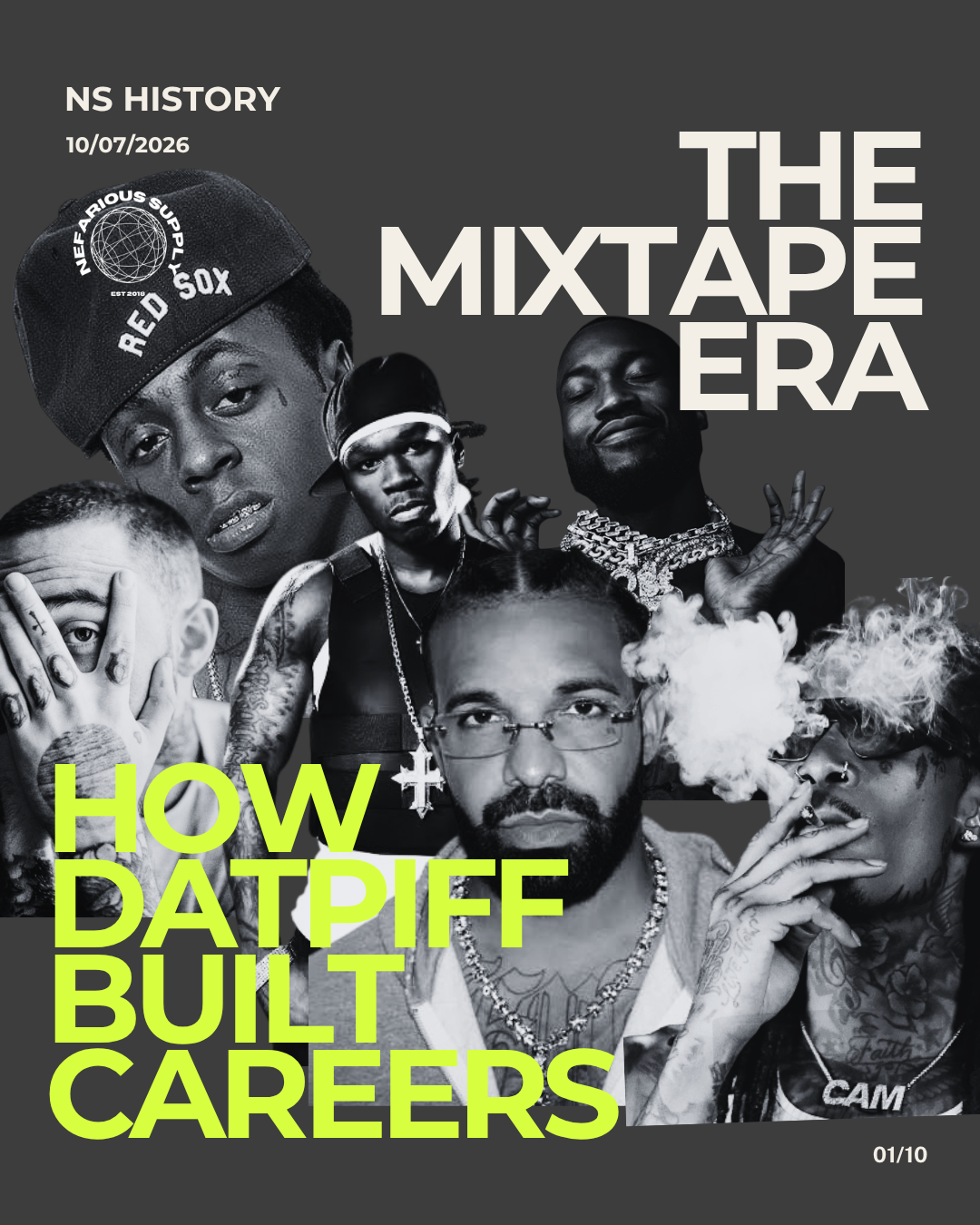
Today, a new release often arrives as a link to Spotify or Apple Music. An artist announces a single, EP or album, and listeners open it in the same app they use for the rest of their listening. It is a familiar route from artist to audience, but music has not always reached people this way. Some of rap’s most consequential releases built their following outside that system.
Across the 2000s and early 2010s, mixtapes circulated through CDs, music blogs and dedicated download sites. A rapper’s debut album could arrive well after listeners had begun following their work. These earlier projects were not necessarily rough drafts for the official release. They could introduce an artist’s perspective, give established rappers room to experiment, and become bodies of work listeners valued on their own terms.
DatPiff became one of the places where that music found an audience. It helped carry mixtapes beyond the local scenes and physical copies through which they had circulated. In Jimmy Ness’s 2014 interview for Passion of the Weiss, the platform’s Kyle “KP” Reilly recalled persuading artists that giving music away online could open markets far beyond their home cities. Beside the music, a download counter made the response public. A free project could give an artist something to point to before there were album sales to discuss.
The platforms have changed, but making music available and building a lasting audience remain different tasks. Revisiting DatPiff means looking at the work around a release as well as the music itself: how artists introduced a perspective, reached listeners beyond their immediate circle and gave those listeners a reason to follow the next project. A download could signal curiosity without establishing a lasting connection. For independent artists today, the useful inheritance is not a demand to give everything away or release more often. It is a clearer understanding of what a project should communicate, where an interested listener can go next, and what an artist can do to sustain that interest after someone presses play.
Before the download
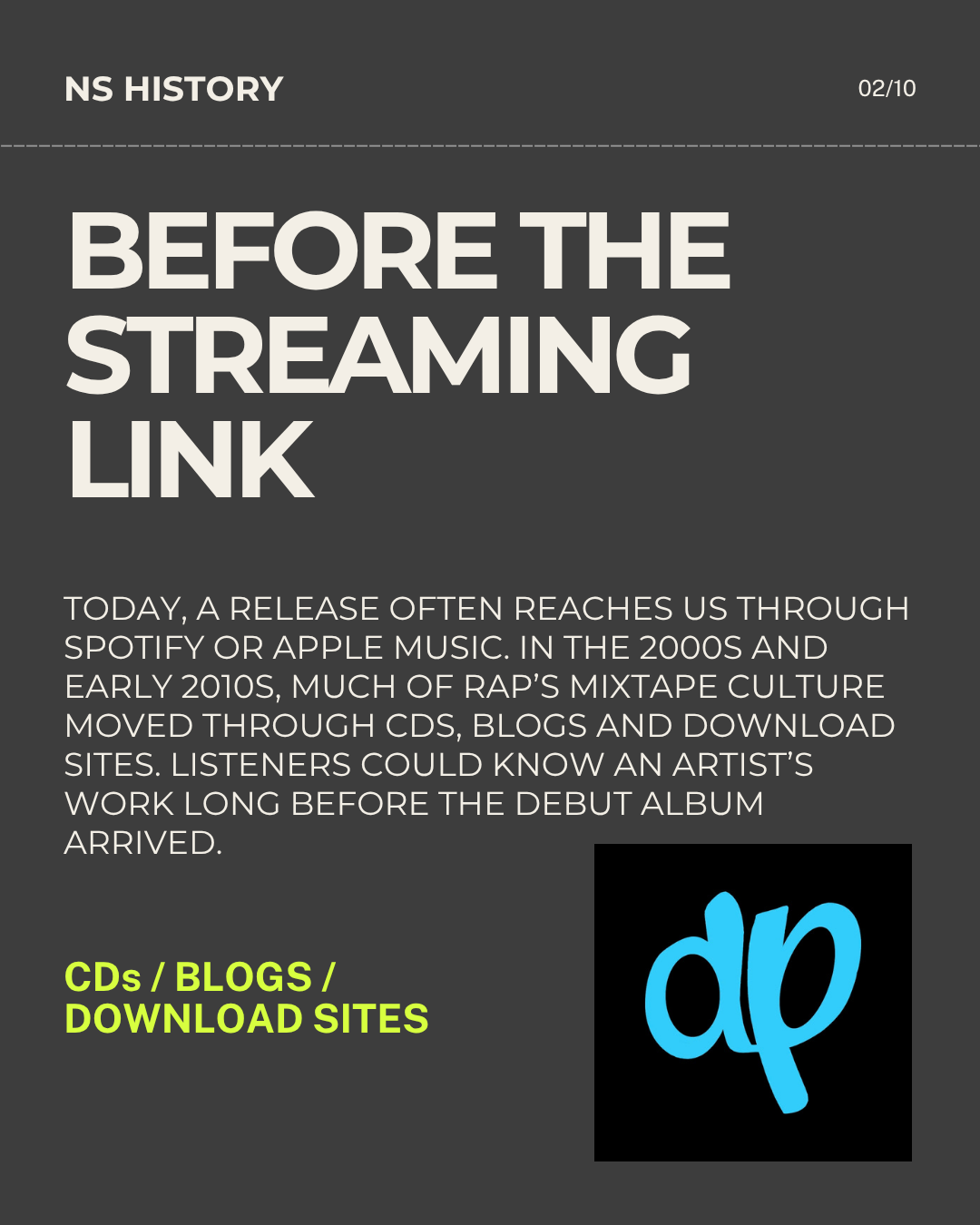
An official album was not the only way to make an artist’s case. In 2002, 50 Cent used mixtapes to put work into circulation before Get Rich or Die Tryin’ arrived the following year. In Paul Thompson’s retrospective for The FADER, Guess Who’s Back? brought together new recordings, earlier mixtape material and songs from his shelved Columbia album. 50 Cent Is the Future, released that June, took a different approach: new performances over largely borrowed production, with Lloyd Banks and Tony Yayo appearing alongside him. The tapes gave listeners more than an announcement that an album was coming. They gave them work through which to understand the artist before it arrived.
Thompson distinguishes that artist-centered format from a DJ’s compilation of material by different acts. The familiar production could provide a point of entry, while the new verses redirected attention toward the rapper performing them. Across a full project, an artist could establish more than the appeal of one song. The mixtape offered a sustained introduction on terms that did not have to match a retail album. That does not mean it alone explains 50’s rise; Thompson explicitly cautions against that reading.
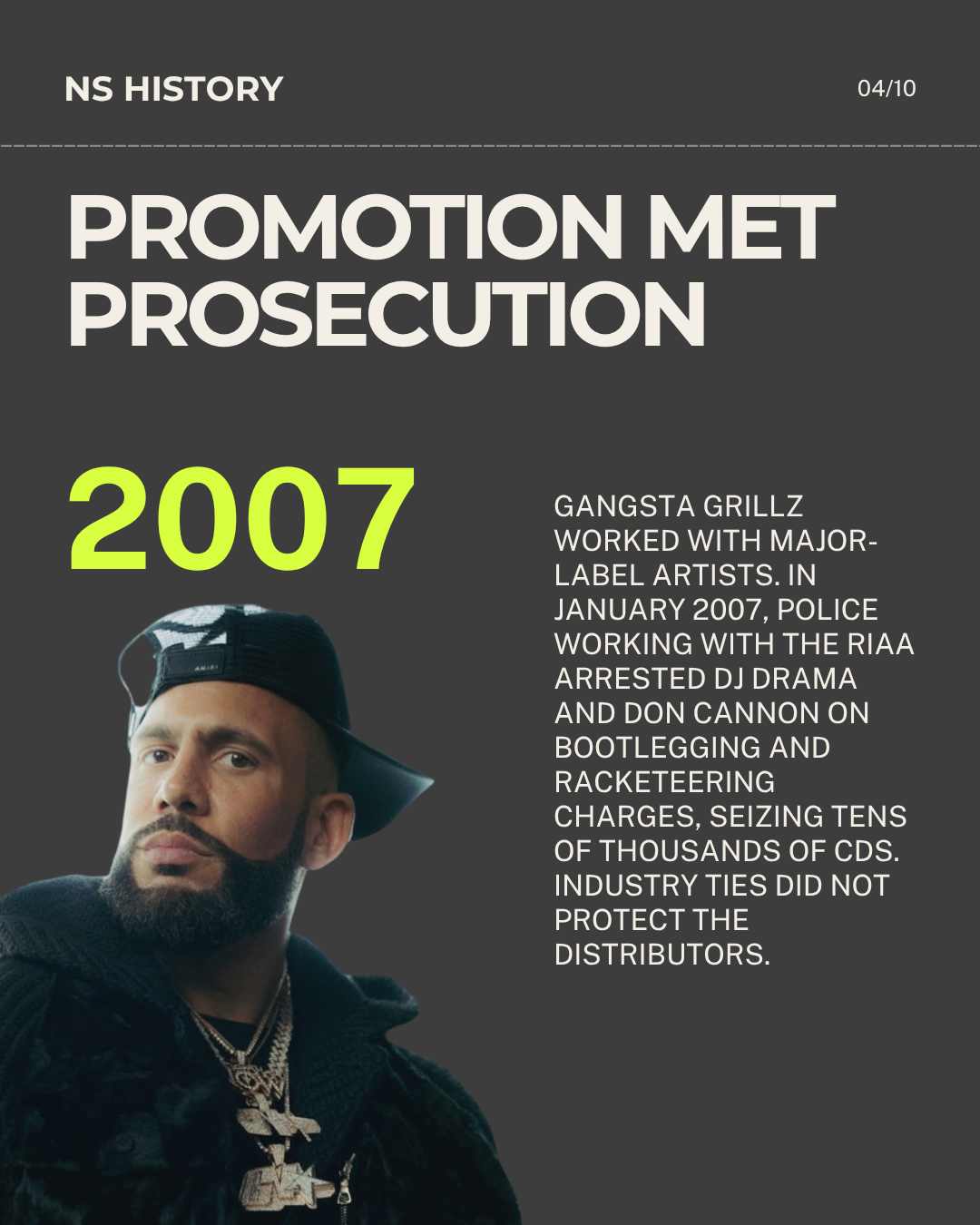
The artist becoming the focus did not remove the DJ from the process. NPR’s Louder Than a Riot account traces the role of DJ Drama’s Gangsta Grillz series in the careers of T.I., Lil Wayne and Jeezy. These were artist projects circulating under a recognizable series, and the operation worked directly with major-label artists to promote and distribute new music. Mixtapes were not simply recordings that escaped the industry. They could be part of how the industry developed attention around its own artists.
That relationship makes the January 2007 raid especially revealing. NPR reports that officers, working in collaboration with the RIAA, confiscated tens of thousands of mixtape CDs and arrested Drama and Don Cannon on bootlegging and racketeering charges. An operation participating in the promotion of major-label artists was being treated as a criminal distribution enterprise. The contradiction was not that mixtapes existed entirely outside the music business. It was that involvement in that business had not protected their distributors from enforcement.
The raid did not create online distribution, and physical mixtapes did not disappear overnight. DatPiff was already operating, having launched in 2005, as Andre Gee later documented in Rolling Stone. But the arrests exposed a vulnerability in the physical model: the CDs carrying an artist’s promotional work were also stock that could be seized. Digital distribution offered another way for that work to travel. It changed the means of circulation, not the underlying question of who had the right to distribute the music.
The Audience Became The Pitch
DatPiff’s initial problem was smaller than transforming the music industry. Marcus Frasier wanted a way to share mixtapes with friends without burning another CD. In Jimmy Ness’s 2014 interview for Passion of the Weiss, Kyle “KP” Reilly recalled joining early to handle content and marketing. Listeners found the site through searches for mixtapes, and the team promoted it on Myspace. A practical solution to copying music began to gather people already looking for it.
The significance was not simply that an artist could upload a project. DatPiff assembled a destination for that kind of music. As Andre Gee’s Rolling Stone history describes, emerging acts could appear alongside established names. That proximity offered a possibility a solitary download link could not: reaching listeners who had arrived for someone else.
But access to the site was not the same as equal access to its attention. Reilly’s 2014 account describes arrangements with DJ Drama, Don Cannon and DJ Holiday, beginning in 2011, that brought DatPiff into planning for their hosted projects. Distribution, social promotion and placement could be coordinated before a release arrived. Visibility was shaped by those working relationships as well as by the ability to upload music.
The counter made one part of that response visible. An artist’s team could point to download activity instead of asking everyone to take its claims of interest on faith. It remained an imperfect measure. Reilly said DatPiff scanned for suspicious activity and banned users who manipulated statistics; those were the platform’s assurances, not an independent audit. The important shift was that a release outside the retail album system could produce public evidence of activity. What that activity meant for a career still required interpretation.
More Than An Album’s Waiting Room
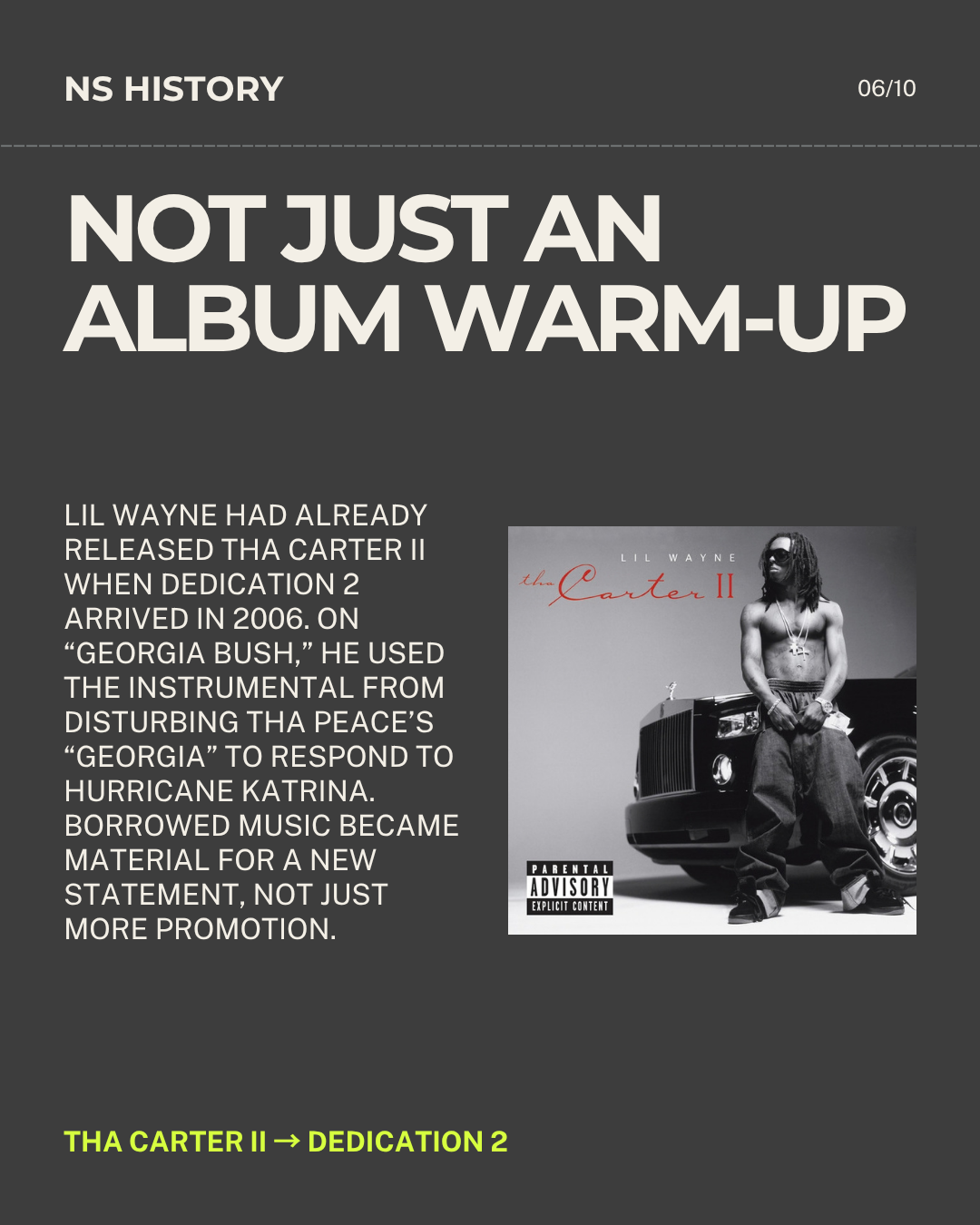
The format also changed what an artist could make. Lil Wayne’s Dedication 2, released with DJ Drama in 2006, arrived after Tha Carter II. It was not simply a demonstration that Wayne was ready to make an album. He had already done that. The mixtape offered another setting in which to extend his work.
In Peter Macia’s contemporary Pitchfork review, the material includes Wayne’s performances over production associated with “What You Know,” “Hustlin’” and “Poppin’ My Collar.” Macia also singles out “Georgia Bush,” which uses the instrumental from Disturbing Tha Peace’s “Georgia” for Wayne’s response to Hurricane Katrina and the failures surrounding it. An existing record could become the starting point for a different subject, not merely a backing track for more verses.
That example helps explain why a mixtape’s significance cannot be reduced to its price or promotional function. The borrowed material was part of the creative method. The project could place an artist in conversation with songs listeners already knew while giving that conversation a distinct purpose.
The same conditions complicated the music’s future. In Brian Josephs’s New York Times reporting, signed artists sometimes released music without label oversight, and many projects used uncleared samples. The freedom to circulate a tape did not establish the rights needed to keep every recording available indefinitely. What made the format flexible in its moment could make it difficult to transfer unchanged into another distribution system.
The Proof Class
The careers associated with the era did not all begin in the same place or follow the same route. Reducing them to a story of an unknown artist uploading a free tape and becoming a star misses the relationships and earlier work already in motion.
Drake: an audience before the major-label decision
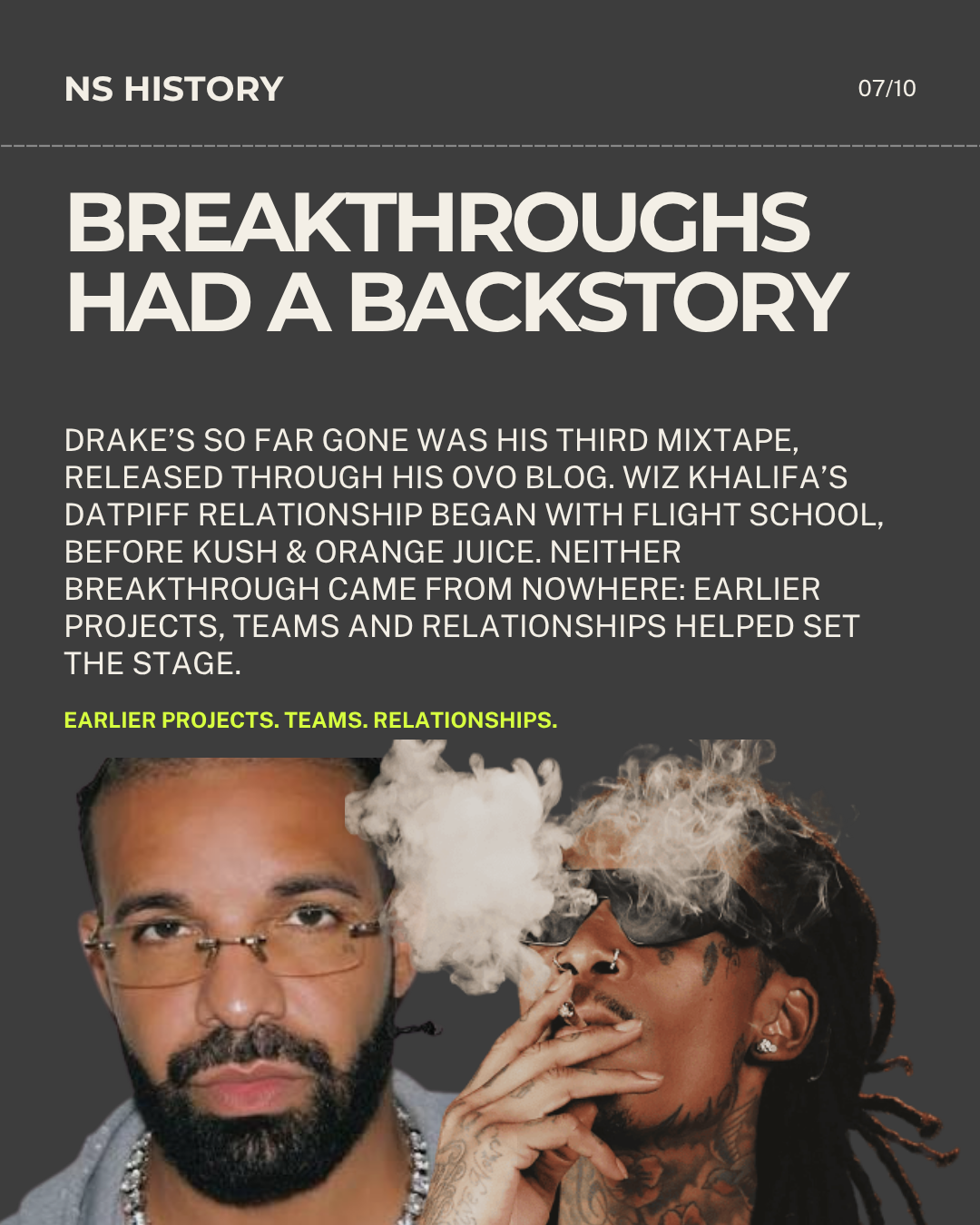
Drake’s So Far Gone was his third mixtape, not his first introduction. Paul Bowler’s uDiscover Music retrospective traces Room for Improvement in 2006, Comeback Season in 2007 and touring with Lil Wayne in 2008. So Far Gone arrived as a free download on Drake’s OVO blog on February 13, 2009.
By June, Mariel Concepcion’s Billboard report described major labels competing to sign him. It also documented his existing Young Money affiliations and management team. Drake told Billboard he wanted a label to add to what his team had already built. The audience was part of his negotiating position, but he was not approaching the industry without relationships or support.
Drake was negotiating from an existing body of work and a team around it. A major-label partnership would build on that foundation, rather than make the first introduction.
Wiz Khalifa: a breakthrough with a history behind it
For Wiz Khalifa, 2010’s Kush & Orange Juice was both a larger introduction and a more defined artistic identity. Speaking to Jordan Rose at Complex in 2025, Wiz described earlier work that had not yet given him the same sense of himself: “Kush and OJ gave me my identity.”
The platform relationship had begun earlier. In Kemet High’s 2019 Complex report, manager Will Dzombak traced the team’s first official DatPiff release to Flight School. Contact with Reilly continued online and eventually in person. The celebrated launch was therefore part of an existing sequence of projects and relationships. Its value was not simply attracting more people. In Wiz’s own account, the project made the artist they were meeting more clearly defined.
Mac Miller: free work and a commercial next step
Mac Miller’s 2010 K.I.D.S. was another introduction that remained important after the artist’s career moved forward. David Renshaw’s FADER report documents Rostrum Records marking its tenth anniversary with a deluxe edition. In his 2014 interview with Ness, Reilly counted Miller among the artists he believed DatPiff had helped propel.
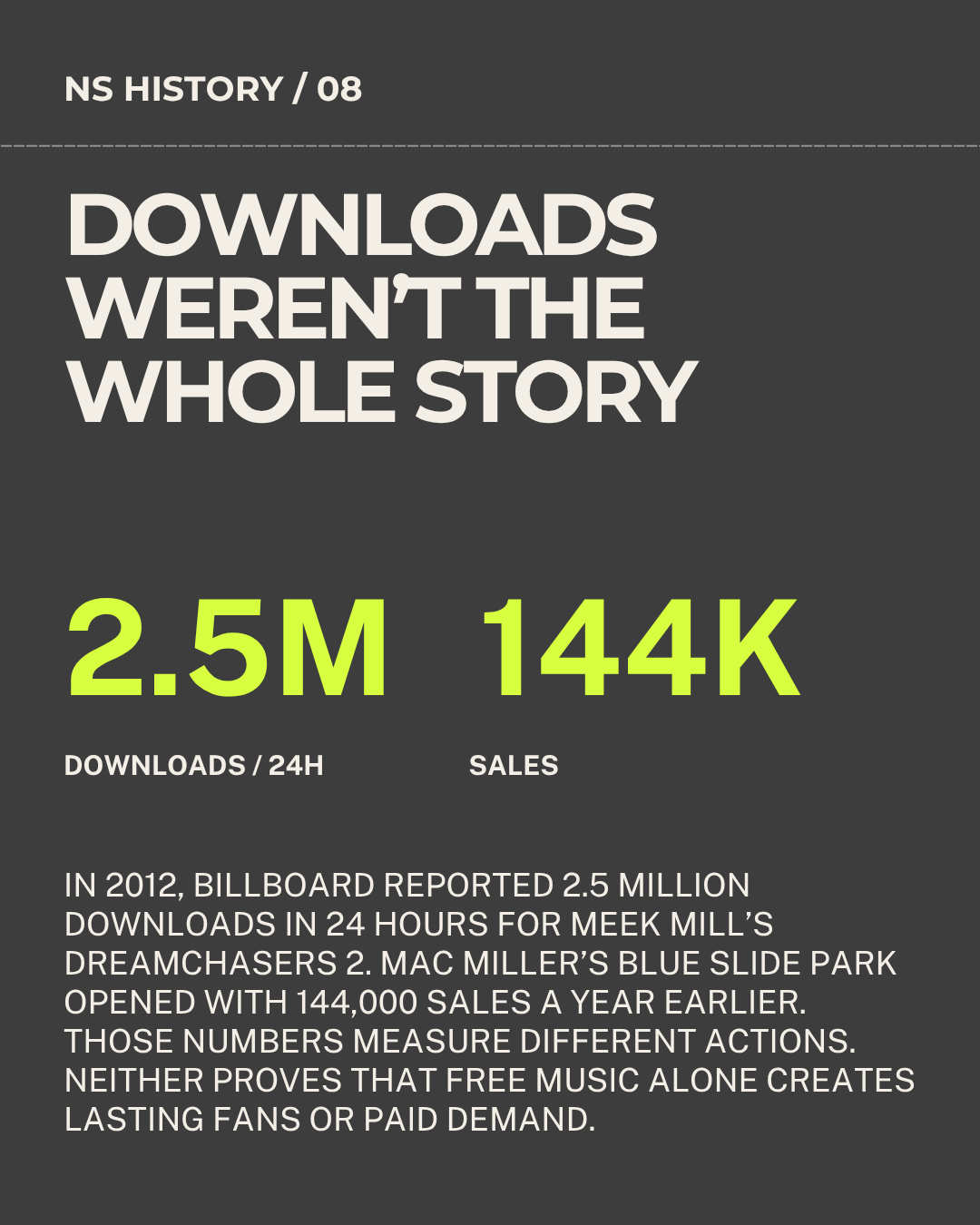
A separate contemporary measure shows the scale of Miller’s next stage. In November 2011, Keith Caulfield reported for Billboard that Blue Slide Park debuted at No. 1 with 144,000 copies sold, according to Nielsen SoundScan. It was the first independently distributed debut album to top the Billboard 200 since 1995. Caulfield also specified the infrastructure: a Rostrum release distributed through INgrooves and Fontana, Universal Music Group Distribution’s independent arm.
Those sales cannot be attributed to K.I.D.S. downloads alone. They do show why free music and a paid release need not be opposing strategies. The next stage involved a different product, a distribution network and listeners willing to purchase it.
Meek Mill: scale with context
Meek Mill’s Dreamchasers 2 made the scale of a free release especially visible. In her August 2012 Billboard report, Carolyn Menyes reported 2.5 million downloads in 24 hours following its May 7 release. That is a reported download total, not a count of unique listeners or independently audited fan demand.
Reilly’s 2014 explanation connected the response to DatPiff’s Philadelphia base, Meek’s standing in the area, radio records and the platform’s promotional support. The counter did not show an audience appearing from nowhere. It recorded activity around an artist whose local momentum and industry position were already developing.
Chance the Rapper: recognition through a changing system
Chance the Rapper demonstrates why the larger free-music ecosystem matters more than a single platform’s origin story. Madison Bloom’s Pitchfork report identifies SoundCloud as the free-release destination for 10 Day in 2012 and Acid Rap in 2013. His career cannot be explained as a DatPiff upload leading directly to a Grammy.
In 2017, Coloring Book, released the previous year, became the first streaming-only album to win a Grammy, taking Best Rap Album. Lyndsey Havens’s Billboard report notes that the Recording Academy disputed the idea that the project caused its eligibility revision. Jordan Darville’s contemporary FADER account also makes the boundary clear: qualifying streaming services counted toward general distribution, while mixtape-site uploads remained ineligible under the rules announced in 2016.
Institutional recognition had expanded, but it had not accepted every earlier distribution method on equal terms. Even the music’s transfer could require changes. Bloom reported that when Acid Rap reached major streaming services in 2019, the original “Juice” recording was absent because its samples had not been cleared.
Listening links lead to streaming editions, which may differ from the original mixtapes.
Free Was A Price, Not A Business Model
The listener’s price did not describe the cost of making or circulating the music. In his 2014 interview with Ness, Reilly put advertising at roughly 60–65 percent of DatPiff’s revenue. He also described DJ-hosting arrangements costing artists thousands of dollars, connected to promotional support and platform placement. The music could be free to download while the system around it remained commercial.
For an established artist such as Wiz, Reilly described free mixtapes as something fans expected alongside buying concert tickets and merchandise. An artist without a touring audience or a viable merchandise offer could not assume the same exchange would work.
The useful distinction is between the price of one release and the economics of a career. A free project could contribute to discovery, satisfy an existing audience or create material for a performance. None of those functions removed recording costs, rights questions or the need to fund the next stage. The work still needed a purpose beyond being free.
When the discovery platform became an archive
The platform’s later history puts another limit on the idea of permanence. In High’s 2019 Complex interview, Reilly described negotiations to keep older music available, including disabling downloads or redirecting listeners to streaming services. He also recalled having to remove Drake’s So Far Gone. Keeping a catalog accessible involved continuing relationships with rights holders, not merely storing files.
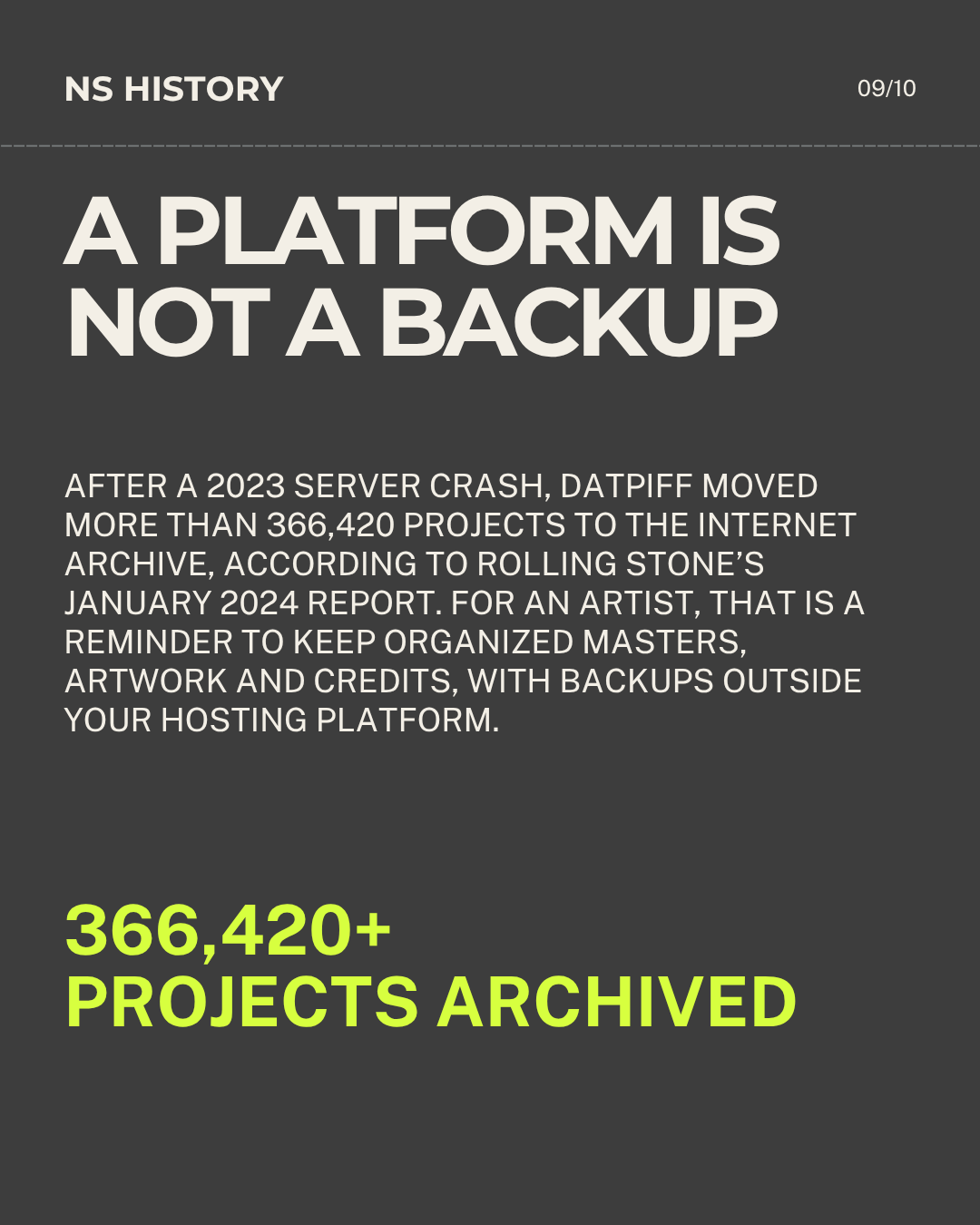
In January 2024, Andre Gee reported for Rolling Stone that DatPiff had transferred a catalog of more than 366,420 projects, approximately 50 terabytes, to the Internet Archive after a server crash in March 2023. The story was not that the entire catalog had vanished. A substantial collection had been moved into another institution’s care.
An archive, however, serves a different purpose from the community that originally surrounded the music. It can preserve the recordings without recreating the release-day attention, relationships or context through which listeners encountered them. DatPiff’s history is therefore also a reminder that an artist’s catalog and the platform carrying it are not the same thing. Availability requires maintenance, even after the moment of discovery has passed.
What to Borrow, What to Leave Behind
These are celebrated careers, not a representative sample of everyone who released a tape. The outcomes depended on different music, teams, resources and circumstances. The lessons below are our practical reading of the history, not a formula for reproducing those outcomes.
Decide what the project adds to your story
The distinction between Guess Who’s Back? and 50 Cent Is the Future shows that two releases by the same artist can do different work. One gathered material into a public introduction; the other presented new performances in an artist-centered format. Wayne’s mixtape extended a career already established through albums. Wiz described his breakthrough tape as clarifying his identity.
For your next release, identify its particular job. If it is a first single, what does it introduce about your work? If you have several projects behind you, what is different enough to justify asking listeners to return? Write an answer that the music can support. “My strongest project yet” does not tell someone what they are about to encounter.
Choose a song, performance or short account of the project’s making that gives a listener a clear way in. The aim is not to invent a story around the music. It is to communicate the one the work actually contains.
Plan for discovery and the connection afterward
DatPiff gathered listeners who were already searching for mixtapes. Its regional audience and relationships also affected which projects found support. That is a more useful lesson than simply choosing the biggest available platform.
Identify a few places where people who might connect with your work already spend time: a particular curator, publication, local event or artist community. Understand why your project belongs there before approaching anyone. A relevant, specific introduction is different from distributing the same request everywhere, and editorial interest is not a purchased entitlement.
Then decide what an interested listener should find next. It could be the rest of your catalog, a show or an optional mailing list with a clear promise about what you will send. Choose an invitation you can maintain. Do not require someone to join a community merely to hear the release, or create one you cannot look after.
The follow-up does not have to be another project. A performance or a thoughtful account of how a song was made can continue the encounter with this one. Give the release enough attention to discover what people are responding to before replacing it with another announcement.
Match the evidence to the decision
Meek’s download total made activity visible. Miller’s album sales measured purchases of a different release. Neither figure answers every question about the audience behind it. Before choosing a metric, identify what you need to decide:
Where should I focus outreach? Listener locations, where available, suggest places to investigate. They do not establish that a local community is waiting for you.
Are people returning? Repeat-listening information can help where a service provides it. An optional email sign-up gives permission for future contact, not proof of another listen.
Can I support a local show? Test interest with people who can attend, then distinguish their interest from actual ticket purchases. A worldwide play total cannot settle a local booking decision.
Use a response to learn what to do next, not simply to make the release look successful. If the evidence is incomplete, a small test may be more useful than a larger commitment.
Keep the freedom, account for the costs
The era’s free releases were not free of production costs, promotional arrangements or rights disputes. Nor does its history justify releasing constantly, buying a co-sign or treating attention as a guaranteed return on spending.
Decide what you can afford to make available and what it is meant to achieve. If you pay for a promotional service, specify the deliverable and its limits. An advertisement, a hosted event and independent editorial coverage are different things; none should be described as a guaranteed fanbase.
Confirm the permissions needed for material you distribute, rather than assuming a free release is exempt. Keep organized copies of masters, artwork, credits and relevant rights documentation, with backups separate from the service hosting your work. Preservation is part of caring for a catalog, not a task to begin only after a link stops working.
Put it to work on your next release
Before adding more promotional tasks, write a short brief:
What this project introduces: One specific sentence about what a listener should understand about your work.
Where to start: The song, performance, visual or story that provides an entry point.
Who it could reach: A few relevant communities or outlets, and why the work belongs there.
Where to go next: One clear destination or voluntary invitation for someone who wants more.
Why to return: One meaningful follow-up you can deliver with your available resources.
What you want to learn: One question about the response and the evidence you can realistically collect to answer it.
For a first release, this might mean a clear introduction, one performance and an invitation to hear the next piece of work. For an artist with an existing catalog, it might mean explaining what has changed, directing new listeners toward an earlier project and testing interest in a show. These are options, not a requirement to build every part of a campaign at once.
The mixtape era did not eliminate gatekeepers or the costs of a career. It showed that an artist could build a body of work and a public response before a major-label album arrived. The advantage was not free music alone. It was the room to make a sustained introduction, then give that introduction somewhere to lead. For an artist now, the release is where that work becomes visible, not where it ends.
For a first release, this might mean a clear introduction, one performance and an invitation to hear the next piece of work. For an artist with an existing catalog, it might mean explaining what has changed, directing new listeners toward an earlier project and testing interest in a show. These are options, not a requirement to build every part of a campaign at once.
The mixtape era did not eliminate gatekeepers or the costs of a career. It showed that an artist could build a body of work and a public response before a major-label album arrived. The advantage was not free music alone. It was the room to make a sustained introduction, then give that introduction somewhere to lead. For an artist now, the release is where that work becomes visible, not where it ends.
Put these lessons to work on your next release: save the brief above, work through it with your collaborators and choose one meaningful way to keep listeners connected after release day. If you’re an independent artist with music to share, submit your music to Nefarious Supply. Send a release that represents where your work is headed, along with a little context about the story behind it. Submissions are considered independently for editorial coverage and playlist inclusion. Coverage cannot be purchased, and submitting does not guarantee coverage, placement or a response.
Editorial bibliography
Street distribution and the raid
Thompson, P. (2019, January 17). How 50 Cent’s revenge-soaked, hollow-tipped hustle changed rap forever. The FADER.
NPR, Louder Than a Riot. (2020, October 29). The Day the Mixtape Died: DJ Drama.
DatPiff, economics and preservation
Ness, J. (2014, May 16). We Used to Sell Mixtapes: An Interview with KP Reilly of DatPiff.com. Passion of the Weiss.
High, K. (2019, October 7). ‘We’re Still Here and Stronger Than Ever’: How DatPiff Found Its Niche. Complex.
Josephs, B. (2023, June 28). Mixtape Sites Like DatPiff Propelled Rap. Can They Be Preserved?. The New York Times.
Gee, A. (2024, January 8). The Internet Archive Now Hosts One of the World’s Biggest Collections of Rap Mixtapes. Rolling Stone.
Lil Wayne
Macia, P. (2006, June 22). Dedication 2. Pitchfork.
Drake
Bowler, P. (2026, February 13). ‘So Far Gone’: How Drake Sparked a Bidding War. uDiscover Music.
Concepcion, M. (2009, June 3). Drake’s Major Label Bidding War Heats Up, Universal Signing Likely. Billboard.
Wiz Khalifa
Rose, J. (2025, April 24). Wiz Khalifa Doesn’t Need Rap’s Recognition. Complex.
Mac Miller
Caulfield, K. (2011, November 16). Mac Miller Moves In at No. 1 on Billboard 200. Billboard.
Renshaw, D. (2020, August 13). Listen to Two New Mac Miller Songs on 10th Anniversary Edition of K.I.D.S.. The FADER.
Meek Mill
Menyes, C. (2012, August 2). Meek Mill’s Debut Album Pushed Back. Billboard.
Chance the Rapper
Bloom, M. (2019, June 28). Chance the Rapper’s Mixtapes Are Now Streaming, Coming to Vinyl. Pitchfork.
Darville, J. (2016, June 16). Streaming-Only Albums Like Chance the Rapper’s Coloring Book Are Now Eligible for Grammys. The FADER.
Havens, L. (2017, February 13). Chance the Rapper’s Coloring Book Is First Streaming-Only Album to Win a Grammy. Billboard.