
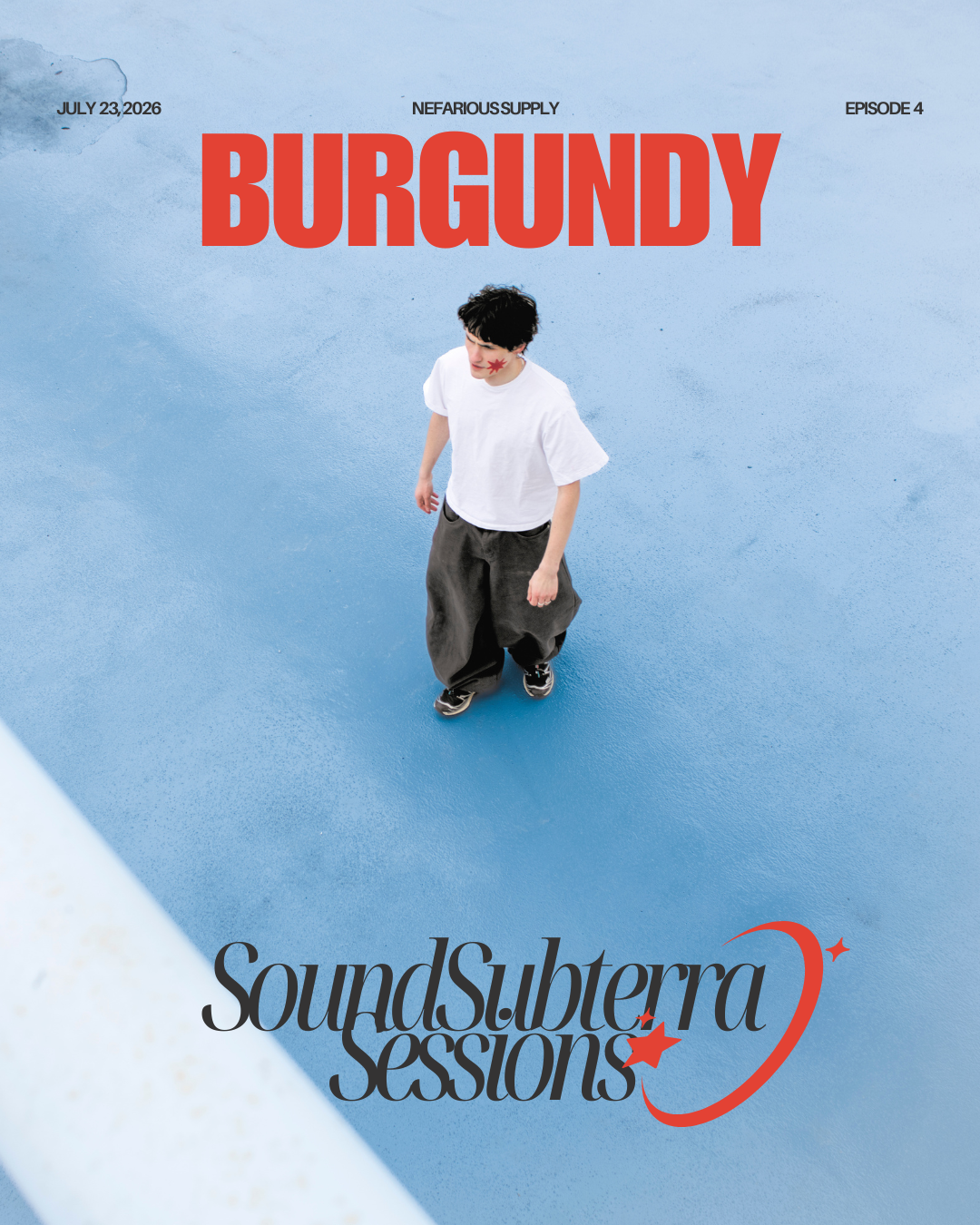
Hosted by Burgundy, this edition of SoundSubterra Sessions moves through songs that sit between motion, texture, and feeling.
There is a certain kind of artist whose sound does not announce itself by force. It moves by temperature, by detail, by the small decisions that make a record feel lived in before it ever tries to be impressive. Burgundy sits in that space. The Montreal-based artist has always felt fluid by design, moving between alternative R&B, soul, atmospheric production, and songwriting that knows how to leave room around the feeling.
That fluidity is also the point. When Burgundy describes the world of the project, the answer is simple: “in between genres, free to expand into any direction.” It is a clean thesis for music that never sounds interested in staying still. The songs can be intimate without shrinking, melodic without becoming obvious, and polished without losing the human pace underneath.
Burgundy’s story also starts in a way that explains the looseness of the work. Before it felt like a project with a team, a release plan, or a clearer long-term vision, it began with guitar sketches shown to friends. The reaction gave Burgundy enough confidence to push past doubt and take the music seriously. Since then, the project has sharpened without losing that first instinct: follow the feeling, then let the world around it expand.
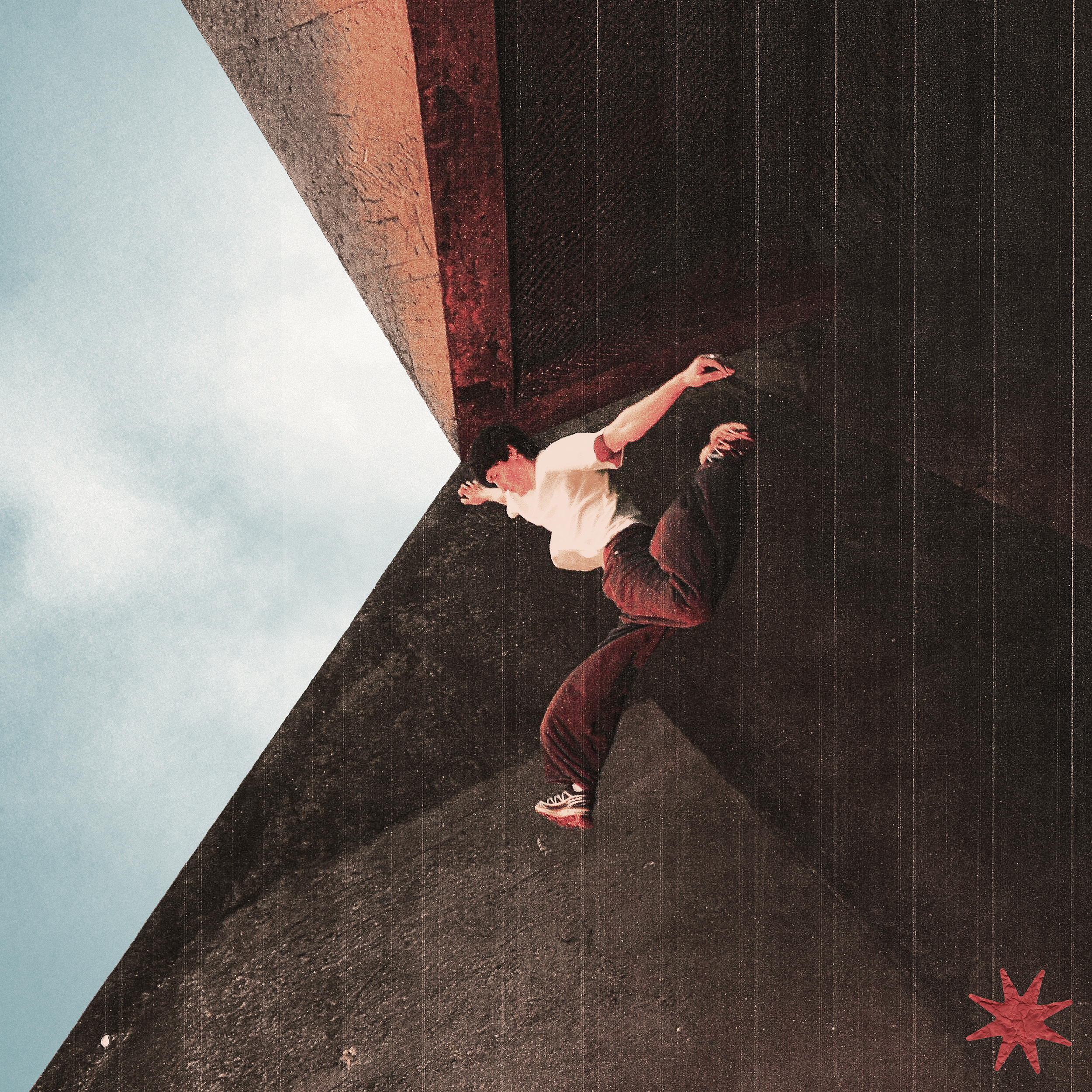
For this edition of SoundSubterra Sessions, Burgundy steps into the curator seat with a playlist that mirrors that same instinct. The selections move through soft left turns, textured grooves, indie-soul pockets, electronic warmth, and songs that feel like they were chosen less for genre alignment than for how they open up a room. It is not a playlist trying to prove range. It is a playlist that understands range as a natural condition of listening.
The session begins with Burgundy’s own “Marathon,” which works as the emotional anchor. The song came from a period where everything was in motion at once: long-distance love, 70-hour work weeks, saving money to travel, and trying to roll out a project while life kept accelerating. A rough beat from Oclair arrived during a restaurant shift. Burgundy heard a melody almost immediately, carried it through the shift, and recorded the idea as a bathroom voice note so it would not disappear.
That detail matters because it gives “Marathon” its shape. It is not just a song about longing. It is a song about longing while still having to move, work, plan, save, and keep going. The lyrics started in Montreal, were refined in Melbourne, and were finalized back home with Mathias Clerc. The finished record carries that geography without turning it into exposition. It sounds like distance, labor, memory, and forward motion folded into one track.
That duality runs through the playlist too. There is movement, but not escape. There is groove, but not distraction. Tracks like emory’s “double dog,” Bricknasty and Oscar Jerome’s “joyrider,” Portraits Of Tracy’s “Child’s Play,” and 1tbsp and Mietze Conte’s “No Nein” each bring their own pulse, but they all share a looseness that lets the session breathe. Nothing feels overexplained. The songs have shape, but they are not boxed in.
That lines up with how Burgundy thinks about the project as a whole. The sound is tied to season, city, and collaboration. Montreal’s mix of cultures and scenes has pushed Burgundy toward different sounds, while the project itself shifts with the weather: mellower and more intimate in winter, more open and upbeat in summer. You can hear that sensibility in the curation. The playlist does not treat influence like a fixed map. It treats it like climate.
The collaborator thread is important without needing to become the whole story. Oclair and Mathias Clerc sit close to the center of Burgundy’s current sound, helping shape the textures, dynamics, and balance between acoustic and electronic elements that make “Marathon” feel tactile. There is also a wider creative circle around the project, including Luca Renaud on the visual side, that points to Burgundy’s larger interest in building a world rather than just releasing songs.
The middle stretch opens the room further. Brighter Days Family’s “Backinthedays,” spill tab’s “Roamer,” Martin Luke Brown’s “hello !,” and Asal’s “i’ll kiss the sun” all carry a kind of soft momentum, the type that feels better when you let it run instead of trying to pin it down. Burgundy’s ear leans toward music that can hold mood and movement at the same time, songs with texture, color, and a clear emotional center even when the production is drifting somewhere more abstract.

There is also a student-of-sound quality in the way Burgundy listens. In conversation, Burgundy points to artists like Bricknasty, Saya Gray, and Nick Hakim as current reference points: not because the goal is to copy them, but because each of them understands how sound, structure, and texture can carry identity. That makes the presence of Bricknasty and Saya Gray in this playlist feel less like name-checking influence and more like showing the listener what kind of decisions Burgundy is studying in real time.
The back half of the playlist keeps that sense of motion intact while shifting the palette. Saya Gray’s “DIPAD33 / W.I.D.F.U - Mixed,” Alex Banin’s “Doc Whiler,” reggie’s “Watch Committee,” LAUSSE THE CAT’s “The Midnight Hour,” Boy Deco and Quantum Keys’ “Strangers,” and Kinji’s “windburn” close the session with a slightly stranger glow. These are songs that feel curious rather than clean, guided by instinct more than formula. That is where Burgundy’s taste becomes clearest.
SoundSubterra Sessions works best when the artist’s ear tells us something the bio cannot. Burgundy’s playlist does that. It reveals an artist drawn to texture, movement, intimacy, and songs that leave some air in the frame. It also makes clear that Burgundy is not trying to arrive at one final sound. The project is still expanding, still listening, still letting the work move where it needs to go.
That is what makes this session feel aligned with Burgundy’s larger story. The music lives between genres because Burgundy’s creative world lives between states: distance and closeness, winter and summer, acoustic and electronic, instinct and intention. The playlist does not flatten those tensions. It lets them sit next to each other.
That might be the clearest way into Burgundy’s world right now: not through one fixed definition, but through a run of songs that keep moving without losing their center.