

Some artists make music that feels like a fleeting moment in time, while others craft soundscapes that pull you deep into their world. November Day falls into the latter category. With his latest album, Brown Songs, he takes listeners on an immersive journey filled with raw emotion, experimental textures, and an unfiltered creative process. Known for his DIY approach, November Day blends slowcore, noise rock, and lo-fi aesthetics with deeply personal storytelling. His music isn’t just something you listen to—it’s something you experience.
In this interview, we dive into the creative process behind Brown Songs, the struggles of staying true to his sound, and how he’s already gearing up for his next artistic evolution. From recording on a four-track cassette recorder to letting accidental samples shape his songs, November Day embraces imperfection in a way that makes his music feel alive. Read on as he shares his thoughts on growth, inspiration, and the freedom of making music without limits.
Your latest album, Brown Songs, feels deeply personal and sonically immersive. What was your mindset while creating it, and how did you push yourself differently compared to past projects?
I was in a bit of a reclusive stage after finishing my previous album, Lucky; that album took a lot of emotional energy to make and I wasn’t sure what to do next. Then one day my dashingly charismatic roommate Tobias Fever and I were at the local music shop and I saw a Tascam MF-P01 four track cassette recorder behind the glass and just knew I had to have it. That whole project, along with the subsequently released project Blue Songs, were made entirely on that four track. When I first got to play with it I only bought a microphone and a tiny Behringer synth so the opening track is mostly guitar drone/acoustic until the random Three Six Mafia song plays, which for the record, I did 𝘯𝘰𝘵 know was going to happen until it did. You can pretty much hear me adapt to the tempo in the recording which I find pretty fun. There are plenty of moments like that on the album: samples I only obtained because I was using 2 for 1 dollar cassettes that already had shit on them. Like on the song Flowers, there’s this voicemail of this dude calling his fiancé’s parents and just being a real horrible human being. It made me feel sick in a warm, humid way so I put him on the album. Love that stuff. Front to back it only took me three days to make Brown Songs; it was me learning a new means of recording and really, learning how to have fun making music again.
You handled all the guitar work and production yourself. What was the most difficult aspect of working entirely solo, and did that process bring any unexpected creative breakthroughs?
I find making music alone to be extremely cathartic. On Brown Songs for example, where every song was made in under an hour, usually like 30 minutes tops by myself in my room, I was able to capture exactly how I was feeling or what was going on that moment, unfiltered. I want to always be moving closer to that sense of self, or sense of moment in my music. I think working mostly alone and slowly building my own creative habits is best for my more personal work. I recall early on in my experience producing (around 2 years ago) a lot of people wouldn’t fully get what I was going for sonically and would always lob the same critiques of “𝘵𝘢𝘬𝘦 𝘵𝘩𝘢𝘵 𝘥𝘪𝘴𝘵𝘰𝘳𝘵𝘪𝘰𝘯 𝘰𝘧𝘧” or “𝘸𝘩𝘺 𝘤𝘢𝘯 𝘐 𝘩𝘦𝘢𝘳 𝘺𝘰𝘶𝘳 𝘤𝘩𝘢𝘪𝘳 𝘤𝘳𝘦𝘢𝘬𝘪𝘯𝘨” and while I do think it’s crucial to listen to what people have to say about your music; after all it’s the ears of others that will be hearing more than your own, I know for a fact that if I took to heart everything people had said instead of trusting my gut instincts with how I felt my music should sound and feel, the music would become something other than a 𝘵𝘳𝘶𝘦 extension of myself, and we’d never want that.

There’s a strong emotional weight in your music. Do you write from lived experiences, or do you use songwriting as a way to explore emotions outside of yourself?
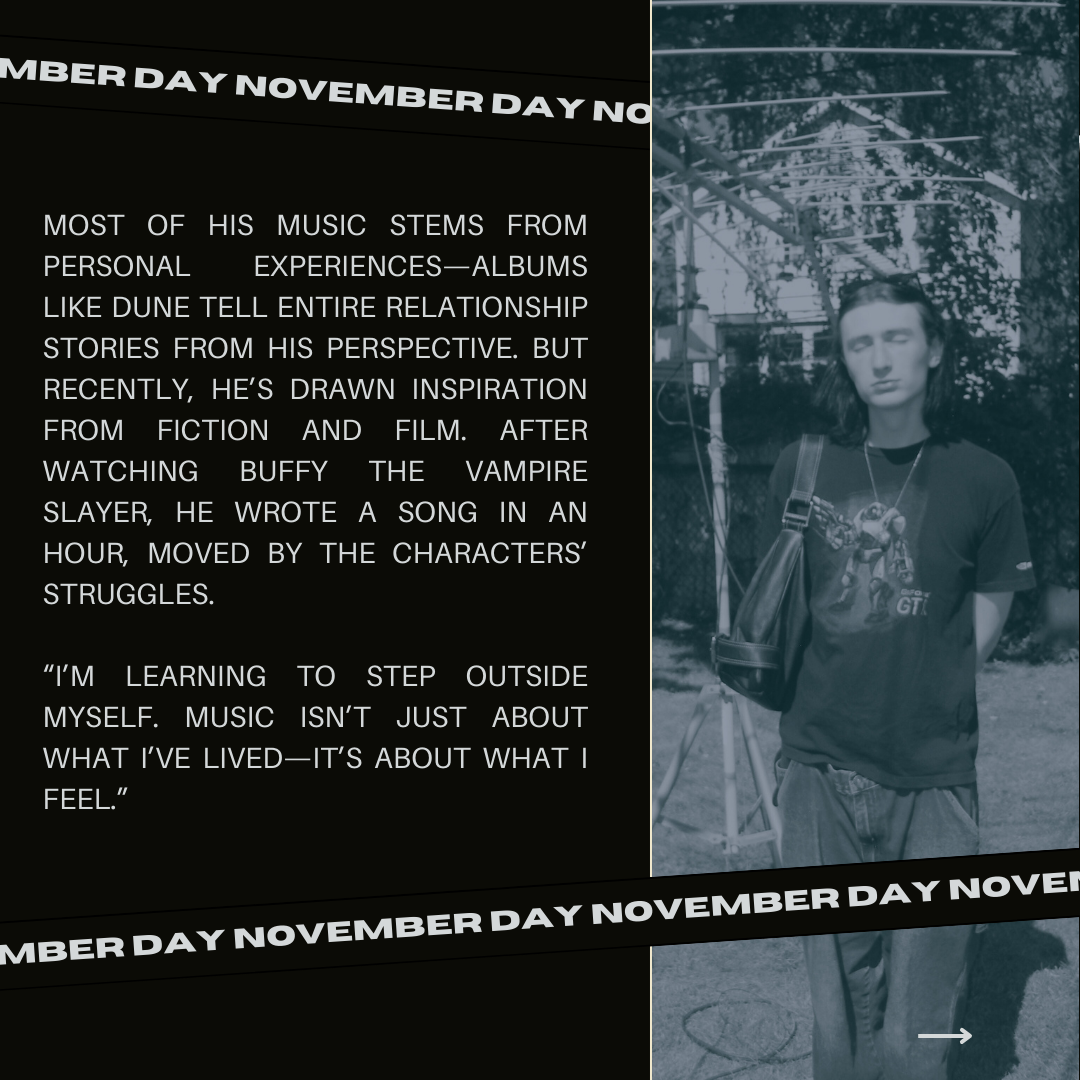
Most of my songs are definitely lived experiences; my album Dune for example is like, word for word my entire experience with a person from where I was standing. I feel like making music in this way is important for me in my healing processes. If something is really affecting me, I pretty much 𝘤𝘢𝘯’𝘵 move on until I’ve written every possible emotion out, and then some. Recently though I have found myself moved by fictional characters to write my stories. The other day I was watching Buffy the Vampire Slayer (highly recommend) and couldn’t help but feel depressed on behalf of the main characters’ over their constant struggles finding love, since they’re all so busy every night killing monsters and stuff. I finished an especially sad episode and had about it ready in an hour! It felt really good to step outside myself to write, I think I’m gonna try it more.
The album features a mix of downtempo, ambient songs and more energetic, guitar-driven moments. How do you approach that balance when structuring an album?
I wouldn’t necessarily consider myself the greatest guitarist, or even a traditionally 𝘨𝘰𝘰𝘥 one, but I believe I have a knack for improvisation. A lot of songs I will have one idea going in and end up with a completely different sounding finished product. The key to me is to embrace whatever shifts come as the song develops. Did I start this as a slowcore song? 𝘠𝘦𝘴. Does it now have boom bap fart drums and a loud warbling synth? 𝘠𝘦𝘴. 𝘕𝘰𝘸 𝘐’𝘮 𝘨𝘰𝘯𝘯𝘢 𝘳𝘢𝘱 𝘰𝘯 𝘪𝘵. And I wouldn’t have it any other way. Sometimes I surprise myself and crack out a pretty catchy guitar melody that can carry me through a whole indie/rock song; 5C and Peter Time come to mind. I think I’m gonna spend more time getting consistent with my guitar playing this year so I can lean into more focused efforts melodically. I never wanna lose sight of the chaos though.
What’s a song on Brown Songs that was particularly challenging to create—whether technically, emotionally, or just in finding the right sound?
𝘙𝘪𝘨𝘩𝘵 𝘣𝘢𝘤𝘬 𝘪𝘯𝘵𝘰 𝘵𝘩𝘦 𝘨𝘳𝘰𝘶𝘯𝘥. I was so intimidated recording that song. It’s a cover of one of my favorites, “The Man Who Was Wrong” by Dr. Dog. I don’t really know any traditional guitar chords so I had to learn my first, and initially I wasn’t really sure what direction I wanted to take since the original song is almost five minutes long. I settled for cutting it to the first verse and chorus and was pretty happy with the result. A lot of my friends say that song has my best singing and I am in love with the sound of me stomping on my floor and cracking a snare drum with my knuckle for the percussive element. I’ve decided to try to put a cover on every album from now on to keep me on my toes; I covered “The Narcissist” by Dean Blunt and Inga Copeland on Blue Songs, which was a lot of fun. Definitely check out Dean Blunt if you haven’t, his sound was the most prime influence over the 𝘦𝘯𝘵𝘪𝘳𝘦𝘵𝘺 of Blue Songs, which is the evolved, subjectivity uglier little brother of Brown Songs.
Many independent artists struggle with finding an audience while staying true to their sound. How do you navigate promotion while keeping your creative vision intact?
At the end of the day I think it’s most important that the integrity of the art is not hindered by the fact that it needs to be promoted to the people. If you change your art for the world, you will never find the audience who would have appreciated it for what you 𝘸𝘢𝘯𝘵𝘦𝘥 it to be, and you will never find the artist you were 𝘮𝘦𝘢𝘯𝘵 to find within yourself. Dean Blunt comes to mind again. His music is awesome and so ahead of its time. The first album I heard by him was “The Narcissist II” released in 2012. That album is a fucking horror movie. It’s all recorded into tape and the chords are so eerie yet comforting and sometimes sexy even; he’s singing in this smooth baritone register through the lens of this 𝘷𝘦𝘳𝘺 𝘦𝘷𝘪𝘭 man, as he gains the trust of this woman and becomes more and more violent until he eventually kills her. He plays the role so well and the music is insanely good! I bet a lot of people wouldn’t have made an album that conceptually risky. Dean Blunt is rising to the top of the industry nowadays; where would he be if he hadn’t stuck to his gut instincts way back in 2012?

Your music has a very cinematic quality to it. Do you have visual or film influences that shape your approach to songwriting?
While I don’t 𝘵𝘺𝘱𝘪𝘤𝘢𝘭𝘭𝘺 get a lot of inspiration from movies or shows, that seems to be changing as I touched on earlier. And even outside of film, I would definitely say that visuals are one of the places I get the most potent inspiration. More often than not, I base a lot of my albums’ sounds off the cover arts. I usually go through a few arts over the process, but having a visual element tied to the music while making it is absolutely crucial for me. And I also want my music to be something that you automatically visualize while you’re hearing it; keeping in room ambience and intentionally making sure there are random natural sounds and patterns in the music is something I find 𝘱𝘪𝘷𝘰𝘵𝘢𝘭 to maintaining the essence of my current sound. So is panning. In my experience, an interesting or unexpected pan will tickle more ears than a shiny mix or thumpy bass 𝘮𝘰𝘴𝘵 𝘵𝘪𝘮𝘦𝘴.
If you could score a film with your music, what kind of movie would it be and why?
It would have to be something depressing, that’s for sure. My song Chuck was written about my experience accidentally killing an animal with my car. It looked to be a large woodchuck or gopher type of guy. I felt his whole body crunch underneath my wheel, I don’t think I’ll ever forget that. Those are the kinds of moments that make me sit down and start playing my guitar. 9. All of it man, I’m gonna do it all. I’m currently offloading most of my time into a 90s/2000s boom bap inspired space album as a pitched down buff space guy named Spazeman Spliff. And it’s 𝘎𝘈𝘚. My musical journey started with rap and it feels so right to step back into that cockpit with fresh ears and ideas. It’s like, what sounds the most fun right now? Lemme do 𝘵𝘩𝘢𝘵. Me and all my friends at Exxitworld have a really cool group tale planned that’s gonna be a blast to make as well! I have a lot of fun stuff planned this year, and while I’m far from done satiating my lofi-noise-slowcore-rock-DIY-experimental-garbo-music itch, November is just one month. There’s a whole universe out there. A year from now I wanna be making gospel music too. I want to serve my God in everything I do, especially my music.

If someone were to listen to Brown Songs years from now, what’s the one thing you’d want them to take away from it?
Be yourself! Brown Songs and, by extension, Blue Songs, are just exercises in me having as much fun as possible making music. If I thought it would sound interesting or funny or weird, I would do it. I think we need more of that nowadays. Get outside of your comfort zone. Fuck whatever you are doing, do something else. You can always come back later with more perspective and varied artistic DNA than you ever could have gained just doing the same thing over and over; you will thank yourself. And stop caring what people think. They are always learning, always changing. So are you, and so am I. You might not love your newest song a few years from now but if you follow your heart’s intrigue instead of what the masses accept as what you should be making, you will be damn glad you chose to do what felt right.
November Day is an artist who refuses to stay in one lane, constantly evolving while staying true to his vision. Brown Songs is just one chapter in his journey, and with new projects already in the works, now is the time to tap in. Follow him on Instagram, Twitter, Spotify, and SoundCloud to keep up with his latest drops.
Want to be featured on Nefarious Supply? Our submissions are always open, and we’re constantly looking for new talent to showcase. Click the link to submit your music and stay updated with our latest interviews and editorials. Let’s keep building.